You're comparing AC hose suppliers. The prices look similar. The product photos look identical. Every supplier says the same thing: "high quality, good material, reliable performance." But none of that tells you whether the hose will hold pressure at 150 psi or fail at 90. AC hose quality testing is the only way to close that gap.
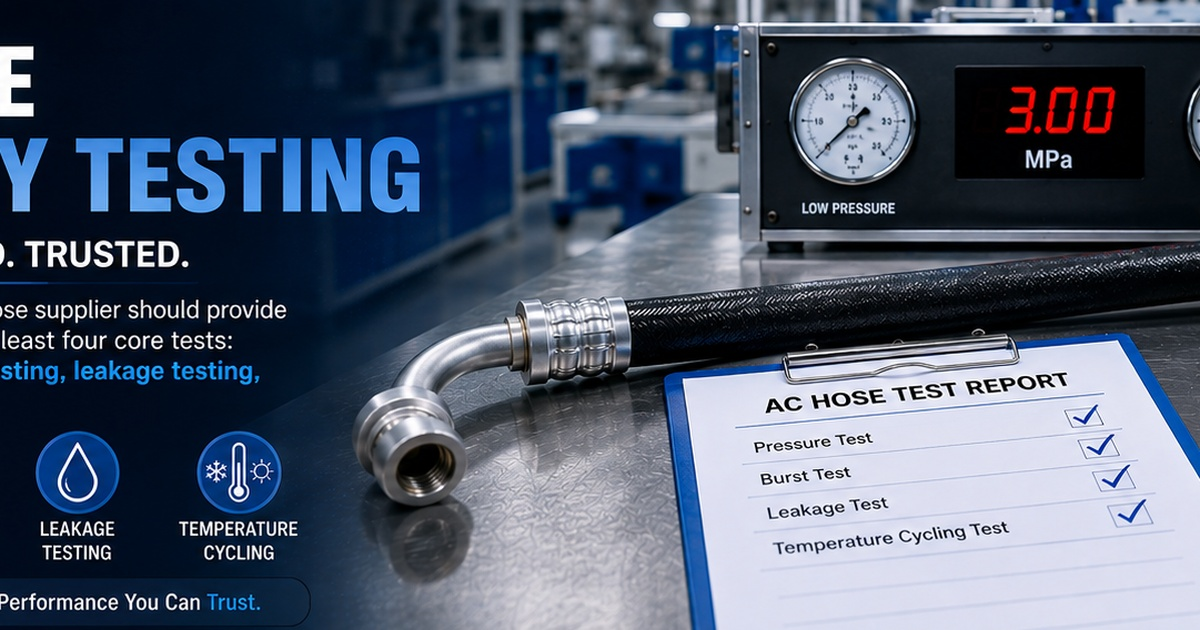
The short answer: a reliable automotive AC hose supplier should provide documented results for at least four core tests — pressure testing, burst testing, leakage testing, and temperature cycling. Each test maps to a specific failure mode. If a supplier can't share the numbers behind these tests, you have no real basis for trusting their quality claims. "High quality" is not a test result. A specific pass threshold is.
Most buyers accept supplier quality claims at face value — especially on early orders where the price looks right and everything seems fine. The problem usually shows up later: a slow refrigerant leak that drains efficiency over two months, or a hose that cracks in a cold-climate market. By then, you've already distributed the batch. The sections below break down exactly what tests matter, what numbers to look for, and what documentation to request before you commit to a large order.
Why Is AC Hose Testing Important?
Most automotive component failures aren't dramatic. They're slow, gradual, and expensive — and they often trace back to a quality shortcut made at the factory level before the product ever reached your warehouse.
A refrigerant hose operates in one of the harshest environments in a vehicle. It's exposed to high internal pressure, extreme temperature swings, engine vibration, and chemical contact with refrigerant and compressor oil — all at the same time.1 A hose that passes a visual inspection can still fail within months if the internal materials weren't tested under real working conditions.
AC hose quality testing exists to simulate those conditions before the product leaves the factory. This protects the end user, but more directly, it protects you as the importer or distributor. A single product recall, warranty claim wave, or customer complaint batch can cost far more than the price difference between a tested and untested hose.2
The Problem With "Experienced Supplier" Claims
I've spoken with many buyers who chose a supplier based on years of operation, export volume, or a well-designed catalog. These are reasonable signals — but they're not test results. A factory that's been producing for ten years can still be producing the same substandard hose for ten years.3
The only thing that separates a credible quality claim from a marketing statement is verifiable test data. That means documented procedures, specific pass/fail thresholds, and batch-level records. Without those, you're trusting a reputation, not a process.
What Are the Common AC Hose Tests?
AC hose testing isn't a single procedure. It's a set of targeted tests, each designed to expose a different failure mode. Here's what a production-level QC process typically looks like — and what numbers should appear in the results.
Pressure Test — Does the Hose Handle Normal Operating Load?
The pressure test checks whether an AC hose can withstand the working pressure it will face in a real vehicle system without deforming, kinking, or losing structural integrity.
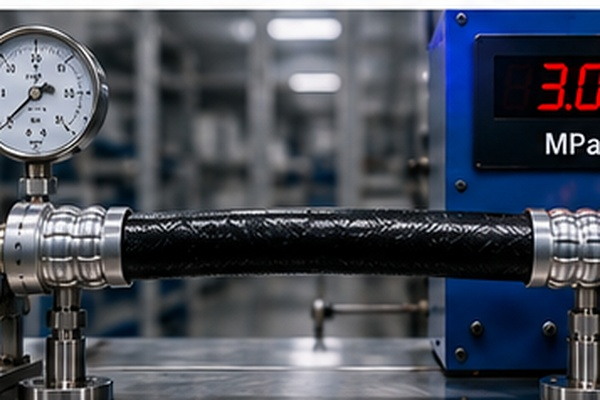
In our production line, we test hoses at a working pressure of around 3.0 MPa (approximately 435 psi). The hose must hold this pressure for a defined period without any measurable deformation. If it collapses, bulges, or shows permanent deformation, it fails.
This test matters because underpressure hoses are the most common source of slow system degradation. The hose doesn't burst — it just deforms slightly under load, restricting refrigerant flow and forcing the compressor to work harder. The vehicle owner notices reduced cooling efficiency over weeks and eventually a higher repair bill.
What to look for in supplier documentation:
- Stated working pressure value (in MPa or psi)
- Duration of the hold test
- Pass/fail criteria (typically zero deformation within the defined pressure range)
Burst Test — What's the Safety Margin Before Catastrophic Failure?
The burst test pushes the hose well beyond its working pressure until it ruptures — intentionally. This defines the burst pressure, which tells you how much safety margin exists between normal operation and complete failure.
A reasonable burst pressure benchmark for automotive AC hose is at least 4–5× the working pressure. In our process, we test to a burst threshold of approximately 12.0 MPa (around 1,740 psi). The hose must not rupture before reaching this value.
Why does this matter? Automotive AC systems can experience pressure spikes — especially during compressor start-up or when the system is overcharged. A hose with a low burst threshold is a refrigerant release event waiting to happen. In R-134a systems, that's a nuisance. In R-1234yf systems, it's a safety and regulatory issue.4
What to check in the supplier's burst test report:
- Minimum burst pressure (in MPa or bar)
- Whether the result is measured per piece or per batch sample
- Sample size tested per production run
Leakage Test — Is the System Actually Sealed?
This is arguably the most practically important test for end users — and the most quietly damaging failure mode for your brand as a distributor.
A leakage test checks whether refrigerant can escape through the hose wall, through the fitting connection, or through any micro-defect in the hose assembly. The test is typically conducted by pressurizing the hose with nitrogen or refrigerant and detecting any gas escape — either through submersion or using a leak detector.
Common leakage test parameters:
| Parameter | Typical Value |
|---|---|
| Test pressure | 1.5–2.0 MPa |
| Hold duration | 30–60 seconds minimum |
| Acceptable leakage | Zero detectable leakage |
| Detection method | Nitrogen + submersion or electronic detector |
A hose that passes the pressure test can still fail the leakage test if the inner tube has micro-porosity or if the crimped fitting isn't sealed correctly. These defects are invisible to the eye. A slow leak from one defective hose might drain 20–30% of a system's refrigerant charge in 30–60 days5 — just fast enough that the customer notices reduced cooling but doesn't immediately connect it to the hose.
Temperature Cycling Test — Will the Hose Perform in Real-World Climates?
AC hoses don't operate in a controlled lab environment. They sit next to a running engine in summer heat, and they flex in cold-start conditions in winter markets.
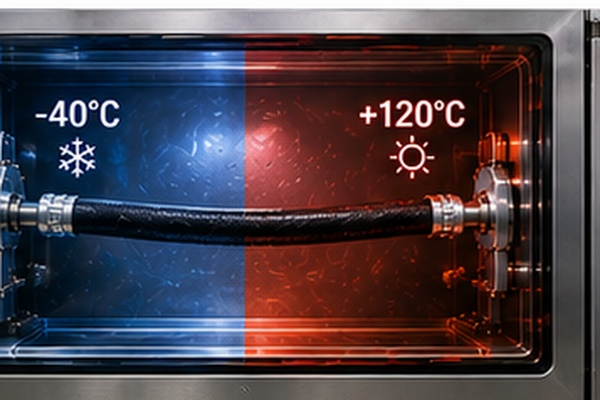
A temperature cycling test exposes the hose to repeated thermal stress across its full operational range. In our process, we test across -40°C to +120°C — cycling between the extremes multiple times to check for material cracking, stiffness, delamination, or fitting separation.
Why both ends of the range matter:
- Low temperature (-40°C): Hose rubber becomes brittle. If the inner tube or outer cover cracks under flexing, you have a leak point. This is a real problem for customers in Northern Europe, Canada, Russia, or high-altitude markets.6
- High temperature (+120°C): Prolonged heat causes rubber degradation and accelerated permeation. Hoses routed close to exhaust components are particularly vulnerable.7
If a supplier only lists a high-temperature rating and says nothing about cold-temperature performance, that's worth asking about directly.
How Does Quality Control Protect Buyers?
Good quality control doesn't just protect the end user — it directly protects your margin, your customer relationships, and your sourcing reputation.
Think about the cost structure of a quality failure as a distributor or importer:
- Direct cost: Returns, replacements, and freight for defective products
- Indirect cost: Customer attrition, lost reorder volume, damaged brand positioning
- Regulatory cost: In some markets, faulty refrigerant components trigger recall requirements or liability exposure8
A supplier with a documented QC process shifts a significant portion of that risk back to the production stage — where it's far cheaper to catch. A hose that fails a burst test at the factory costs almost nothing to reject. The same failure in the field costs you a customer relationship.
Internal QC vs. Third-Party Certification
It's worth being clear about the distinction here. Factory-internal test reports — like the ones described above — reflect the supplier's own QC procedures and declared parameters. These are valuable and should be requested. But they are not the same as third-party certification from an independent lab.
If your market requires certified components (for example, SAE J2064 compliance for refrigerant hoses9), ask specifically whether the supplier has third-party lab documentation for those standards — not just internal test reports. A credible supplier will tell you clearly which certifications they hold and which they don't.
What Should Importers Request From Suppliers?
Asking for test documentation is a standard procurement step. It's not an accusation. Suppliers who treat it as one are signaling that documentation doesn't exist.
Here's a practical checklist of what to request before placing a significant order:
Before sampling:
- [ ] List of internal quality tests performed (pressure, burst, leak, temperature)
- [ ] Declared pass/fail thresholds for each test (specific values, not descriptors)
- [ ] Whether testing is per-piece, per batch, or statistical sample
With or before the sample:
- [ ] Internal test report for the sample batch
- [ ] Certificate of Conformance (COC) — basic confirmation the product meets declared specs
- [ ] Material specification sheet for inner tube, cover, and reinforcement layer
Before large-order commitment:
- [ ] Batch QC records from a recent production run (not just a single sample report)
- [ ] Confirmation of which third-party certifications are held (if any)
- [ ] Clarity on what happens if a batch fails internal QC — what's the rejection and rework procedure?
One thing I've noticed: the suppliers who are most confident in their process are usually the quickest to share this documentation. The ones who slow-walk the request or send vague marketing materials instead of actual reports tend to be the ones whose process wouldn't hold up to scrutiny.
Frequently Asked Questions
What is the minimum burst pressure an automotive AC hose should meet?
A reliable AC hose should reach a burst pressure at least 4 times its rated working pressure. For hoses rated at approximately 3.0 MPa working pressure, a burst threshold of 12.0 MPa is a common production benchmark. Ask your supplier for the specific burst pressure value in their test report — not just a general "high pressure resistance" claim.
Is a Certificate of Conformance the same as a third-party certification?
No. A COC is an internal declaration from the supplier confirming that the product meets their own stated specifications. Third-party certification — such as SAE J2064 — requires independent lab testing. Both have value, but they serve different purposes. Always clarify which you're receiving.
What temperature range should a quality automotive AC hose withstand?
A quality AC hose should be tested across its full operational range — typically -40°C to +120°C. Cold-end performance matters especially for customers in cold climates, where brittle hoses can crack under low-temperature flexing. Ask specifically whether the supplier's temperature test covers both ends of the range.
How often should AC hose test reports be updated?
Test reports should be generated per production batch, not just once at product launch. If a supplier shows you a test report from two years ago for product you're ordering today, ask for a current batch report. Materials and production consistency can change — batch-level documentation matters.
Can I request a sample for my own testing before placing a bulk order?
Yes — and you should. Requesting a physical sample and having it tested by a local lab is one of the most effective due diligence steps available to importers. A supplier who is confident in their product will support this process. One who discourages it is worth reconsidering.
Conclusion
AC hose quality testing is what separates a documented quality process from an unverifiable promise. The four core tests — pressure, burst, leakage, and temperature — each target a real failure mode that has real cost consequences for importers and distributors. A working pressure of around 3.0 MPa, a burst threshold of 12.0 MPa, zero-tolerance leakage criteria, and a temperature range of -40°C to +120°C give you a concrete reference framework to evaluate any supplier's claims.
Before your next order, ask the supplier you're evaluating to provide their test parameters, sample test reports, and batch QC records. The response you get will tell you as much about their quality process as the documents themselves.
<!--[googlesitekit-end-of-content]-->
"Servicing of motor vehicle air conditioners | U.S. Code | US Law", https://www.law.cornell.edu/uscode/text/42/7671h. SAE International technical standards for automotive refrigerant hose assemblies, including SAE J2064, document the combined mechanical, thermal, and chemical exposure conditions that hose materials must withstand in service. Evidence role: general_support; source type: institution. Supports: That automotive AC hoses are subject to simultaneous mechanical, thermal, and chemical stressors during vehicle operation.. Scope note: Standards documents define test conditions as proxies for real-world stressors; they do not directly measure in-vehicle simultaneous loading. ↩
"Report on Vehicle Safety Recall Completion Rates", https://www.nhtsa.gov/sites/nhtsa.gov/files/2025-01/recall-completion-rates-report-update-01172025.pdf. Research on automotive recall economics documents that per-unit recall costs, including logistics, labor, regulatory compliance, and reputational damage, routinely reach multiples of the original component cost, supporting the argument that upstream quality testing represents a cost-effective risk mitigation strategy. Evidence role: general_support; source type: research. Supports: That automotive product recalls and warranty claim events impose substantial costs on distributors and importers that typically exceed upstream quality control investment.. Scope note: Published recall cost data typically reflects OEM-level events; costs for aftermarket distributors handling smaller volumes may differ in structure, though the directional relationship between recall cost and component cost differential is broadly consistent. ↩
"SURVEY RESEARCH DESIGN IN SUPPLY CHAIN MANAGEMENT", https://scholarworks.indianapolis.iu.edu/bitstreams/ba564b1f-72e0-44aa-abc7-148a26d6531c/download. Supply chain quality management literature consistently identifies documented process controls, measurable quality metrics, and third-party verification as more reliable quality predictors than supplier age or production volume alone, noting that long-established suppliers can sustain substandard practices absent external accountability mechanisms. Evidence role: general_support; source type: research. Supports: That supplier operational history is an insufficient proxy for product quality without documented process controls and test data.. Scope note: This is a general finding from supply chain management research; direct empirical data specifically on automotive hose suppliers and the correlation between tenure and defect rates is not widely published. ↩
"Listing of HFO-1234yf under the Significant New Alternatives Policy ...", https://www.regulations.gov/document/EPA-HQ-OAR-2021-0347-0001. Regulatory bodies including the European Commission and the U.S. EPA have classified HFO-1234yf (R-1234yf) as a mildly flammable refrigerant (ASHRAE A2L), subject to specific handling, containment, and vehicle safety requirements not applicable to R-134a. Evidence role: general_support; source type: government. Supports: That R-1234yf refrigerant carries distinct safety and regulatory obligations compared to R-134a due to its mildly flammable classification.. Scope note: Regulatory requirements vary by jurisdiction; the characterization of R-1234yf release as a 'safety and regulatory issue' is directionally supported but the severity depends on applicable national or regional rules. ↩
"Investigation of Pressure Drop in Refrigerant Pipes of an ...", https://docs.lib.purdue.edu/iracc/2236/. Research on refrigerant permeation and micro-leak behavior in automotive AC systems documents measurable charge loss over extended periods, though specific depletion rates depend on leak size, system charge volume, and ambient conditions. Evidence role: statistic; source type: research. Supports: That slow refrigerant leaks from hose defects can result in meaningful charge loss over weeks to months.. Scope note: The article's specific figures of 20–30% loss over 30–60 days appear to be illustrative estimates; no single published source directly confirms this precise range as a general benchmark. ↩
"Rubber that resists cracking", https://seas.harvard.edu/news/rubber-resists-cracking. Polymer science literature documents that elastomers exhibit a glass transition temperature below which molecular mobility is restricted, causing increased stiffness and brittleness; flexing below this threshold can initiate surface cracking and material failure in rubber hose components. Evidence role: mechanism; source type: research. Supports: That elastomeric materials used in automotive hoses undergo embrittlement at low temperatures, increasing susceptibility to cracking under mechanical stress.. Scope note: The specific temperature at which embrittlement becomes a practical failure risk depends on the rubber compound formulation; the article's -40°C threshold reflects a common test standard rather than a universal material property. ↩
"Thermal Oxidative Aging and Service Life Prediction of Commercial ...", https://pmc.ncbi.nlm.nih.gov/articles/PMC11085669/. Studies on thermal aging of elastomeric materials demonstrate that elevated temperatures accelerate oxidative degradation of polymer chains and increase gas permeability, both of which reduce the service life and sealing performance of rubber hose assemblies. Evidence role: mechanism; source type: research. Supports: That thermal exposure accelerates both the chemical degradation of elastomeric hose materials and the rate of refrigerant permeation through hose walls.. Scope note: Permeation rates are highly dependent on specific rubber compound, refrigerant type, and temperature level; the article's general claim is directionally supported but quantitative extrapolation requires compound-specific data. ↩
"Interpretation ID: 21331ogm", https://www.nhtsa.gov/interpretations/21331ogm. Regulatory frameworks such as the U.S. National Traffic and Motor Vehicle Safety Act (administered by NHTSA) and the EU General Product Safety Directive establish recall obligations and distributor liability for vehicle components that present safety risks, which can encompass refrigerant system components that fail in service. Evidence role: general_support; source type: government. Supports: That regulatory frameworks in major automotive markets impose recall obligations and potential liability on importers and distributors of defective vehicle components including refrigerant system parts.. Scope note: Recall trigger thresholds and liability structures vary significantly by jurisdiction and by whether the component is classified as safety-critical; the article's general claim is supported in principle but the specific applicability depends on market and failure type. ↩
"J2064_202104 : Coupled Automotive Refrigerant Air- ...", https://www.sae.org/standards/j2064_202104-coupled-automotive-refrigerant-air-conditioning-hose-assemblies. SAE J2064, published by SAE International, establishes dimensional, performance, and test requirements for hose and hose assemblies used in mobile air conditioning systems, and is widely referenced in North American automotive procurement and compliance contexts. Evidence role: definition; source type: institution. Supports: That SAE J2064 is the established SAE International standard defining performance, construction, and test requirements for automotive refrigerant hose assemblies.. Scope note: SAE J2064 is primarily a North American standard; buyers in other markets may need to reference additional or alternative standards such as ISO 13765 or regional equivalents. ↩