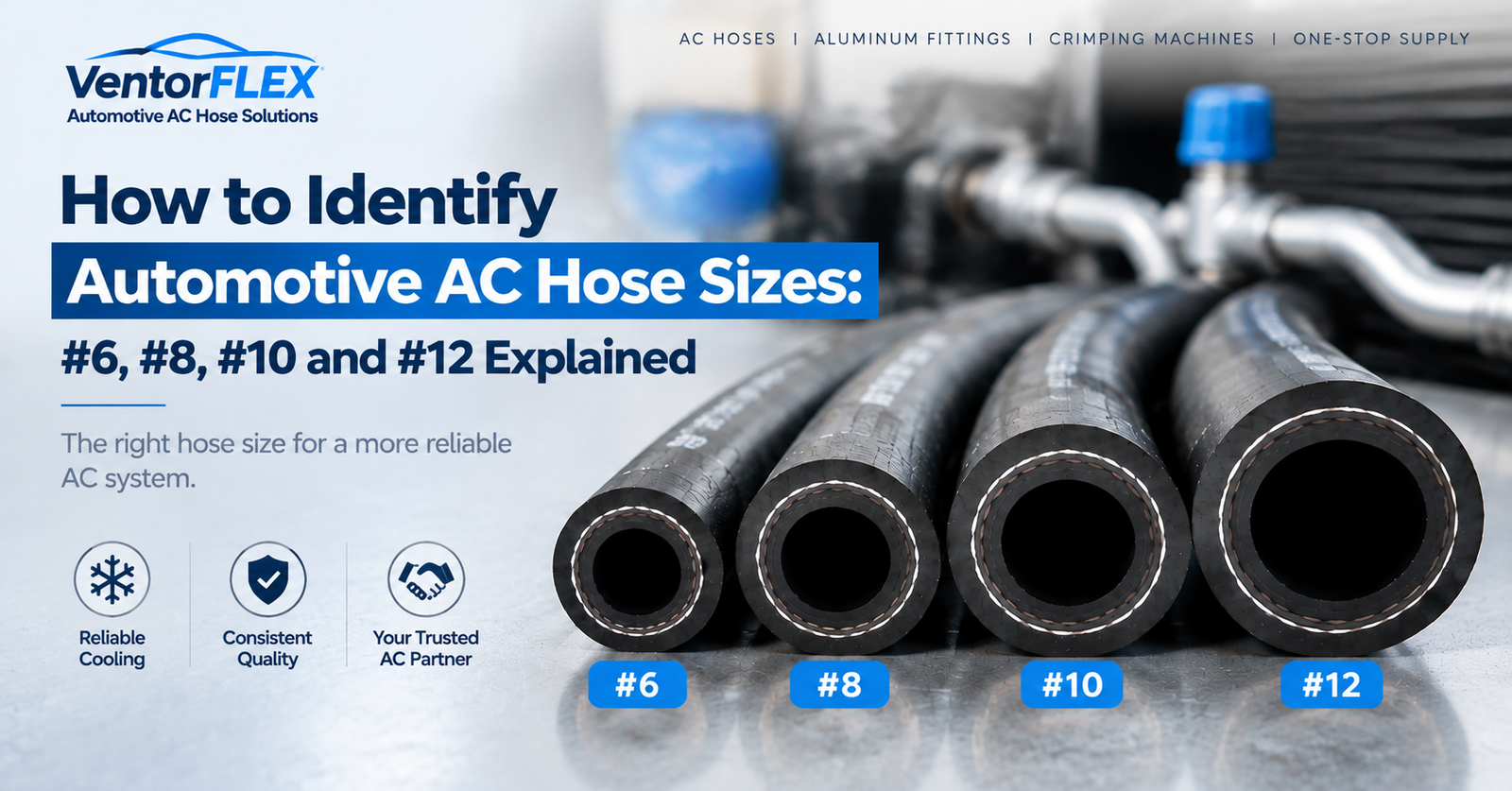
Getting automotive AC hose sizes wrong is more common than most buyers expect — and the cost of that mistake shows up fast. A misidentified hose leads to a fitting that won't seat, a system that leaks under pressure1, or a replacement order that arrives completely wrong. Understanding how the sizing system actually works is the first step to avoiding that.
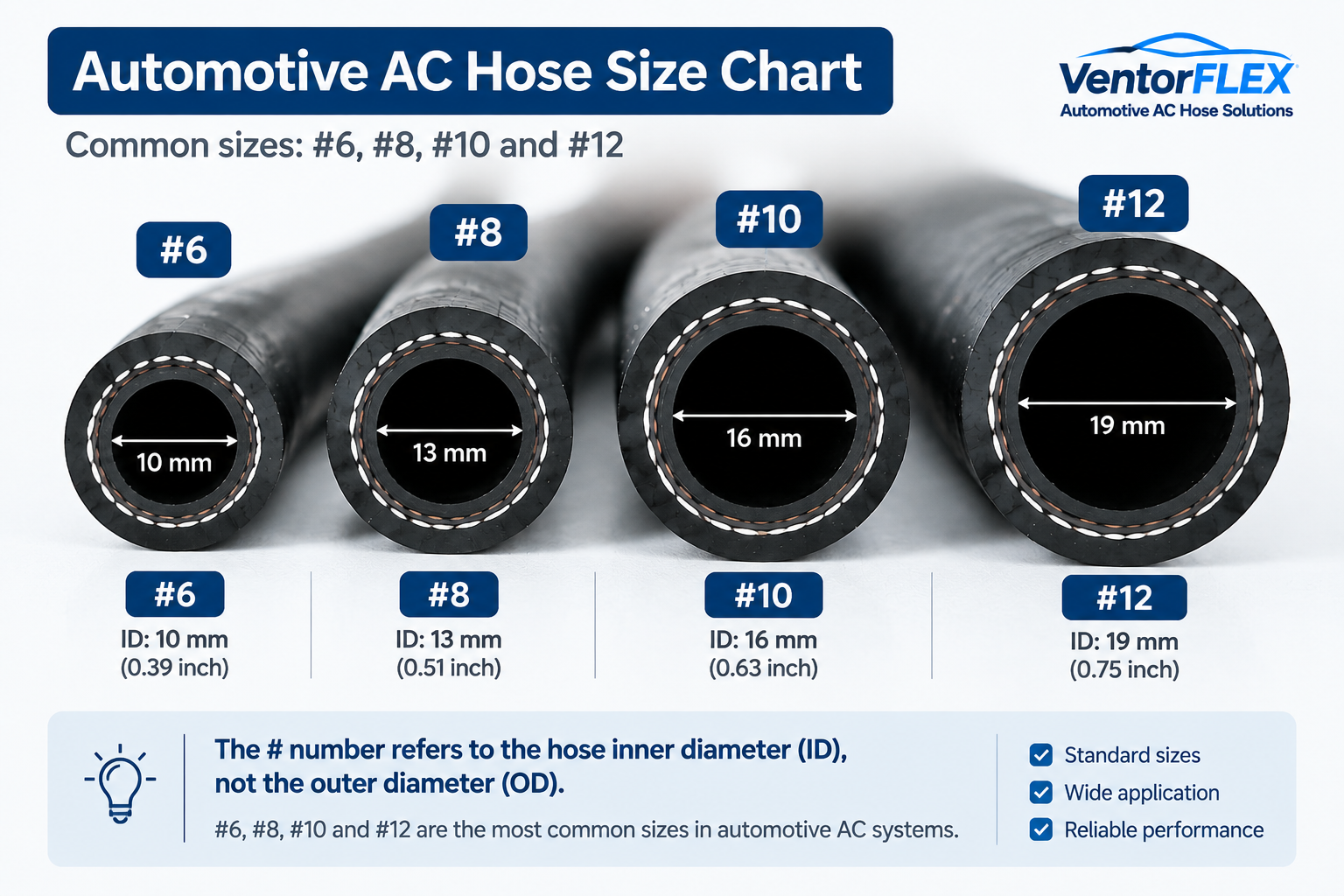
Automotive AC hose sizes like #6, #8, #10, and #12 refer to the nominal inner diameter of the hose, not the outer diameter. The "#" number is an ID-based designation defined under SAE J20642. Each size has a standardized approximate ID in millimeters, but the outer diameter varies depending on hose construction type — so measuring OD alone is not a reliable way to identify the correct hose size.
The number system looks simple on the surface, but there are a few layers underneath that trip up even experienced buyers. Let's go through each size, how to measure correctly, and how to avoid the fitting mismatch problem we see regularly in customer orders.
What Do #6, #8, #10 and #12 Mean on an AC Hose?
Most buyers assume the number printed or stamped on an AC hose refers to the outside diameter. That assumption causes a lot of problems. The number is actually a nominal inner diameter classification — and "nominal" matters here.
The #6, #8, #10, and #12 designations are nominal ID codes based on SAE J2064. They indicate the approximate inner bore size of the hose. These numbers do not directly tell you the OD, the wall thickness, or the fitting configuration. Two hoses with the same size number can have different outer diameters depending on their construction type.
Why "Nominal" Matters
The word "nominal" means the number is a reference classification, not an exact measurement. In our production specs, a #8 hose has a nominal ID of approximately 13 mm — but the actual measured ID can sit within a tolerance range. The OD depends on whether the hose is Standard Barrier or Reduced Barrier construction (more on that below).
What the "#" System Is Based On
The # numbering in automotive AC hose follows the SAE J2064 standard, which defines refrigerant hose requirements including construction, pressure ratings, permeation limits, and dimensional references. When a hose is labeled "#10," that's a shorthand for a specific ID class within that framework — not a measurement you can take with a ruler from the outside.
I've seen customers receive a quote, measure the OD of their old hose, and then request a hose with "the same OD." That always leads to follow-up questions, because OD is a construction outcome — not the sizing input we work from.
Automotive AC Hose Size Chart
Before diving into each size individually, here's a reference chart based on our production-verified figures, cross-referenced against SAE J2064.
| Hose Size | Nominal ID (approx.) | Standard Barrier OD (approx.) | Reduced Barrier OD (approx.) | Typical Use |
|---|---|---|---|---|
| #6 | 10 mm | 18–19 mm | 16–17 mm | Liquid line |
| #8 | 13 mm | 21–22 mm | 19–20 mm | Liquid or discharge |
| #10 | 16 mm | 25–26 mm | 22–23 mm | Suction or discharge |
| #12 | 19 mm | 28–30 mm | 25–27 mm | Suction line |
Important: These figures reflect the hoses we produce and are provided as a practical reference, not as a substitute for vehicle-specific or application-specific specifications. Always confirm dimensions against your actual application requirements before ordering.
Notice that for every size, the Standard Barrier and Reduced Barrier ODs are different. This is exactly why OD alone cannot identify hose size reliably.
What Is a #6 AC Hose Used For?
The #6 hose is the smallest in the standard automotive AC lineup3, and buyers sometimes underestimate how specific its application is.
A #6 AC hose is typically used for liquid refrigerant lines in automotive air conditioning systems. It handles the high-pressure, high-density refrigerant flow between the condenser and the expansion valve or orifice tube. Its smaller bore suits the lower flow volume required on the liquid side of the circuit.
Where You'll See #6 in the System
- Liquid line connections from condenser outlet to expansion device
- Retrofit or custom assemblies where a tight routing path requires a smaller diameter
- Passenger car systems where the refrigerant charge volume is modest
Because #6 handles liquid refrigerant at relatively high pressure4, hose construction integrity matters. In our quality checks, we pay particular attention to the inner tube smoothness on #6 assemblies — any roughness or delamination risk is more consequential on the liquid side.
What Is a #8 AC Hose Used For?
The #8 size sits in a flexible middle position — it appears in more than one part of the AC circuit depending on the vehicle design.
A #8 AC hose is commonly used for discharge lines (from the compressor to the condenser) in smaller vehicles, and occasionally for liquid lines in larger systems. It handles high-pressure, high-temperature refrigerant on the discharge side, which places demanding requirements on the hose's heat resistance and pressure rating.
8 Discharge Line Considerations
- High operating temperature: Discharge gas exits the compressor hot5. We recommend verifying that the hose's inner tube material is rated for sustained elevated temperatures in this application.
- Pressure rating: Discharge side pressure is the highest in the system. Confirm burst and working pressure specs before substituting a #8 for a #10 in any repair.
- Fitting compatibility: #8 discharge lines often use different end fitting configurations than #8 liquid lines — the hose size is the same, but the fitting spec may differ. This is a common source of confusion in replacement orders.
What Is a #10 AC Hose Used For?
The #10 is arguably the most frequently ordered size in automotive AC applications, and it's also the size where construction type confusion happens most often.
A #10 AC hose is most commonly used for suction lines (low-pressure side, from evaporator to compressor)6 and in some systems for discharge lines. As the suction line, it carries low-pressure refrigerant vapor and typically runs the longest path in the system, which is why correct sizing matters for system efficiency7.
Why #10 Construction Type Matters More Here
Because #10 suction lines are often longer and more exposed, the difference between Standard Barrier and Reduced Barrier construction becomes more practically significant. A #10 Standard Barrier hose and a #10 Reduced Barrier hose share the same nominal ID, but their outer diameters differ by roughly 2–3 mm based on our measurements. That difference affects:
- Routing clearance in tight engine bays
- Fitting crimp specifications — the crimp die set used for Standard Barrier #10 is not the same as for Reduced Barrier #10
- Bracket compatibility in OEM replacement scenarios
We've had customers order #10 hose by size number alone, then run into crimping problems at their workshop because they were using the wrong die for the construction type. Confirming both size and construction type upfront prevents that.
What Is a #12 AC Hose Used For?
The #12 is the largest common size in passenger vehicle AC systems, and it's almost always on the suction side.
A #12 AC hose is used for low-pressure suction lines in larger vehicles, trucks, SUVs, or systems with higher refrigerant capacity requirements8. Its larger bore supports higher refrigerant vapor flow on the low-pressure side without excessive pressure drop, which helps maintain system efficiency.
12 in Commercial and Larger Vehicle Applications
In our export orders, #12 hose tends to appear more frequently in:
- Light truck and SUV platforms with rear evaporator systems
- Bus and commercial vehicle AC applications
- Dual-zone systems requiring higher flow capacity
Because #12 suction hoses are physically larger and more flexible, they're also more prone to routing challenges and abrasion in tight spaces. Construction quality — specifically the braid reinforcement and outer cover durability — matters more at this size.
Standard Barrier vs Reduced Barrier Hose: Are the Sizes the Same?
This is one of the most common points of confusion we handle in customer inquiries, and it directly affects how you measure and order.
Standard Barrier and Reduced Barrier hoses share the same nominal size number, but they have different outer diameters9 and require different crimp specifications. The barrier layer in Reduced Barrier hose is thinner and more tightly integrated, resulting in a smaller OD at the same ID. Treating them as interchangeable based on size number alone will cause fitting and crimping problems.
What's Actually Different Between Them
| Feature | Standard Barrier | Reduced Barrier |
|---|---|---|
| Barrier layer type | Thicker nylon or PTFE inner barrier | Thinner integrated barrier layer |
| Outer diameter | Larger for same nominal size | Smaller for same nominal size |
| Flexibility | Slightly stiffer | More flexible, easier routing |
| Crimp die requirement | Specific to SB construction | Specific to RB construction |
| Refrigerant permeation10 | Good | Better (lower permeation rate) |
Why This Matters in Practice
When a customer brings in an old hose for replacement and measures the OD, they might get 25 mm for a worn #10 Standard Barrier hose. A new #10 Reduced Barrier hose might measure 22–23 mm OD. Both are "#10" — but the customer thinks the new hose is the wrong size because the OD doesn't match.
This is exactly why we always ask customers to confirm both size number and construction type before we process a production or replacement order.
How to Measure an Existing Automotive AC Hose
If you're working from an old hose without documentation, here's the measurement sequence that actually gives you reliable results.
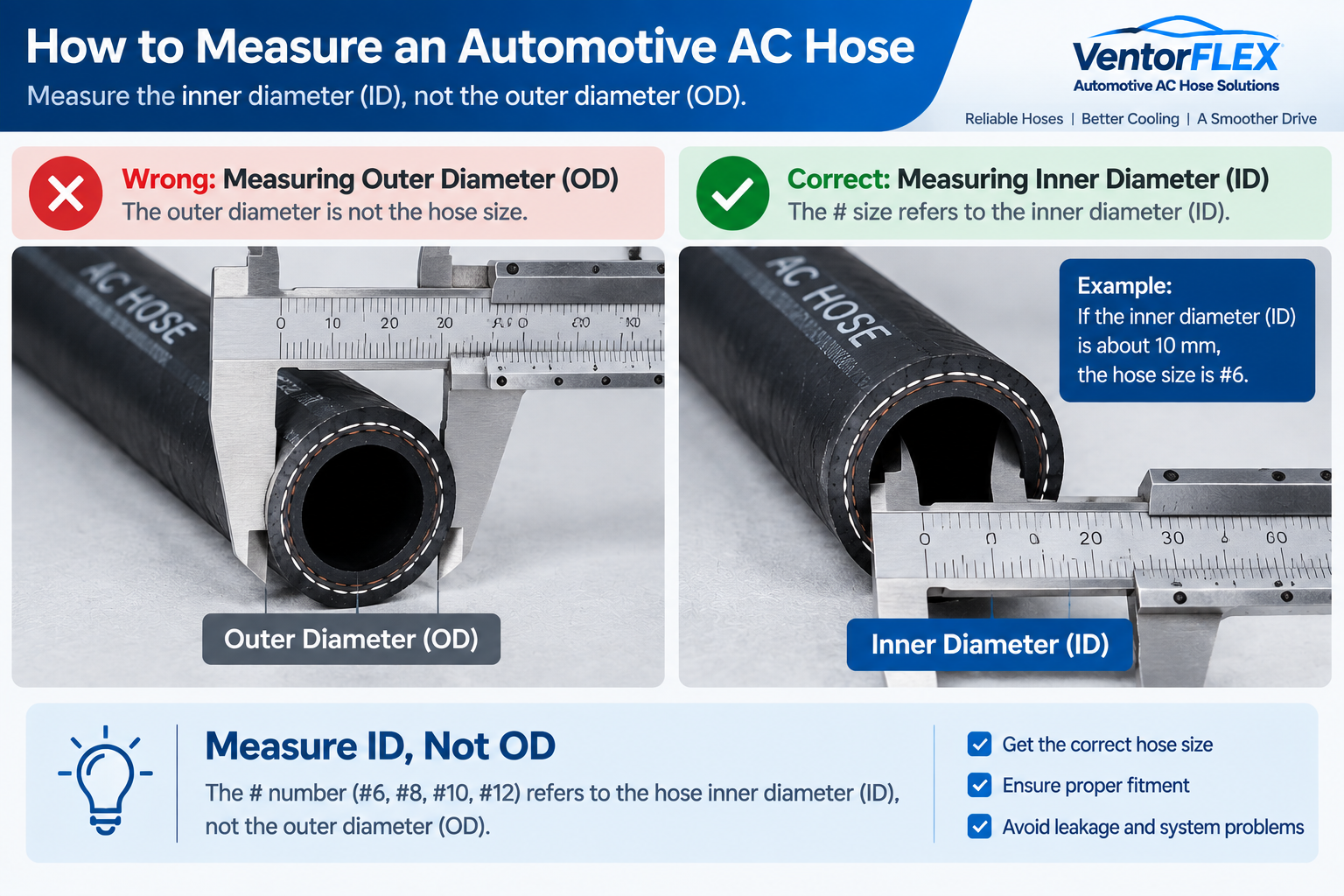
To correctly identify an automotive AC hose size: first, measure the inner diameter of the hose bore; second, identify the construction type (Standard or Reduced Barrier) by inspecting the inner barrier layer or cross-referencing OD against known specs; third, confirm the fitting size and configuration separately. Do not rely on OD measurement alone.
Step-by-Step Measurement Method
-
Measure the inner diameter first. Use a caliper inserted into the hose end or measure a clean cross-section if the hose is cut. Match this to the nominal ID table to identify the size number.
-
Inspect the construction. Look at the inner tube. Standard Barrier hoses typically have a visible distinct barrier tube. Reduced Barrier hoses integrate the barrier into the tube wall more seamlessly. If you can't tell visually, note the OD and cross-reference against known Standard vs. Reduced Barrier OD ranges for that size.
-
Do not use OD as the primary measurement. OD tells you the construction type, not the hose size. Using OD as the starting point will lead you to wrong conclusions when construction type differs.
-
Confirm the fitting separately. Just because you've identified the hose size doesn't mean the fitting size is automatically known. Fitting specs — thread type, seat angle, shell diameter — must be confirmed independently.
How to Choose the Correct AC Hose Size for Replacement or Production
Knowing the size chart is necessary but not sufficient. The final decision requires a complete specification, not just a number.
To choose the correct AC hose size, identify the nominal ID using direct measurement or OEM documentation, confirm the construction type required for the application, and verify the fitting configuration separately. For production orders, provide complete specs including hose size, barrier type, hose length, and end fitting details to avoid manufacturing errors.
Decision Checklist for Buyers
- ✅ Do you know the nominal ID (hose size number)?
- ✅ Is the application Standard Barrier or Reduced Barrier?
- ✅ What are the end fitting types (thread, seat, shell size)?
- ✅ What is the required hose length?
- ✅ Does the application require a specific pressure or temperature rating?
- ✅ Are you sourcing a one-off replacement or a production volume order?
If any of these are unclear, that's the point to ask before ordering — not after the hose arrives and doesn't fit.
Frequently Asked Questions
What size is a #6 AC hose?
A #6 AC hose has a nominal inner diameter of approximately 10 mm. It is the smallest standard automotive AC hose size and is most commonly used for liquid refrigerant lines. The outer diameter varies between roughly 16–19 mm depending on whether the hose is Standard Barrier or Reduced Barrier construction.
What size is a #8 AC hose?
A #8 AC hose has a nominal inner diameter of approximately 13 mm. It is commonly used for discharge lines in smaller vehicles or liquid lines in larger systems. As with all AC hose sizes, the OD depends on construction type and should not be used as the primary identification method.
How do I know my automotive AC hose size?
Measure the inner diameter of the hose bore and match it to the nominal ID for each size: approximately 10 mm (#6), 13 mm (#8), 16 mm (#10), or 19 mm (#12). If the hose is still installed, check OEM documentation or the hose label for the size designation. Always confirm construction type separately.
Is hose OD enough to identify AC hose size?
No. OD alone is not a reliable way to identify automotive AC hose size. Standard Barrier and Reduced Barrier hoses of the same nominal size have different outer diameters. Measuring OD without knowing the construction type will lead to incorrect size identification. Always measure or confirm ID first.
Do AC hose and fitting sizes have to match?
The hose size and fitting size are related, but they are not automatically the same specification. Hose size determines the bore and construction, while fitting size covers thread type, seat geometry, and shell diameter. These must be confirmed separately. Ordering hose by size number without specifying fitting configuration is one of the most common causes of assembly mismatches we see in customer orders.
Conclusion
Identifying automotive AC hose sizes correctly comes down to one principle: the # number refers to nominal inner diameter, and everything else — OD, construction type, and fitting spec — must be confirmed separately. A #10 Standard Barrier and a #10 Reduced Barrier are both "#10," but they are not interchangeable in the field. The fitting is a separate decision entirely.
Whether you're sourcing replacement hoses for a repair shop, building a custom assembly, or placing a production order, starting with the right size identification method prevents the fitting mismatches and re-order delays that cost real money. If you're unsure about any part of the specification — hose size, construction type, or fitting configuration — reach out to us directly. We work through these exact questions with customers every day, and getting the spec right before production starts is always the better path.
<!--[googlesitekit-end-of-content]-->
"Why Does an Automotive AC Hose Leak?", https://acpartstech.com/why-does-an-automotive-ac-hose-leak/. Proper dimensional compatibility between refrigerant hoses and fittings is critical for seal integrity in pressurized systems; mismatched components may fail to achieve proper metal-to-metal or elastomeric seal contact, resulting in refrigerant leakage under operating pressure. Evidence role: general_support; source type: education. Supports: dimensional mismatches between hoses and fittings can compromise seal integrity. Scope note: This describes the general mechanism rather than quantifying failure rates from sizing errors ↩
"J2064_201102 : R134a Refrigerant Automotive Air-Conditioned Hose", https://www.sae.org/standards/j2064_201102-r134a-refrigerant-automotive-air-conditioned-hose. SAE International publishes J2064 as a technical standard specifying performance requirements for refrigerant hoses used in mobile air-conditioning systems, including dimensional classifications, pressure ratings, and permeation limits. Evidence role: definition; source type: institution. Supports: SAE J2064 exists as a technical standard governing automotive refrigerant hose specifications. ↩
"Changing Hose Sizes? - Automotive Air Conditioning Information Forum", https://www.autoacforum.com/viewtopic.php?t=14190. Industry standards recognize #6 as among the smallest bore sizes in typical automotive air conditioning applications, though specialized systems may employ smaller configurations. Evidence role: general_support; source type: institution. Supports: #6 represents the lower end of commonly used automotive AC hose sizes. Scope note: This reflects common practice rather than an absolute minimum defined by standards ↩
"[PDF] Experimental Analysis of an Automotive Air Conditioning System ...", https://docs.lib.purdue.edu/cgi/viewcontent.cgi?referer=&httpsredir=1&article=1734&context=iracc. In automotive air conditioning systems, the liquid line downstream of the condenser operates at high-side pressure, typically the second-highest pressure point in the circuit after the compressor discharge, with specific values depending on refrigerant type, ambient temperature, and system design. Evidence role: general_support; source type: education. Supports: the liquid line between condenser and expansion device operates at elevated pressure. Scope note: Absolute pressure values vary significantly with operating conditions and refrigerant used ↩
"Vapor-compression refrigeration", https://en.wikipedia.org/wiki/Vapor-compression_refrigeration. In vapor compression refrigeration cycles, the compression process increases both pressure and temperature of the refrigerant gas, with discharge temperatures in automotive systems typically ranging significantly above ambient depending on operating conditions and refrigerant type. Evidence role: mechanism; source type: education. Supports: compression increases refrigerant temperature on the discharge side of AC systems. Scope note: Specific temperature values depend on refrigerant type, ambient conditions, and system design ↩
"Vapor-compression refrigeration - Wikipedia", https://en.wikipedia.org/wiki/Vapor-compression_refrigeration. In automotive air conditioning systems following the vapor compression cycle, the suction line transports low-pressure refrigerant vapor from the evaporator outlet to the compressor inlet, representing the lowest pressure point in the refrigeration circuit. Evidence role: mechanism; source type: education. Supports: the suction line carries low-pressure refrigerant vapor from evaporator to compressor. ↩
"Automotive air conditioning - Wikipedia", https://en.wikipedia.org/wiki/Automotive_air_conditioning. Refrigerant line sizing influences system efficiency through pressure drop effects; undersized lines increase frictional losses and pressure drop, which can reduce compressor suction pressure, increase compression work, and decrease overall system coefficient of performance. Evidence role: mechanism; source type: research. Supports: refrigerant line sizing affects pressure drop and system performance. Scope note: The magnitude of efficiency impact depends on line length, refrigerant mass flow rate, and specific system design ↩
"Experimental Analysis of an Automotive Air Conditioning ...", https://docs.lib.purdue.edu/cgi/viewcontent.cgi?referer=&httpsredir=1&article=1734&context=iracc. Automotive air conditioning system capacity scales with vehicle cabin volume and cooling load requirements; larger vehicles such as trucks and SUVs typically have greater refrigerant charge quantities and higher mass flow rates, necessitating larger-bore suction lines to maintain acceptable pressure drop and system efficiency. Evidence role: general_support; source type: education. Supports: larger vehicles typically require higher AC system capacity and larger refrigerant lines. Scope note: Specific hose sizing depends on detailed system design rather than vehicle class alone ↩
"AC Hose by the Foot or Spool | Barrier & Reduced ...", https://www.autocoolingsolutions.com/collections/bulk-ac-hose?srsltid=AfmBOop6N5HFTonvVuV6-zbAuETc8kvA4CPEnJEzjB7lk3l95pONu0B5. Refrigerant hose construction standards allow for different barrier layer configurations that maintain the same nominal inner diameter classification while producing different overall outer diameters, with reduced barrier designs integrating thinner permeation barriers into the tube wall structure. Evidence role: general_support; source type: research. Supports: barrier layer construction affects overall hose diameter while maintaining the same bore size. Scope note: Specific dimensional variations depend on manufacturer specifications within standard tolerances ↩
"Compatibility of R1234yf and R134a and Lubricants used in ...", https://docs.lib.purdue.edu/cgi/viewcontent.cgi?article=3057&context=iracc. Refrigerant permeation describes the diffusion of refrigerant molecules through the walls of hoses and seals in air conditioning systems; industry standards such as SAE J2064 specify maximum allowable permeation rates to limit refrigerant loss and environmental impact over the service life of the hose. Evidence role: definition; source type: institution. Supports: refrigerant permeation refers to the rate at which refrigerant molecules pass through hose wall materials. ↩