Buying an AC hose crimping machine sounds straightforward — until you receive the equipment and discover it doesn't cover your most common hose diameter. That single mismatch can stall your workflow, waste your budget, and force a second purchase. The real question isn't which machine is better. It's which machine actually fits your operation.
The right AC hose crimping machine is the one that matches your specific hose size range, your daily production volume, and your business type. A small independent workshop and a high-frequency fleet service center have fundamentally different requirements. Getting those three factors right before you buy eliminates most of the common sourcing mistakes we see buyers make.
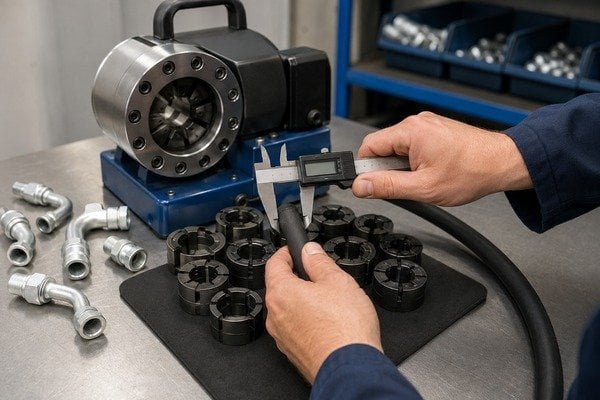
Most buyers come to us having already compared prices and brands. Very few have confirmed whether the machine's crimping range actually covers their hose inventory. That's where the problems start — and that's exactly what this guide will help you avoid.
Why Does the Right Crimping Machine Matter?
Choosing the wrong crimping machine isn't just an inconvenience. It's a technical risk that shows up later, in the field, under pressure — literally.
The consequence of a poor match isn't always obvious at purchase. You might crimp a fitting that looks finished, but if the machine wasn't designed for that hose diameter or material, the seal integrity is compromised. In automotive A/C applications, that means refrigerant leaks, system pressure failure, and customer complaints that trace back to your workshop bench1.
From the buyer conversations we've had, the most common mistake isn't choosing a "bad" machine. It's choosing a machine that works fine — just not for the hoses you actually run.
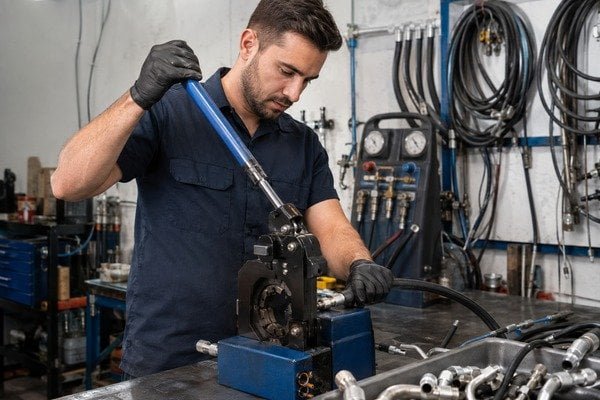
The Stakes Are Higher in Automotive A/C Applications
Automotive air conditioning systems operate under significant pressure2. A crimp that's slightly loose, slightly off-center, or applied with the wrong die set doesn't just look wrong — it fails. And because A/C leaks often develop gradually, the problem may not surface until the system has been running for weeks3.
That's why this decision deserves more than a price comparison. The machine has to be technically compatible with your hose specs before anything else matters.
What Specifications Should Buyers Consider?
This is where most buyers start asking the right questions — but often in the wrong order. Price comes up first. Brand comes up second. Specs come up last. We'd suggest reversing that.
Before comparing models, confirm four core specifications: crimping range, maximum hose size, accuracy, and production capacity. These four numbers tell you whether a machine can handle your work — everything else is secondary.
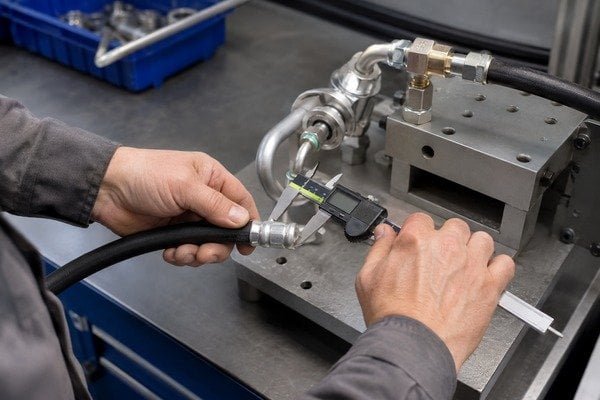
Crimping Range — The Non-Negotiable Filter
Crimping range is the first filter. It defines the minimum and maximum hose outer diameter the machine can handle. If your hose sizes fall outside that range, the machine simply cannot do the job — no workaround, no adjustment.
What buyers should do before anything else:
- List every hose size currently in your inventory
- Identify the smallest and largest outer diameter you regularly work with
- Confirm the machine's crimping range fully covers both ends
A common situation we see: a buyer selects a machine that covers 80% of their hose range and assumes the remaining 20% can be "managed." It can't. Those edge-case hose sizes are often the ones used in specific vehicle models — and you'll end up needing a second machine or a workaround that slows everything down.
Don't let price lead this decision. Let your hose range lead it.
Maximum Hose Size — Larger Isn't Always Better
Maximum hose size is related to crimping range but worth separating. A machine rated for a high maximum diameter isn't automatically a better choice. A larger capacity machine typically costs more, occupies more floor space, and may sacrifice precision at the smaller end of the range.
Match the maximum to what you actually need — with a reasonable margin for future product expansion, but no more.
| Machine Capacity | Best Fit For | Trade-Off |
|---|---|---|
| Up to 25mm OD | Small shops, standard A/C hoses | Limited for larger truck or industrial hoses |
| Up to 40mm OD | Mid-size workshops, broader hose range | Higher upfront cost, larger footprint |
| 40mm+ OD | Fleet service, heavy equipment, industrial | Overkill for light-duty automotive use |
Accuracy — The Specification That Affects System Reliability
Accuracy is the specification buyers most often overlook. It's easy to focus on whether the machine completes the crimp. The harder question is whether the crimp is correct.
Crimping accuracy determines:
- Seal consistency — whether every crimp across a batch achieves the same compression
- Dimensional precision — whether the finished crimp diameter falls within the fitting manufacturer's tolerance
- Leak resistance — whether the hose-fitting connection holds under the operating pressures of an automotive A/C system
Inaccurate crimping doesn't always produce an obvious defect. The fitting looks attached. The connection seems solid. But under refrigerant pressure4, a crimp that's 0.3mm off tolerance can cause a slow leak that the customer doesn't notice until their system loses charge mid-summer5.
The question isn't "can this machine crimp?" It's "can this machine crimp accurately and repeatedly?"
For automotive A/C work specifically, accuracy matters more than it does in lower-pressure applications. If you're supplying hoses to workshops that service passenger vehicles, system pressure integrity is a direct quality commitment — and your crimping machine is part of that chain.
Production Capacity — Volume Determines the Right Machine Type
Production capacity is really a throughput question. How many crimps do you need to complete per day? Per shift? Is crimping a bottleneck in your current workflow, or is it a small part of a larger process?
This spec connects directly to the next section — the choice between manual and hydraulic machines.
Manual vs. Hydraulic Crimping Machine — Which One Do You Actually Need?
This is the question we receive most often, and the framing is almost always wrong. Buyers ask "which is better?" when the correct question is "which fits my volume?"
Manual and hydraulic AC hose crimping machines differ in throughput and operational speed — not in their ability to produce a quality crimp. A manual machine operated correctly can produce a precise, reliable crimp. The difference is how fast you can do it, and how consistently you can maintain that speed across a full day of work.
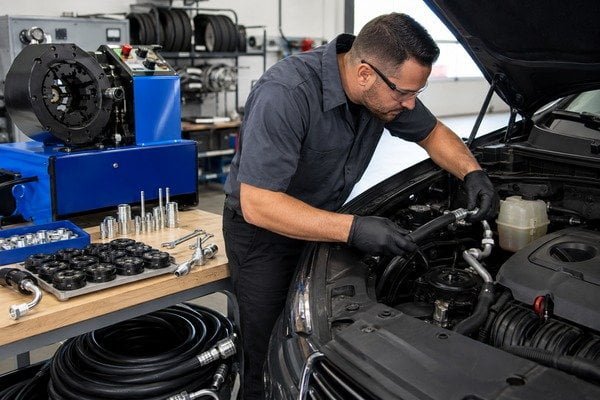
Manual Crimping Machines
Manual machines are lever-operated or screw-operated. They require physical effort per crimp cycle and are slower than hydraulic alternatives.
Where they work well:
- Independent workshops with low-to-moderate daily hose volume
- Operations where crimping is occasional, not continuous
- Buyers with limited floor space or startup budgets
- Mobile service setups where portability matters
The real constraint isn't quality — it's operator fatigue and speed. A technician running 15–20 crimps per day on a manual machine is fine. The same technician running 80–100 crimps per shift will slow down, and consistency will drift as fatigue sets in.
Manual machines are not inferior. They are appropriate for the right volume.
Hydraulic Crimping Machines
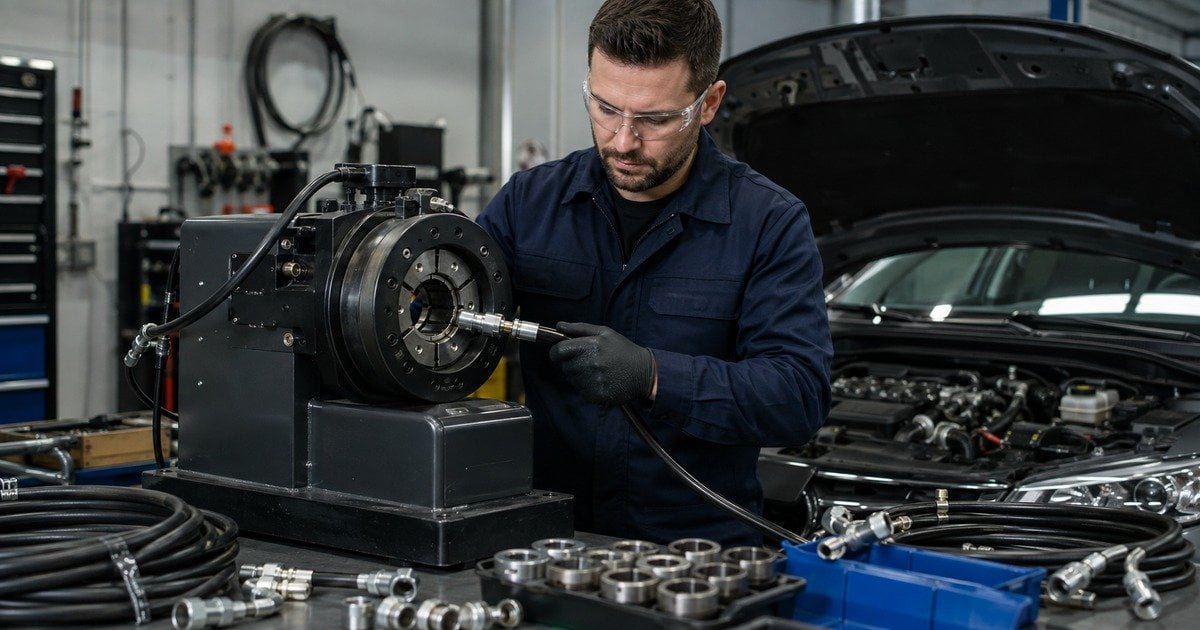
Hydraulic machines use hydraulic pressure to drive the crimping action6. The operator positions the hose, activates the machine, and the hydraulic system does the force work.
Where they become necessary:
- High-frequency workshops completing large daily hose volumes
- Chain workshop networks needing consistent output across locations
- Production environments where crimping is part of a batch assembly process
- Any operation where throughput is currently a constraint
The key advantages are speed and repeatability. Because the operator isn't manually applying force, each crimp cycle takes less time and produces consistent compression — regardless of how many cycles you've already completed that shift.
| Factor | Manual Machine | Hydraulic Machine |
|---|---|---|
| Upfront cost | Lower | Higher |
| Crimping speed | Slower | Faster |
| Operator effort | High per cycle | Low per cycle |
| Consistency across volume | Decreases with fatigue | Remains stable |
| Footprint | Compact | Larger |
| Best for | Low-medium volume | High volume |
Which Machine Fits Different Businesses?
There's no universal answer here. The right machine depends on who you are and what you're running through it.
Match your machine tier to your business model — not to what looks most capable on a spec sheet.
Small Independent Workshops
These operations typically serve a local customer base, handle a moderate volume of vehicle A/C repairs, and operate with limited floor space and tighter budgets.
Best fit: A compact manual crimping machine with a crimping range that covers standard automotive A/C hose sizes7.
The priority here is coverage and accuracy, not speed. A well-specified manual machine handles the volume comfortably without the cost or footprint of hydraulic equipment.
Large Workshops and Fleet Service Centers
These operations run high daily volumes, often with multiple technicians working simultaneously. Consistency across a full shift matters as much as speed.
Best fit: A hydraulic crimping machine with a broad crimping range, stable accuracy at volume, and ideally enough capacity to handle both standard and larger-diameter hoses used in commercial or fleet vehicles.
For multi-location chains, the additional consideration is standardization. The same machine model across locations means the same dies, the same settings, the same training — and consistent output regardless of which location performs the work8.
Distributors and Importers Supplying Workshops
If you're sourcing crimping machines to resell or supply to your workshop customers, your selection logic shifts slightly. You're not matching to one workflow — you're building a product range that covers multiple business sizes.
The practical approach: Stock or offer two tiers — a manual option for smaller buyers and a hydraulic option for high-volume accounts. This avoids the trap of offering a single machine that's too large for small shops and too limited for serious production buyers.
Frequently Asked Questions
What is the most important specification when choosing an AC hose crimping machine?
Crimping range is the first specification to confirm. If the machine doesn't cover your actual hose outer diameter range, no other feature matters. Before comparing price, brand, or features, list your hose sizes and verify the machine covers all of them — including your edge cases.
Is a hydraulic crimping machine always better than a manual one?
No. Hydraulic machines offer speed and consistency at high volume, but they're not superior in terms of crimp quality for low-volume use. A manual machine operated correctly produces reliable, accurate crimps. The choice is a throughput decision, not a quality hierarchy — match the machine to your daily volume.
How does crimping accuracy affect automotive A/C system performance?
Inaccurate crimping compromises the seal between the hose and fitting. In automotive A/C applications, even small deviations from the required crimp diameter can cause refrigerant leaks under operating pressure. Accuracy matters because A/C systems depend on pressure integrity — a crimp that looks complete but falls outside tolerance is a system failure waiting to happen.
Can one crimping machine handle all hose types and sizes?
Not always. Machines have defined crimping ranges. A machine suitable for standard 13mm–25mm automotive A/C hoses may not handle larger commercial vehicle hoses. Always check that the machine's full range — including the die sets available — covers every hose size in your inventory before purchasing.
Should I buy the crimping machine and hoses from the same supplier?
It significantly reduces compatibility risk. Dies, fittings, and hoses from different manufacturers may have dimensional variations that affect crimp performance9. Sourcing machine, hoses, and fittings from a single factory means the components are designed to work together — and you have one contact point if any compatibility issue arises.
Conclusion
Choosing the right AC hose crimping machine comes down to three questions: Does the crimping range cover your hose sizes? Does the machine type match your production volume? Does the equipment tier fit your business model? Answer those in order, and the decision becomes straightforward. Get them out of sequence — leading with price or brand — and you risk buying equipment that creates more problems than it solves.
If you're looking to simplify your sourcing further, we supply AC hose crimping machines alongside compatible hoses and fittings from the same factory. That means consistent compatibility across your full setup, with one supplier to coordinate. Reach out and let us know your hose size range and daily volume — we'll help you identify the right configuration.
<!--[googlesitekit-end-of-content]-->
"Root-cause analysis", https://en.wikipedia.org/wiki/Root-cause_analysis. Industry technical guidance from automotive service organizations identifies hose assembly integrity, including proper crimping, as a key factor in preventing refrigerant leaks and ensuring A/C system reliability after service. Evidence role: general_support; source type: institution. Supports: That hose and fitting assembly quality, including crimping, is a recognized contributor to automotive A/C system failures and refrigerant leaks. Scope note: Quantitative data on the proportion of A/C failures attributable specifically to crimping errors is not widely published in open literature; the claim is supported by qualitative technical guidance rather than failure-rate statistics. ↩
"R-1234yf A/C Update", https://downloads.regulations.gov/EPA-HQ-OAR-2014-0198-0244/attachment_15.pdf. Automotive A/C systems commonly operate at high-side pressures of 150–250 psi and low-side pressures of 25–45 psi depending on refrigerant type and ambient conditions, underscoring the mechanical demands placed on hose-fitting connections. Evidence role: statistic; source type: encyclopedia. Supports: Typical operating pressure ranges for automotive A/C systems, distinguishing high-side and low-side values. Scope note: Exact pressure ranges vary by refrigerant type (R134a vs. R1234yf), vehicle design, and ambient temperature; cited figures represent typical ranges rather than universal specifications. ↩
"Characteristics of Refrigerant and Oil Losses Due to a Leakage in Air ...", https://docs.lib.purdue.edu/cgi/viewcontent.cgi?article=2380&context=icec. Research on automotive refrigerant emissions notes that small leaks may result in charge losses measured over weeks or months, often going undetected until system cooling performance noticeably degrades. Evidence role: general_support; source type: research. Supports: That small refrigerant leaks in automotive A/C systems can result in gradual charge loss that is not immediately apparent to vehicle operators. Scope note: Available literature tends to address leak rates in the context of environmental emissions rather than crimp-specific failure modes; the connection to crimping quality is inferential. ↩
"Compressor Performance Comparison When Using R134 and ...", https://docs.lib.purdue.edu/cgi/viewcontent.cgi?article=3039&context=icec. Regulatory and environmental agency documentation identifies R134a and its replacement R1234yf as the primary refrigerants in modern automotive A/C systems, with both operating at pressures that impose significant mechanical stress on hose and fitting connections. Evidence role: general_support; source type: government. Supports: The types of refrigerants currently used in automotive A/C systems and their associated operating pressure characteristics. Scope note: Government sources address refrigerant regulation and environmental properties rather than providing detailed pressure-versus-crimp-integrity engineering analysis. ↩
"NASA-STD-8739.4A PDF", https://s3vi.ndc.nasa.gov/ssri-kb/static/resources/nasa-std-8739.4a.pdf. SAE standard J2064 and related specifications define dimensional tolerances for refrigerant hose assemblies; deviations beyond these tolerances are associated with compromised seal integrity under system pressure. Evidence role: mechanism; source type: institution. Supports: Industry or standards-body specifications for acceptable crimp diameter tolerances on refrigerant hose fittings. Scope note: The specific 0.3mm threshold cited in the article is not directly sourced; the cited standard provides the tolerance framework within which such a figure would need to be evaluated. ↩
"Pascal's Principle and Hydraulics", https://www.grc.nasa.gov/www/k-12/WindTunnel/Activities/Pascals_principle.html. Hydraulic systems apply Pascal's law to transmit pressure uniformly through a fluid medium, enabling precise and repeatable force delivery in industrial tools such as crimping machines, independent of operator physical input. Evidence role: mechanism; source type: encyclopedia. Supports: The mechanical principle by which hydraulic systems deliver consistent, controllable force in industrial crimping applications. Scope note: General hydraulic mechanics are well established; the specific relationship between hydraulic force consistency and crimp dimensional accuracy in A/C hose applications would require manufacturer or standards documentation for direct proof. ↩
"SAE J2064 Type C Air Conditioning Hose", https://www.jymfg.com/product/sae-j2064-type-c-air-conditioning-hose/. SAE standard J2064 specifies dimensional and performance requirements for automotive air conditioning refrigerant hoses, defining standard size designations that correspond to specific inner and outer diameter ranges used across the industry. Evidence role: definition; source type: institution. Supports: Industry-standard hose size classifications for automotive A/C refrigerant hose assemblies. Scope note: Specific outer diameter values vary by hose type and size designation within the standard; the table in the article uses illustrative OD ranges that may not map directly to all J2064 size classes. ↩
"How to Standardize Service Processes in Multi-Location ...", https://www.qminder.com/blog/how-to-standardize-service-processes-in-multi-location-organizations/. Operations management research on multi-site service organizations finds that process and equipment standardization reduces inter-location variability in output quality, supports staff training efficiency, and simplifies supply chain management for consumables and tooling. Evidence role: general_support; source type: research. Supports: That equipment and process standardization across multi-site service operations is associated with more consistent quality outcomes. Scope note: Available research addresses standardization benefits in general service and manufacturing contexts; studies specific to automotive workshop chains and crimping equipment are not widely published in open academic literature. ↩
"Introduction to Hydraulic Hose and Fittings", https://dlnr.hawaii.gov/mk/files/2017/01/Freitas-S-18-a.pdf. Standards bodies such as SAE International and ISO publish dimensional specifications for hose fittings and assemblies; industry guidance notes that mixing components from different manufacturers without verifying dimensional conformance can introduce tolerance stack-up that affects crimp integrity. Evidence role: general_support; source type: institution. Supports: That dimensional tolerances for hose fittings and crimping dies are standardized, and that deviations from matched specifications can affect assembly performance. Scope note: Direct empirical studies quantifying performance degradation from cross-manufacturer component mixing in A/C hose assemblies are not widely available in open literature; the claim is supported by standards logic rather than controlled experimental data. ↩