A leaking steering hose can suddenly turn smooth driving into a dangerous problem. Many vehicle owners only notice the issue after steering becomes heavy or fluid starts leaking.
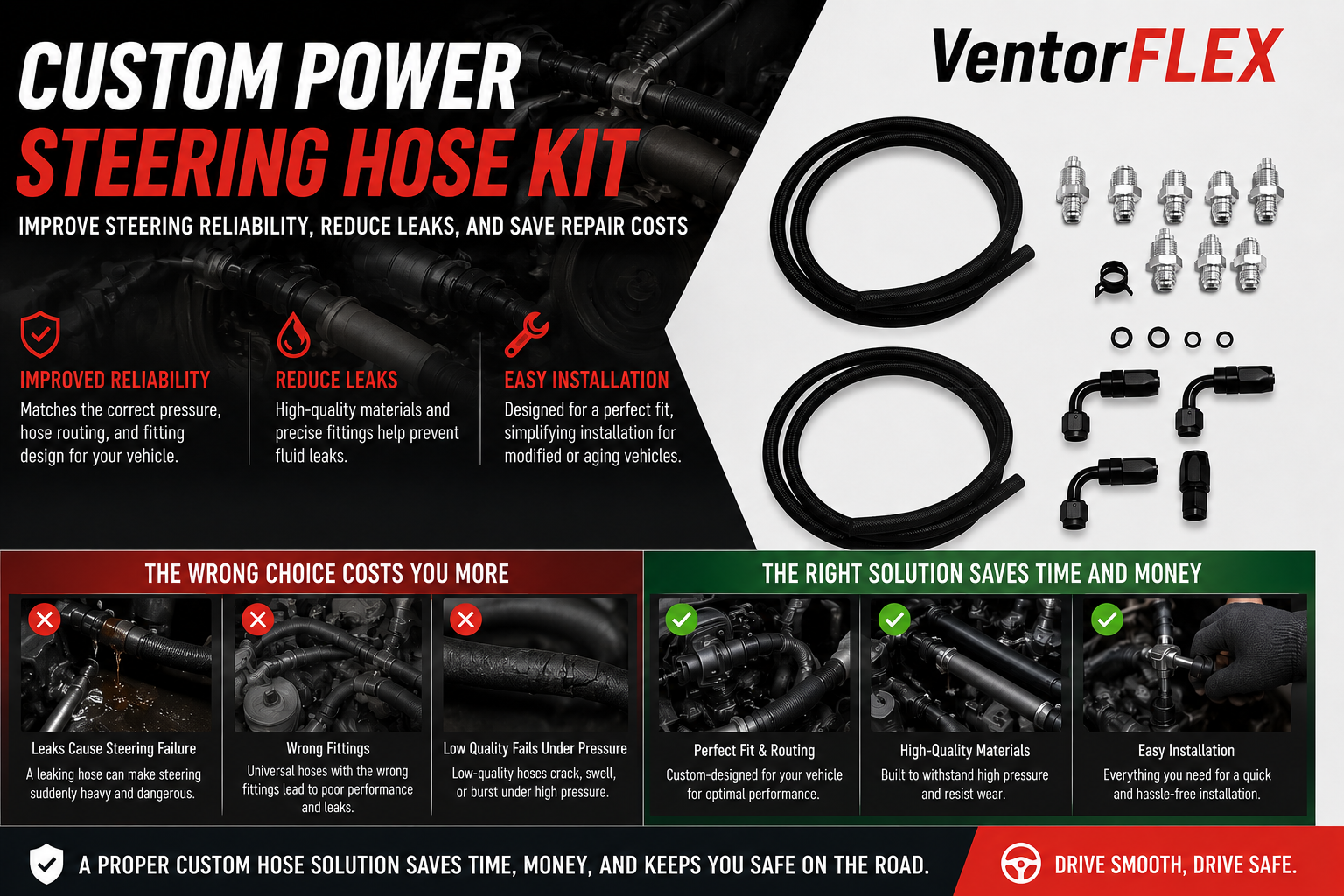
A custom power steering hose kit improves steering reliability by matching the correct pressure, hose routing, and fitting design for the vehicle. It also helps reduce leaks, improve durability, and simplify installation for modified or aging vehicles.
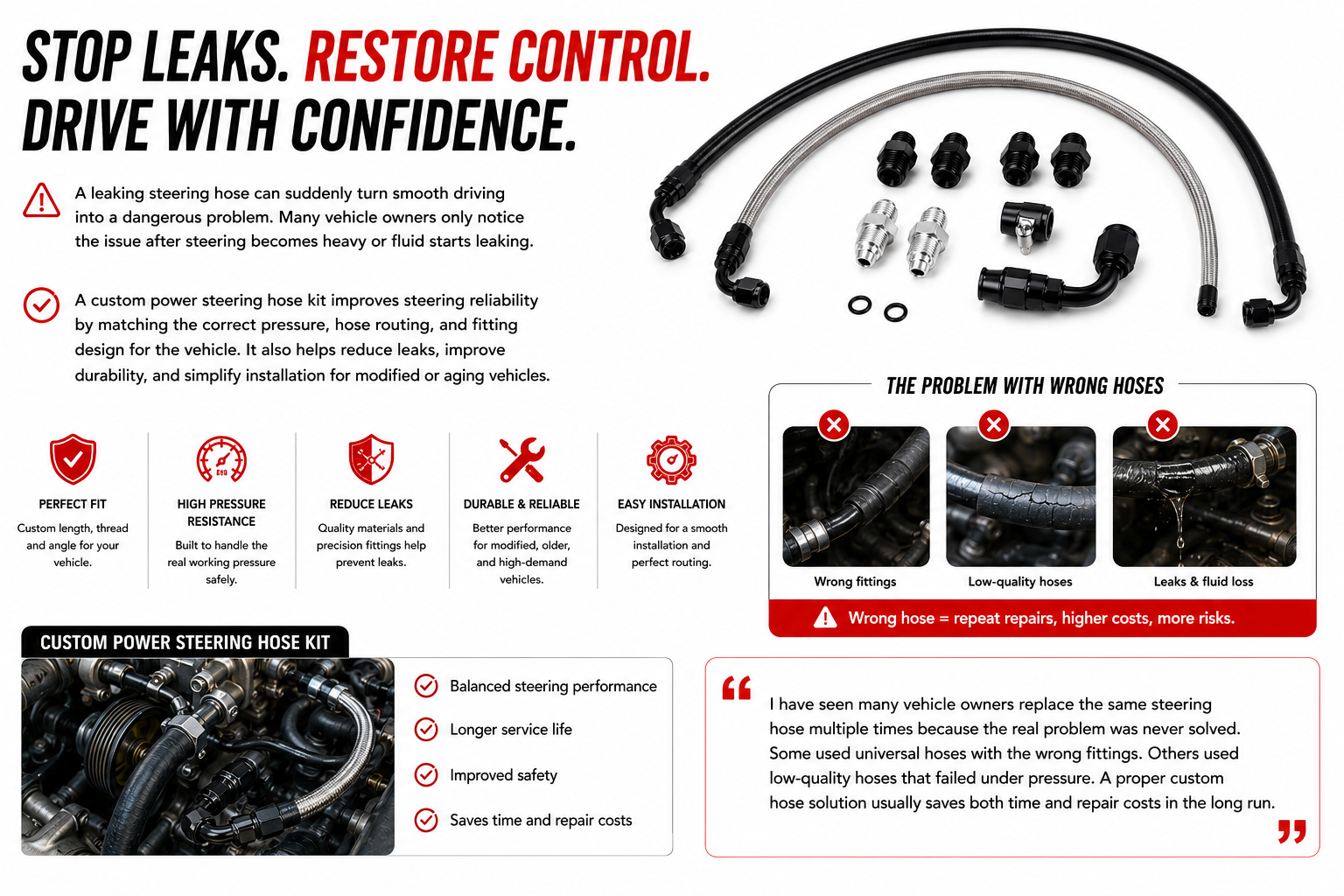
I have seen many vehicle owners replace the same steering hose multiple times because the real problem was never solved. Some used universal hoses with the wrong fittings. Others used low-quality hoses that failed under pressure. A proper custom hose solution usually saves both time and repair costs in the long run.
Why Do Power Steering Hoses Leak So Often?
Many drivers ignore small steering fluid leaks at first. After some time, the hose may suddenly burst under pressure and create a much bigger repair problem.
Power steering hoses usually leak because of heat, vibration, poor crimping quality, aging rubber, or incorrect hose routing. High hydraulic pressure slowly damages weak areas near fittings and crimp connections.1
Common Leak Locations
Most steering hose leaks happen in predictable areas. Understanding these weak points helps prevent repeated failures.
| Leak Area | Common Cause | Risk Level |
|---|---|---|
| Crimp Area | Poor crimp diameter | High |
| Fitting Thread | Loose sealing | Medium |
| Rubber Section | Heat aging | High |
| Hose Bend | Excessive twisting | Medium |
Why Crimping Quality Matters
I once worked with a repair shop that kept replacing steering hoses every few months. The problem was not the vehicle. The real issue was unstable crimping quality from a low-cost supplier.
A proper hydraulic crimping process controls:
- Crimp diameter
- Hose compression
- Fitting retention
- Pressure sealing
Even a small crimping error can cause leakage under high pressure.2
Heat and Vibration Damage
Engine compartments create constant vibration and high temperatures.3 Rubber hoses slowly harden over time. Once flexibility decreases, cracks usually appear near bends or fittings.4
Protective sleeves and proper hose routing can greatly improve service life.5
OEM Hose or Custom Hose: Which One Is Better?
Many old vehicles no longer have available OEM steering hoses. Some modified vehicles also cannot use factory hose routing.
OEM hoses work well for standard vehicles, but custom power steering hoses provide better flexibility for modified cars, discontinued models, and high-performance applications.
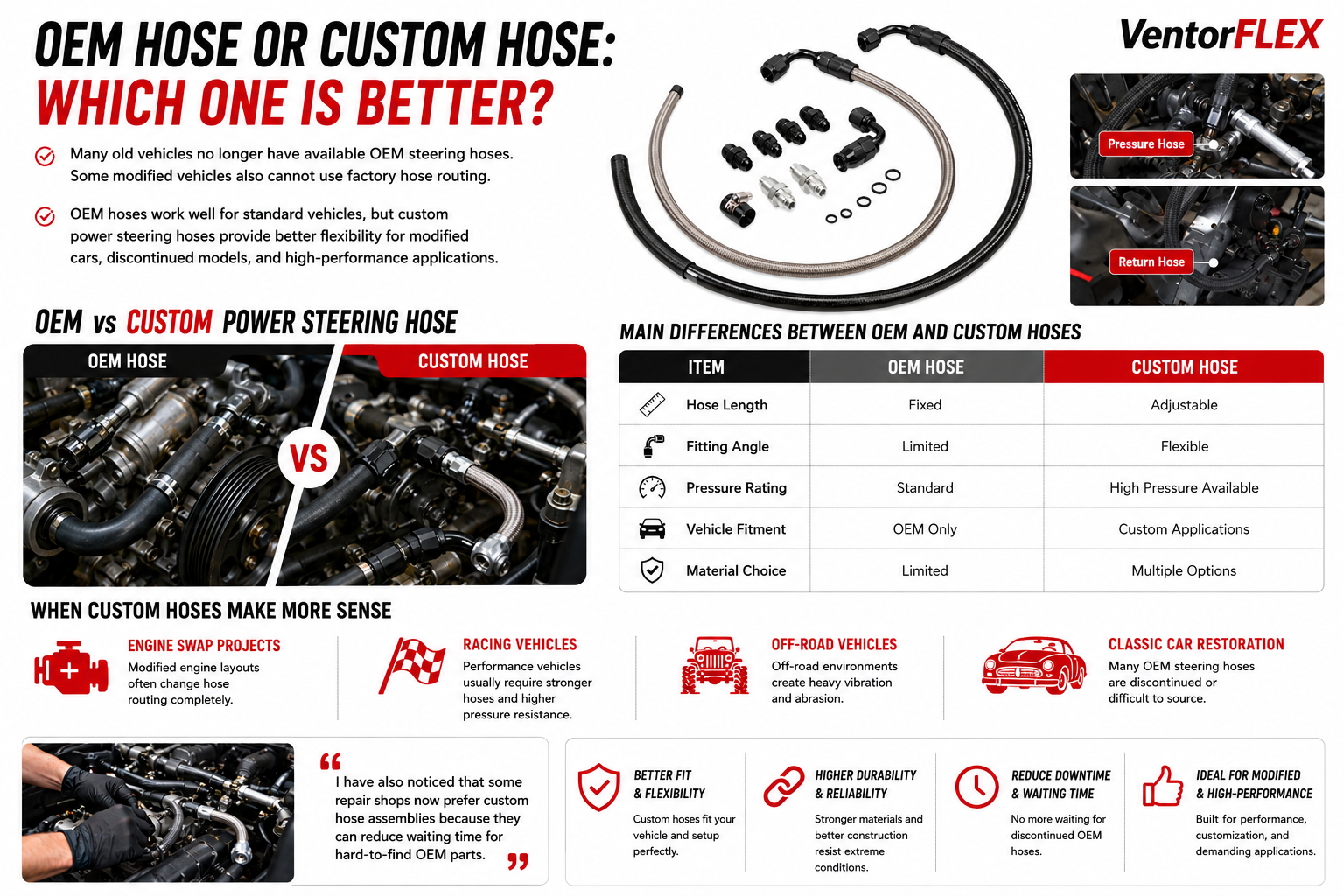
Main Differences Between OEM and Custom Hoses
| Item | OEM Hose | Custom Hose |
|---|---|---|
| Hose Length | Fixed | Adjustable |
| Fitting Angle | Limited | Flexible |
| Pressure Rating | Standard | High Pressure Available |
| Vehicle Fitment | OEM Only | Custom Applications |
| Material Choice | Limited | Multiple Options |
When Custom Hoses Make More Sense
Custom hoses are especially useful for:
Engine Swap Projects
Modified engine layouts often change hose routing completely.
Racing Vehicles
Performance vehicles usually require stronger hoses and higher pressure resistance.6
Off-Road Vehicles
Off-road environments create heavy vibration and abrasion.
Classic Car Restoration
Many OEM steering hoses are discontinued or difficult to source.
I have also noticed that some repair shops now prefer custom hose assemblies because they can reduce waiting time for hard-to-find OEM parts.
What Materials Are Best for Power Steering Hoses?
Many steering hose failures happen because the hose material does not match the actual working environment.
The best power steering hose material depends on pressure, temperature, installation space, and durability requirements. Rubber hoses are common, while braided and PTFE hoses provide higher performance.
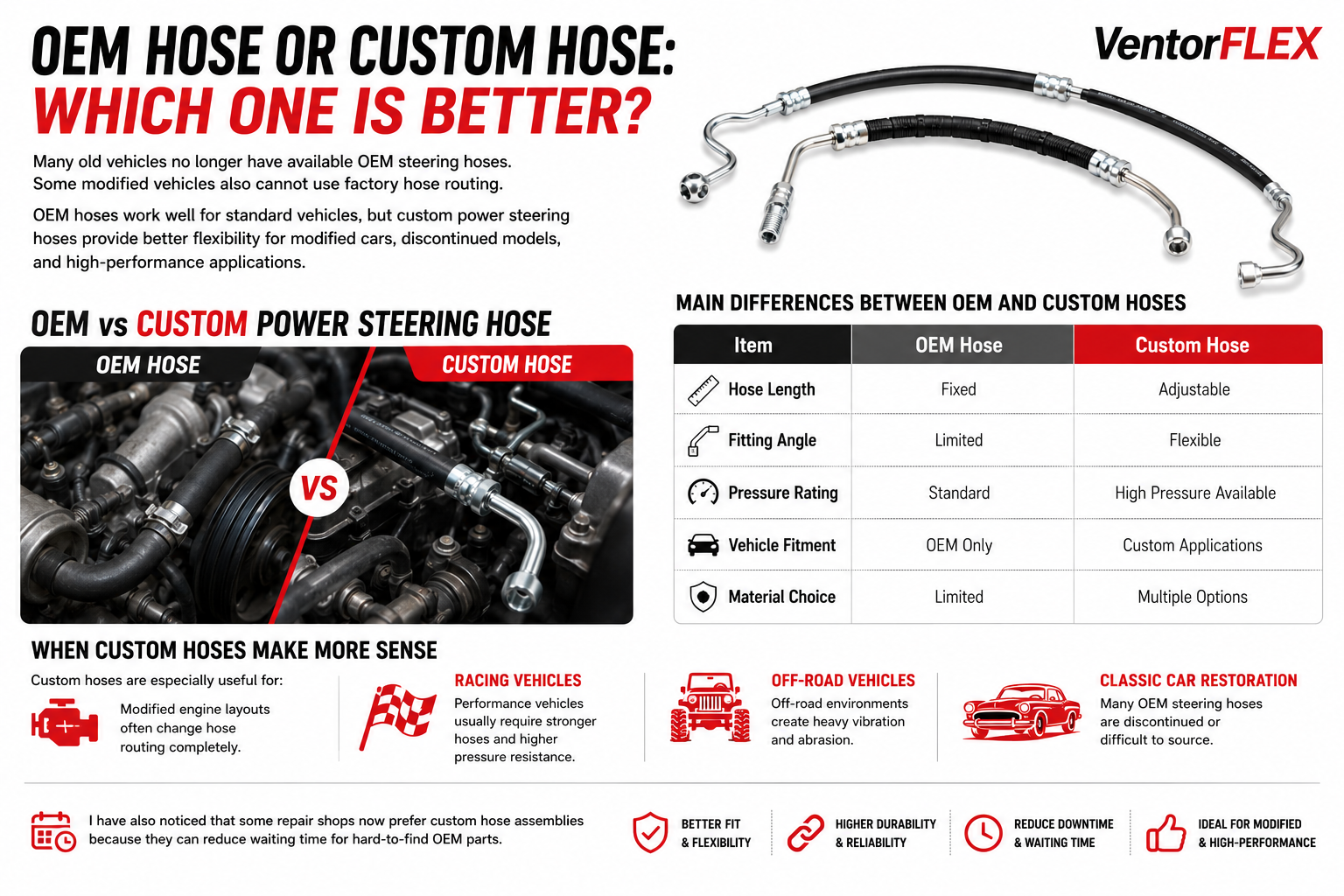
Synthetic Rubber Hose
Synthetic rubber hoses are widely used for daily driving.
Advantages:
- Flexible
- Cost effective
- Easy installation
Disadvantages:
- Lower heat resistance
- Shorter service life in harsh conditions
Steel Braided Hose
Braided hoses are popular in racing and modified vehicles.
Advantages:
- Better pressure resistance
- Improved abrasion protection
- Stronger outer reinforcement
Disadvantages:
- Higher cost
- Less flexibility in tight spaces
PTFE Steering Hose
PTFE hoses are designed for extreme conditions.7
Advantages:
- Excellent heat resistance
- Chemical resistance
- Long service life
PTFE hoses are commonly used in high-temperature engine bays.
Material Comparison Table
| Hose Material | Heat Resistance | Pressure Resistance | Flexibility |
|---|---|---|---|
| Rubber | Medium | Medium | High |
| Braided Hose | High | High | Medium |
| PTFE | Very High | Very High | Medium |
I usually suggest checking the real working environment before selecting hose material. Many failures happen because people only focus on price.
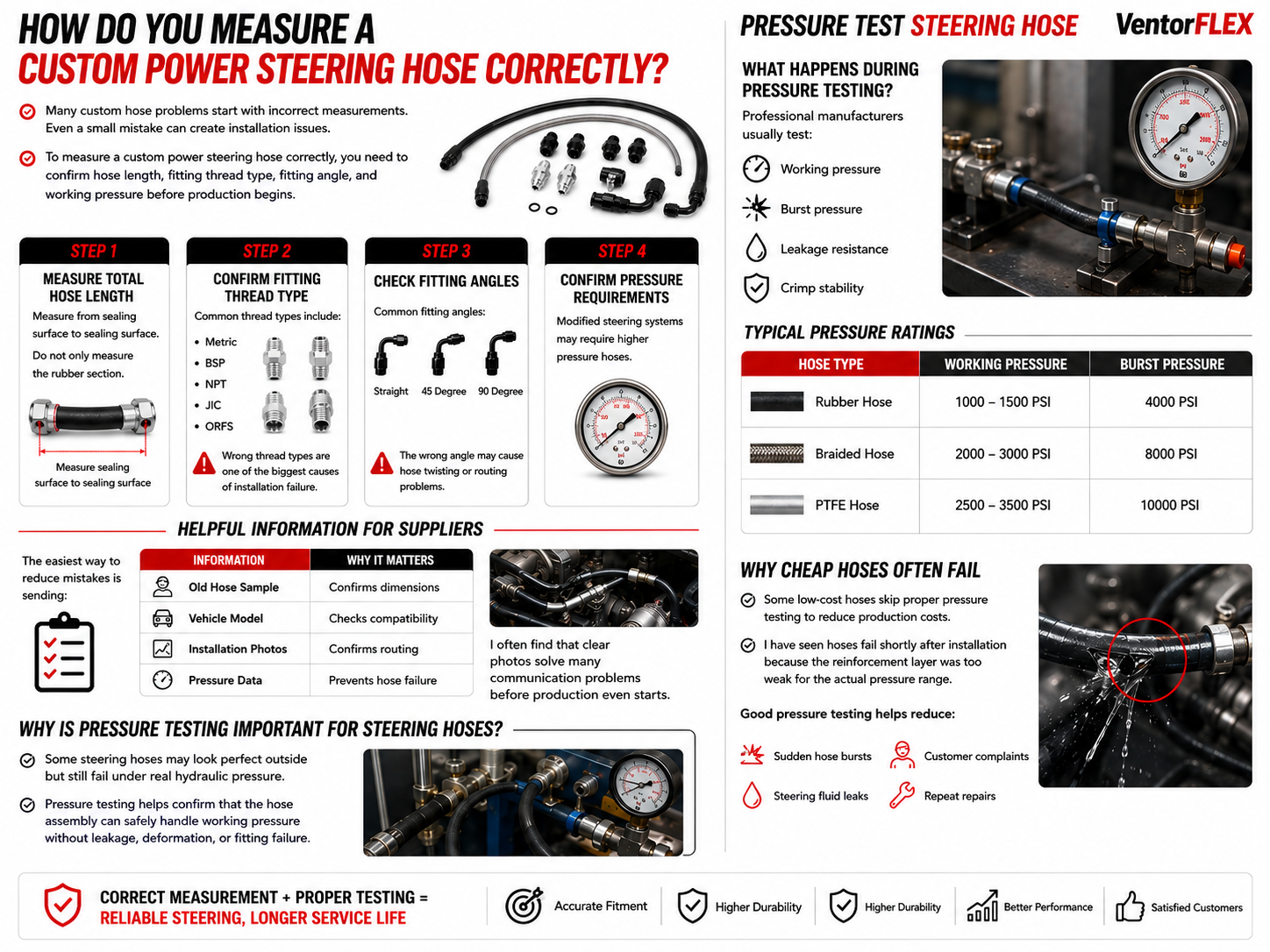
How Do You Measure a Custom Power Steering Hose Correctly?
Many custom hose problems start with incorrect measurements. Even a small mistake can create installation issues.
To measure a custom power steering hose correctly, you need to confirm hose length, fitting thread type, fitting angle, and working pressure before production begins.
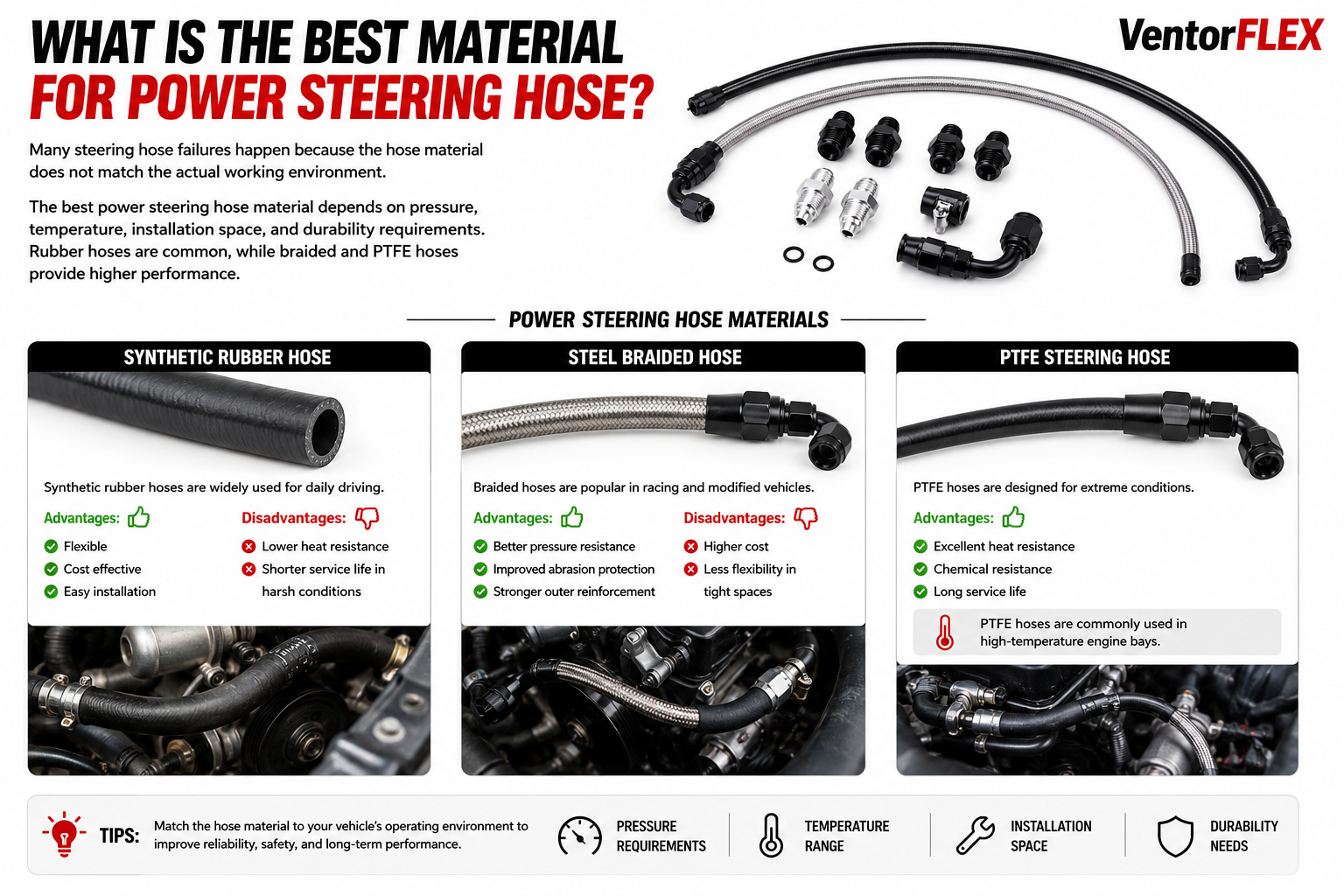
Step 1: Measure Total Hose Length
Measure from sealing surface to sealing surface.
Do not only measure the rubber section.
Step 2: Confirm Fitting Thread Type
Common thread types include:
- Metric
- BSP
- NPT
- JIC
- ORFS
Wrong thread types are one of the biggest causes of installation failure.8
Step 3: Check Fitting Angles
Common fitting angles:
- Straight
- 45 Degree
- 90 Degree
The wrong angle may cause hose twisting or routing problems.9
Step 4: Confirm Pressure Requirements
Modified steering systems may require higher pressure hoses.
Helpful Information for Suppliers
The easiest way to reduce mistakes is sending:
| Information | Why It Matters |
|---|---|
| Old Hose Sample | Confirms dimensions |
| Vehicle Model | Checks compatibility |
| Installation Photos | Confirms routing |
| Pressure Data | Prevents hose failure |
I often find that clear photos solve many communication problems before production even starts.
Why Is Pressure Testing Important for Steering Hoses?
Some steering hoses may look perfect outside but still fail under real hydraulic pressure.
Pressure testing helps confirm that the hose assembly can safely handle working pressure without leakage, deformation, or fitting failure.
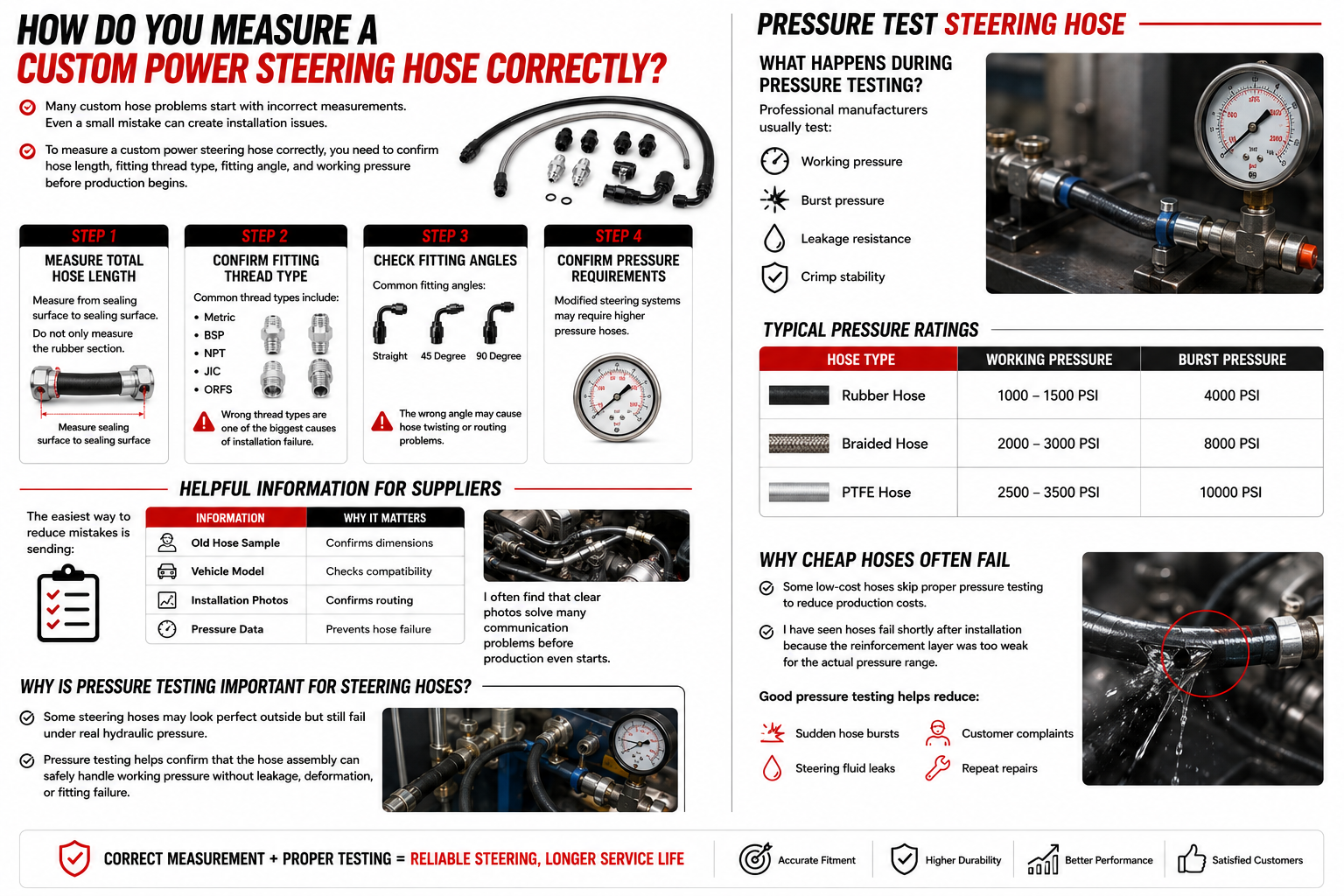
What Happens During Pressure Testing?
Professional manufacturers usually test:
- Working pressure
- Burst pressure
- Leakage resistance
- Crimp stability
Typical Pressure Ratings
| Hose Type | Working Pressure | Burst Pressure |
|---|---|---|
| [Rubber Hose | 1000-1500 PSI | 4000 PSI](https://dlnr.hawaii.gov/mk/files/2017/01/Freitas-S-18-a.pdf)%%%FOOTNOTE_REF_10%%% |
| [Braided Hose | 2000-3000 PSI | 8000 PSI](https://www.royalbrassandhose.com/blog/hydraulics/hydraulic-hose-pressure-guide-from-high-to-low-pressure)%%%FOOTNOTE_REF_11%%% |
| [PTFE Hose | 2500-3500 PSI | 10000 PSI](https://hoseflex.com/wp-content/uploads/2023/06/01.-PTFE-Hose.pdf)%%%FOOTNOTE_REF_12%%% |
Why Cheap Hoses Often Fail
Some low-cost hoses skip proper pressure testing to reduce production costs.
I have seen hoses fail shortly after installation because the reinforcement layer was too weak for the actual pressure range.
Good pressure testing helps reduce:
- Sudden hose bursts
- Steering fluid leaks
- Customer complaints
- Repeat repairs
Conclusion
A reliable custom power steering hose kit improves durability, reduces leaks, and helps vehicles perform more safely under real driving conditions.
<!--[googlesitekit-end-of-content]-->
"[PDF] of 3 IK1000003 - Power Steering Diagnostics Flow / Pressure Specs ...", https://static.nhtsa.gov/odi/tsbs/2013/MC-10138823-9999.pdf. Hydraulic hose failures commonly occur at crimp connections and fittings where stress concentration and cyclic pressure loading create fatigue conditions that propagate cracks in elastomeric materials and compromise seal integrity. Evidence role: mechanism; source type: research. Supports: the mechanical failure modes of hydraulic hoses under pressure. Scope note: This describes general hydraulic hose failure mechanisms rather than power steering systems specifically ↩
"[PDF] Introduction to Hydraulic Hose and Fittings", https://dlnr.hawaii.gov/mk/files/2017/01/Freitas-S-18-a.pdf. Industry standards specify crimp diameter tolerances within 0.1-0.3mm for hydraulic hose assemblies, as deviations compromise the interference fit between fitting and hose reinforcement, reducing seal effectiveness under pressure cycling. Evidence role: expert_consensus; source type: institution. Supports: the relationship between crimping precision and hydraulic seal performance. Scope note: This references general hydraulic fitting standards rather than power steering applications specifically ↩
"[PDF] CFD ANALYSIS OF THE UNDER HOOD OF A CAR FOR ...", https://open.clemson.edu/cgi/viewcontent.cgi?article=2183&context=all_theses. Automotive underhood environments typically expose components to temperatures ranging from ambient to 120-150°C near engine surfaces, combined with multi-axis vibration from engine operation and road conditions. Evidence role: general_support; source type: education. Supports: typical thermal and vibration conditions in automotive engine compartments. ↩
"Molecular Pathways for Polymer Degradation during Conventional ...", https://pmc.ncbi.nlm.nih.gov/articles/PMC10004996/. Elastomeric materials undergo thermal-oxidative degradation through chain scission and crosslinking reactions that reduce molecular mobility, increasing hardness and brittleness, with stress concentration at geometric discontinuities promoting crack initiation. Evidence role: mechanism; source type: research. Supports: the chemical and physical processes causing rubber hardening and cracking. ↩
"Hose Protector Sleeve 7.5m Nylon Abrasion Resistant Flame ...", https://www.amazon.com/Protector-Resistant-Retardant-hydraulic-Protection/dp/B09CCQTY46. Protective sleeves reduce abrasion damage and thermal exposure to hydraulic hoses, while routing that minimizes bend radius stress and vibration contact points extends service life by reducing fatigue accumulation. Evidence role: general_support; source type: research. Supports: the protective effect of sleeves and routing on hose durability. Scope note: This describes general protective mechanisms without specific quantitative service life data ↩
"[PDF] of 3 IK1000003 - Power Steering Diagnostics Flow / Pressure Specs ...", https://static.nhtsa.gov/odi/tsbs/2013/MC-10138823-9999.pdf. Performance and racing vehicle power steering systems may operate at pressures 20-50% higher than standard passenger vehicle systems to provide increased steering assist during high-load cornering conditions. Evidence role: statistic; source type: education. Supports: the higher pressure requirements in performance vehicle steering systems. Scope note: Specific pressure values vary widely by vehicle type and steering system design ↩
"Polytetrafluoroethylene - Wikipedia", https://en.wikipedia.org/wiki/Polytetrafluoroethylene. Polytetrafluoroethylene (PTFE) exhibits exceptional chemical inertness, thermal stability across -200°C to +260°C, and low friction coefficient due to its fluorinated polymer structure, making it suitable for demanding fluid handling applications. Evidence role: definition; source type: encyclopedia. Supports: the material properties of PTFE that enable extreme condition performance. ↩
"A guide to identifying the cause of your hose failure - HoseMate", https://hosemate.com.au/blogs/blog/a-guide-to-identifying-the-cause-of-your-hose-failure. Thread incompatibility represents a significant portion of hydraulic fitting installation failures, as mixing thread standards (metric, NPT, BSP, JIC) prevents proper sealing and can cause cross-threading damage during assembly. Evidence role: expert_consensus; source type: research. Supports: the prevalence of thread incompatibility in hydraulic fitting failures. Scope note: This addresses general hydraulic fitting issues rather than specifically quantifying power steering hose failures ↩
"An Effective Way to Identify Hydraulic Fitting Orientation - Parker Blog", https://blog.parker.com/us/en/unCategorized/an-effective-way-to-identify-hydraulic-fitting-orientation-en.html. Hydraulic hose assemblies require proper fitting orientation to avoid torsional stress during installation, as misaligned angles force the hose into twisted configurations that accelerate fatigue failure and may prevent proper routing clearances. Evidence role: mechanism; source type: institution. Supports: how fitting angles affect hose installation and stress distribution. ↩
"[PDF] Introduction to Hydraulic Hose and Fittings", https://dlnr.hawaii.gov/mk/files/2017/01/Freitas-S-18-a.pdf. Automotive power steering hoses conforming to SAE J188 standards typically specify working pressures in the 1000-2000 PSI range with minimum burst pressure requirements of 4-5 times working pressure, though specific ratings vary by hose construction and application. Evidence role: statistic; source type: institution. Supports: typical pressure ratings for automotive power steering hoses. Scope note: Standard specifications provide ranges rather than exact values, and actual ratings depend on specific hose design ↩
"Hydraulic Hose Pressure Guide: From High to Low Pressure", https://www.royalbrassandhose.com/blog/hydraulics/hydraulic-hose-pressure-guide-from-high-to-low-pressure. Steel-braided hydraulic hoses such as SAE 100R16 types achieve working pressures of 2000-5000 PSI depending on size and construction, with burst pressures typically specified at 4:1 safety ratios, providing enhanced pressure capacity over standard rubber hoses. Evidence role: statistic; source type: institution. Supports: pressure ratings for braided reinforced hydraulic hoses. Scope note: Specific pressure ratings vary significantly based on hose diameter, number of braids, and manufacturer specifications ↩
"[PDF] PTFE HOSE - Pacific Hoseflex", https://hoseflex.com/wp-content/uploads/2023/06/01.-PTFE-Hose.pdf. PTFE-lined hydraulic hoses with stainless steel braiding (such as SAE 100R14 types) achieve working pressures from 1500-5000 PSI depending on size and reinforcement, with burst pressures meeting 4:1 minimum safety factors, offering superior pressure capacity combined with chemical and thermal resistance. Evidence role: statistic; source type: institution. Supports: pressure capabilities of PTFE hydraulic hoses. Scope note: Pressure ratings vary widely based on hose diameter, reinforcement layers, and specific construction, making these generalized values approximate ↩