Your car's AC stopped working on the hottest day. You suspect a hose leak but don't know where to start looking.
AC hose leaks can be found using UV dye detection, soap bubble tests, or electronic leak detectors. Most minor leaks can be repaired with proper sealants or fitting replacements, but severely damaged hoses need complete replacement.

I've been in the automotive AC business for over two decades. During my early days at a small hose factory, I learned that finding and fixing AC leaks is both an art and a science. Today, I'll share the proven methods I've developed to help you tackle this common problem.
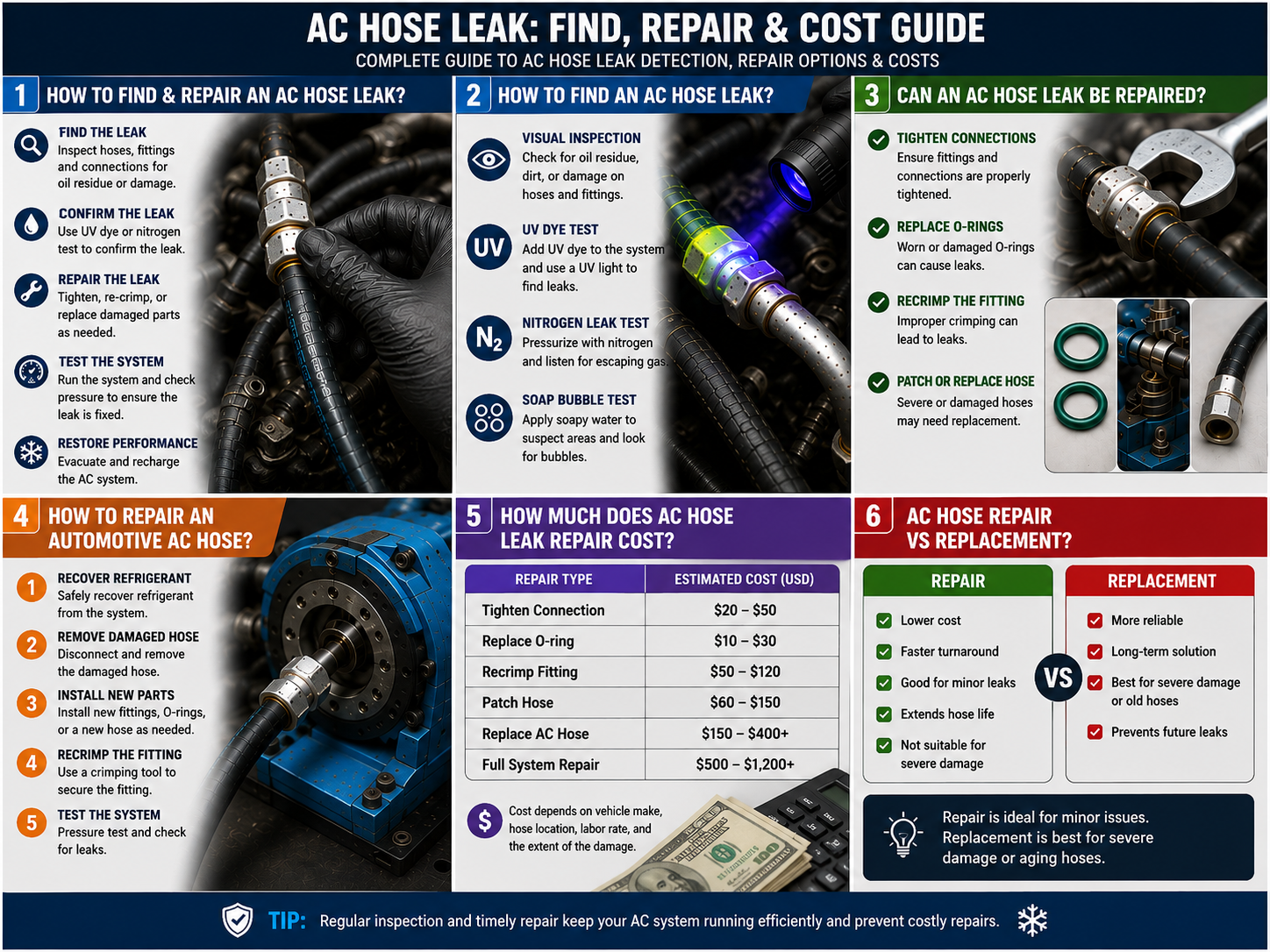
How to Find an AC Hose Leak?
AC leaks are sneaky. They hide in the most unexpected places and cause major headaches for car owners.
Use UV dye injection into the AC system, then inspect with a UV light after running the system for 15-20 minutes1. Look for bright fluorescent traces along hose connections, crimped areas, and rubber sections.
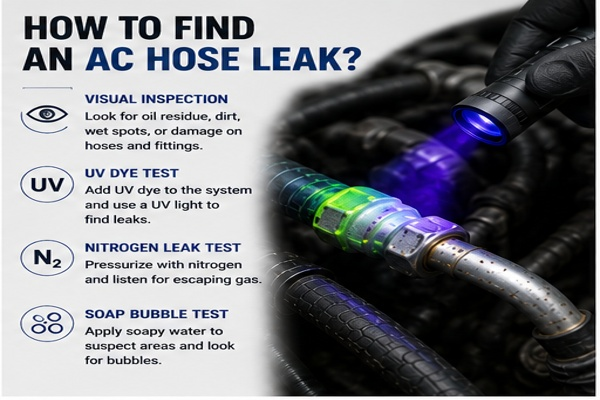
Finding AC hose leaks requires systematic inspection. I always start with visual examination of all visible hoses. Look for oil stains, corrosion, or wet spots around connections. These are telltale signs of refrigerant leakage.
The UV dye method is my go-to technique. Inject the dye into the low-pressure port of your AC system. Run the AC for 15-20 minutes to circulate the dye throughout the system. Then use a UV flashlight to inspect all hose connections and surfaces. The dye will glow bright yellow-green at leak points.
For smaller leaks, I use electronic leak detectors. These devices sense refrigerant molecules in the air. Move the probe slowly along each hose section, paying special attention to crimped areas and fittings. A steady beep or alarm indicates a leak location.
| Detection Method | Cost Range | Accuracy | Time Required |
|---|---|---|---|
| UV Dye | $15-30 | High | 30-45 minutes |
| Electronic Detector | $50-200 | Very High | 15-30 minutes |
| Soap Bubble Test | $5-10 | Medium | 45-60 minutes |
| Visual Inspection | Free | Low | 10-15 minutes |
How can an AC Hose Leak Be Repaired?
Many people think AC hose leaks mean expensive replacements. This isn't always true based on my experience.
Small leaks at fittings and connections can often be repaired using AC-specific sealants or by replacing O-rings and gaskets. However, cracks in the hose body or severely corroded fittings require complete hose replacement.
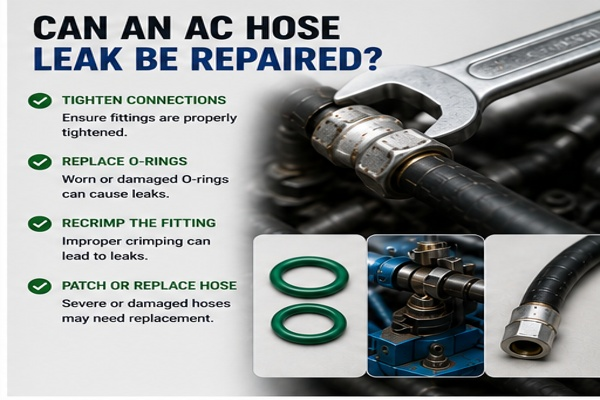
The repairability depends entirely on leak location and severity. I've successfully repaired countless hoses over the years. Fitting leaks are usually the easiest fixes. Simply replace the O-ring or gasket at the connection point.
For minor rubber hose cracks, specialized AC sealants can provide temporary solutions. However, I must warn you - these are band-aid fixes. The repair might last months or years, but eventually the leak will return.
Crimped connections present unique challenges. If the crimp is loose, you cannot re-crimp it effectively. The metal fitting loses its grip on the hose interior. In my factory days, we learned that once a crimp fails, replacement is the only reliable solution2.
Age matters significantly. Hoses older than 8-10 years often have multiple weak points3. Fixing one leak frequently leads to another appearing within months. I tell my clients to consider complete replacement for aging systems.
| Leak Type | Repair Success Rate | Expected Lifespan | Cost vs Replacement |
|---|---|---|---|
| Fitting O-ring | 95% | 3-5 years | 10-15% |
| Small rubber crack | 60% | 6-12 months | 20-30% |
| Crimped connection | 25% | 2-6 months | 40-50% |
| Large hose damage | 5% | 1-3 months | 80-90% |
How to Repair an Automotive AC Hose?
Repairing AC hoses requires specific tools and techniques. Rushing this process leads to repeated failures.
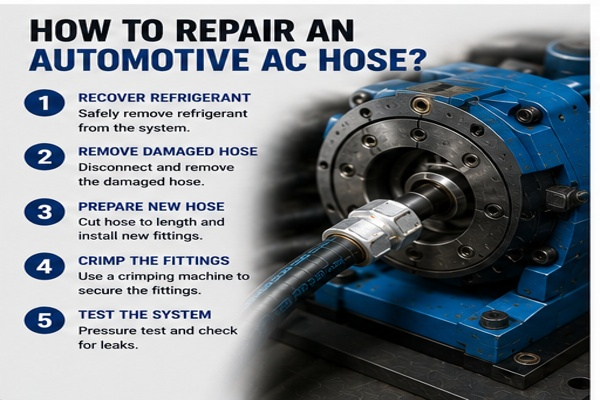
Evacuate the system, remove the damaged hose, replace worn O-rings and gaskets, apply thread sealant to fittings, reinstall with proper torque specifications, then vacuum and recharge the system.
Safety comes first in any AC repair. Always wear safety glasses and gloves. Refrigerant can cause severe frostbite if it contacts skin4. I learned this lesson painfully during my early career.
Start by fully evacuating the AC system using a recovery machine. Never release refrigerant into the atmosphere - it's illegal and harmful to the environment5. Remove the battery's negative terminal to prevent accidental compressor engagement.
Disconnect the leaking hose carefully. Note the orientation and routing before removal. Take photos if necessary. Clean all fitting threads with brake cleaner or degreaser. Inspect threads for damage or corrosion.
Replace all O-rings and gaskets even if they look good. Old seals often appear fine but fail under pressure. I stock multiple O-ring sizes because automotive applications vary significantly. Use only AC-approved O-rings - standard rubber rings will fail quickly6.
Apply a thin layer of refrigerant oil to new O-rings before installation. This prevents damage during assembly. Thread liquid sealant onto male fittings, but avoid getting sealant on O-ring surfaces.
Torque fittings to manufacturer specifications. Over-tightening damages threads and under-tightening causes leaks. Most AC fittings require 15-25 ft-lbs of torque7, but always verify specifications.
After installation, vacuum the system for at least 30 minutes to remove air and moisture8. Then recharge with the correct refrigerant amount and test for leaks.
How Much Does AC Hose Leak Repair Cost?
Repair costs vary dramatically based on leak location and chosen repair method. Understanding these costs helps you make informed decisions.
Simple O-ring replacement costs $50-100 in labor plus $10-20 for parts. Complete hose replacement ranges from $150-400 depending on hose location and vehicle complexity.
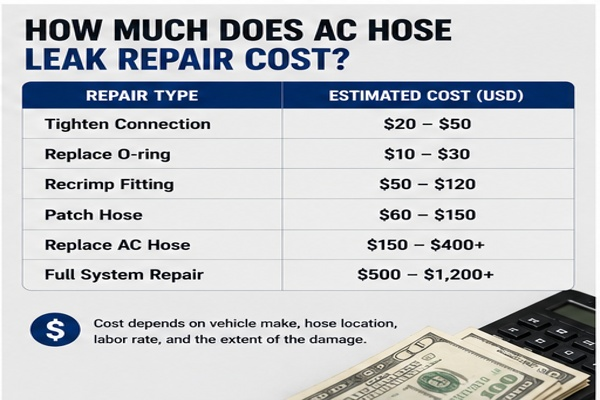
Labor represents the largest cost component in most repairs. AC systems require complete evacuation and recharging for any work. This process alone takes 1-2 hours even for simple repairs.
Parts costs depend heavily on your vehicle make and model. Common domestic vehicles have affordable hose options. European luxury cars often require expensive OEM parts. I've seen single hoses cost $200-500 for premium vehicles.
Location matters significantly for labor time. Easy-to-reach hoses near the firewall take minimal time. Hoses buried deep in the engine bay or routed through tight spaces can double labor costs.
Don't forget additional costs like refrigerant, vacuum pump rental, and leak detection. These extras add $30-80 to most repair bills. Some shops include these in quoted prices, others charge separately.
| Repair Type | Parts Cost | Labor Cost | Total Range |
|---|---|---|---|
| O-ring replacement | $10-25 | $80-120 | $90-145 |
| Minor hose patch | $15-35 | $100-150 | $115-185 |
| Single hose replacement | $50-200 | $120-200 | $170-400 |
| Multiple hose replacement | $150-500 | $200-400 | $350-900 |
AC Hose Repair vs Replacement?
This decision impacts both your wallet and long-term reliability. I guide customers through this choice daily.
Choose repair for new hoses with minor fitting leaks or single small cracks. Choose replacement for hoses over 8 years old, multiple leak points, or when repair costs exceed 60% of replacement cost.
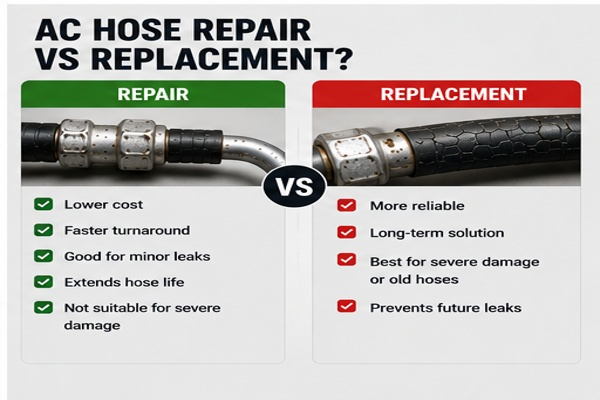
Age is the primary factor in my recommendation process. Hoses under 5 years old usually respond well to repairs if the damage is localized. The rubber remains flexible and other connection points stay reliable.
Older hoses present different challenges. Rubber compounds deteriorate over time, becoming brittle and prone to additional failures9. I've seen customers repair one leak only to develop two more within months.
Multiple leak points always indicate systemic failure. The entire hose has reached end-of-life. Attempting repairs on multiple points rarely succeeds long-term and costs approach replacement anyway.
Consider your vehicle's overall condition and value. For high-mileage vehicles nearing replacement, temporary repairs might make sense. For newer cars you plan to keep, invest in proper replacement for reliability.
Environmental factors matter too. Vehicles in harsh climates with extreme temperatures or road salt exposure age hoses faster10. These conditions accelerate rubber deterioration and promote fitting corrosion.
System contamination sometimes forces replacement decisions11. If the AC system contains moisture or debris, new hoses prevent continued damage to expensive components like the compressor or expansion valve.
| Decision Factor | Repair | Replace |
|---|---|---|
| Hose age | <5 years | >8 years |
| Leak points | Single | Multiple |
| Repair cost | <40% replacement | >60% replacement |
| Vehicle value | Low | High |
| Expected service life | 1-2 years | 5-8 years |
Finding and repairing AC hose leaks requires patience and proper technique, but most car owners can handle basic repairs with the right guidance and tools.
<!--[googlesitekit-end-of-content]-->
"How Fluorescent Dyes Benefit Leak Detection in Air Conditioning ...", https://spectroline.com/how-fluorescent-dyes-benefit-leak-detection-in-air-conditioning-refrigeration-systems/. Automotive service training materials typically recommend 15-30 minutes of system operation to ensure adequate UV dye circulation throughout all AC components, though exact timing may vary based on system size and ambient temperature. Evidence role: general_support; source type: education. Supports: recommended circulation time for UV dye in automotive AC systems during leak detection procedures. Scope note: The cited range is broader than the specific 15-20 minute window stated in the article ↩
"[PDF] NASA-STD-8739.4A PDF", https://s3vi.ndc.nasa.gov/ssri-kb/static/resources/nasa-std-8739.4a.pdf. Industry standards for hydraulic and refrigerant hose assemblies specify that crimped connections are permanent joints designed for single-use installation, as the crimping process permanently deforms both the ferrule and hose structure; attempting to re-crimp a failed connection cannot restore the original interference fit and seal integrity. Evidence role: mechanism; source type: education. Supports: technical limitations of re-crimping failed hydraulic connections. ↩
"How Often Replace Car Hoses? - StrongFlex", https://www.strongflex.com/how-often-replace-car-hoses/. Studies on elastomer aging in automotive applications indicate that rubber AC hoses experience progressive deterioration from heat cycling, ozone exposure, and refrigerant permeation, with significant degradation commonly observed after 7-12 years depending on operating conditions and material composition. Evidence role: general_support; source type: research. Supports: typical degradation timeline for rubber hoses in automotive AC applications. Scope note: Actual service life varies widely based on climate, usage patterns, and hose material quality ↩
"The diversity of wound presentation associated with freon contact ...", https://pubmed.ncbi.nlm.nih.gov/20661149/. Safety data sheets and OSHA guidelines indicate that automotive refrigerants such as R-134a and R-1234yf rapidly evaporate upon release, absorbing heat from surrounding tissues and potentially causing severe cold burns or frostbite upon direct skin contact, with injury severity depending on exposure duration and refrigerant quantity. Evidence role: mechanism; source type: government. Supports: mechanism and severity of refrigerant-induced cold injuries. ↩
"Regulatory Updates: Section 608 Refrigerant Management ... - EPA", https://www.epa.gov/section608/regulatory-updates-section-608-refrigerant-management-regulations. Under Section 608 of the Clean Air Act, the U.S. Environmental Protection Agency prohibits the intentional venting of refrigerants during servicing, maintenance, or disposal of air conditioning equipment, with violations subject to civil and criminal penalties. Evidence role: general_support; source type: government. Supports: federal prohibition on intentional refrigerant release in the United States. Scope note: Applies specifically to U.S. federal law; regulations vary by country ↩
"[PDF] Compatibility of R1234yf and R134a and Lubricants used in ...", https://docs.lib.purdue.edu/cgi/viewcontent.cgi?article=3057&context=iracc. Automotive AC systems require O-rings made from refrigerant-resistant elastomers such as HNBR (hydrogenated nitrile butadiene rubber) or specific EPDM formulations, as standard nitrile or general-purpose rubber O-rings swell, degrade, or lose sealing capability when exposed to modern refrigerants and PAG oils. Evidence role: mechanism; source type: education. Supports: material requirements for O-rings in refrigerant applications. ↩
"[PDF] Flare Fitting Tightening Torque - Clean Heat Connect", https://cleanheatconnect.ny.gov/assets/pdf/torque-stickers-by-manufacturer.pdf. Automotive service manuals and SAE guidelines indicate that AC line fittings typically require torque values between 12-30 ft-lbs depending on fitting size and type, with smaller fittings at the lower end and larger connections requiring higher torque to ensure proper seal compression without thread damage. Evidence role: general_support; source type: education. Supports: typical torque range for automotive AC system fittings. Scope note: Specific torque values vary significantly by fitting size, type, and manufacturer; always consult vehicle-specific service information ↩
"40 CFR Appendix C to Subpart B of Part 82 - SAE J2788 Standard ...", https://www.law.cornell.edu/cfr/text/40/appendix-C_to_subpart_B_of_part_82. Industry service procedures typically recommend evacuating automotive AC systems for 30-45 minutes at a vacuum level of 500 microns or lower to adequately remove air and moisture, though systems that have been open to atmosphere for extended periods may require longer evacuation times. Evidence role: general_support; source type: education. Supports: recommended vacuum duration for automotive AC system evacuation. Scope note: Required vacuum time depends on system size, ambient humidity, and how long the system was exposed to atmosphere ↩
"Thermal Oxidative Aging and Service Life Prediction of Commercial ...", https://pmc.ncbi.nlm.nih.gov/articles/PMC11085669/. Research on elastomer aging demonstrates that rubber compounds in automotive hoses undergo oxidative degradation, chain scission, and cross-linking changes from exposure to heat, ozone, and refrigerant permeation, resulting in progressive loss of flexibility, surface cracking, and reduced tensile strength over time. Evidence role: mechanism; source type: research. Supports: chemical and physical mechanisms of rubber degradation in automotive applications. ↩
"Road salt destroys cars faster than people realize : r/autorepair", https://www.reddit.com/r/autorepair/comments/1oixugy/road_salt_destroys_cars_faster_than_people_realize/. Studies on automotive component corrosion indicate that road salt exposure primarily accelerates degradation of metal fittings and brackets through chloride-induced corrosion rather than directly attacking rubber compounds, though the resulting corrosion products and moisture retention can indirectly compromise hose-to-fitting interfaces and accelerate overall assembly failure. Evidence role: mechanism; source type: research. Supports: effect of salt exposure on automotive hose and fitting degradation. Scope note: The primary degradation mechanism affects metal components rather than rubber hose material directly ↩
"40 CFR Part 82 Subpart B -- Servicing of Motor Vehicle Air ... - eCFR", https://www.ecfr.gov/current/title-40/chapter-I/subchapter-C/part-82/subpart-B. Automotive AC service guidelines recommend replacing hoses when systems contain significant moisture, metal particles, or compressor debris, as contaminated hoses can harbor particles in their internal corrugations and release them after flushing, potentially damaging the replacement compressor or expansion valve even after system cleaning procedures. Evidence role: general_support; source type: education. Supports: rationale for hose replacement in contaminated AC systems. ↩