
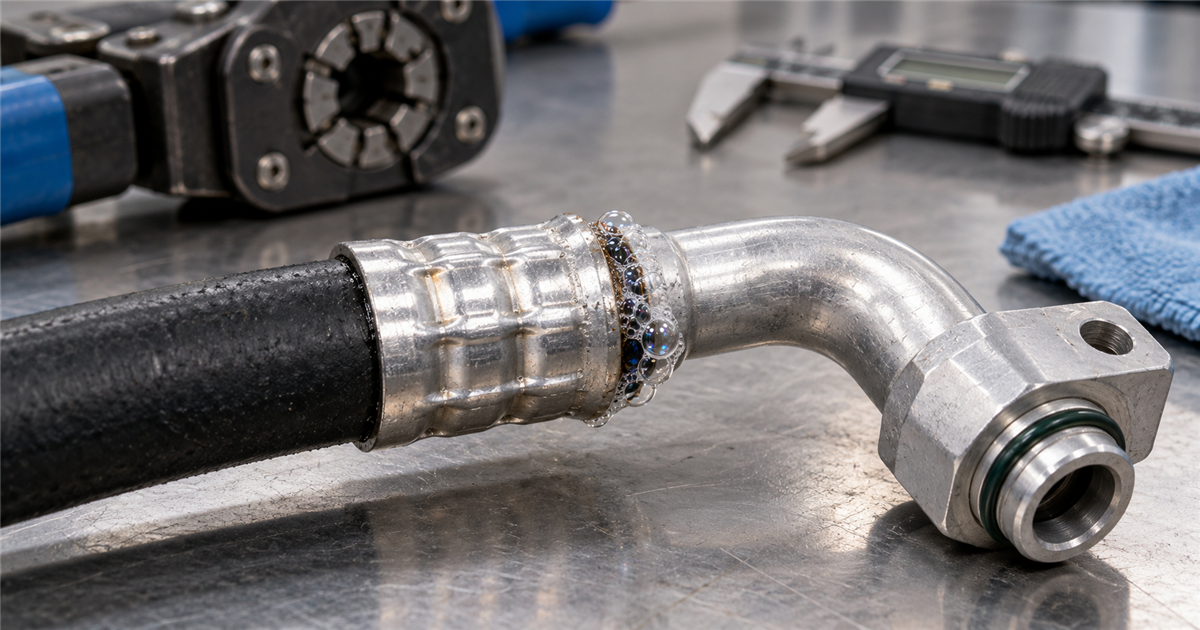
A car AC hose crimp leak is one of the most frustrating failures in refrigeration service work. You've followed the process, the crimp looks clean, and the system still loses pressure. The problem rarely appears at random — and that's actually good news, because it means the cause is traceable and preventable.
An AC hose leaking after crimping is almost always caused by a measurable process error or a component mismatch — not bad luck. The seven most common causes are: incorrect crimp diameter, wrong hose and fitting combination, incorrect ferrule size, over-crimping or under-crimping, hose damage during cutting or assembly, worn or incorrect crimping dies, and poor-quality components. Every one of these is preventable at the sourcing or setup stage.
Understanding why the leak happens changes how you fix it. The sections below break down each cause with the specific mechanism behind the failure — and what to check before the next assembly goes into service.
Why Can an AC Hose Still Leak After Crimping?
Crimping looks like a simple mechanical operation. You insert the hose, position the ferrule, and compress. But a leak-free AC hose assembly depends on several variables aligning at the same time: the right diameter, the right components, and calibrated machine settings. When any one of those variables is off, the seal fails.
A crimped joint creates a seal in two places: between the hose inner liner and the fitting barb, and between the ferrule outer surface and the hose outer cover.1 Both interfaces must be under the correct compression range. Too little, and refrigerant finds a path. Too much, and the liner deforms and creates its own leak path.
That two-sided seal is why a car AC hose crimp leak can look perfect on the outside and still fail under system pressure. The visible surface tells you almost nothing. What matters is what's happening at the inner liner — and the only reliable way to verify that is to measure the crimp diameter and pressure test the assembly.
From what we see in our QC process and in customer returns, the vast majority of crimp leaks trace back to one of the seven causes below.
Incorrect Crimp Diameter
Crimp diameter is the single most common root cause of an AC hose leaking after crimping. A fitting manufacturer specifies a target crimp diameter for a reason — it defines the exact compression range that seals the hose liner against the barb without damaging it.
If the crimp diameter is even 0.3–0.5 mm outside specification, the joint will leak or fail prematurely.2 This gap is invisible to the eye but measurable with calipers in under a minute.
Why This Happens More Than It Should
Most workshops and smaller production lines don't verify crimp diameter on every assembly. They set the machine once, then run production without rechecking. Die wear, different fitting lots, or a simple machine reset can shift the actual diameter without anyone noticing.
What to Check
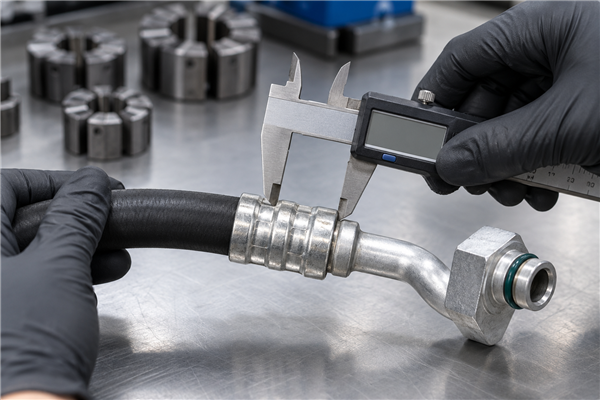
- Use a digital caliper to measure crimp diameter immediately after the first assembly of a new setup.
- Cross-reference the measured diameter against the fitting supplier's spec sheet — not a general table.
- Re-measure periodically during a production run, especially after every 200–300 crimps.
| Crimp Diameter Status | Likely Outcome |
|---|---|
| Within spec (±0.1 mm) | Reliable seal under pressure |
| 0.3–0.5 mm over spec | Over-compression, liner deformation, leak |
| 0.3–0.5 mm under spec | Insufficient compression, leak under pressure |
Wrong Hose and Fitting Combination
This cause shows up frequently when buyers source hoses from one supplier and fittings from another. Different manufacturers build to different dimensional tolerances. A hose that measures 13 mm inner diameter from one factory may have a slightly thicker wall than a 13 mm hose from a different factory. A fitting designed for one tolerance stack won't seal correctly against the other.
We've seen this repeatedly in customer returns. The buyer uses components that look compatible — same nominal size, same refrigerant type — but the hose liner never fully contacts the fitting barb because the fit is slightly loose before crimping even starts.
The Deeper Problem
Mixing sources hides the mismatch. Each component tests fine in isolation. The failure only appears under system pressure because the contact area between the liner and barb is below the minimum needed for a gas-tight seal.
What to Check
- Always confirm hose and fitting compatibility using the same manufacturer's pairing recommendation, not just nominal size matching.
- If mixing sources is unavoidable, request a sample assembly and pressure test it to at least 1.5× working pressure before committing to production volume.
- A single-source supplier who manufactures both hose and fittings eliminates this variable entirely — compatibility is built into the product design.
Incorrect Ferrule Size
The ferrule compresses the hose outer cover and transfers crimping force inward toward the fitting barb. If the ferrule inner diameter is too large for the hose, the crimp force is distributed unevenly and the inner liner never reaches the required compression. If it's too small, the hose deforms before crimping even begins.
Ferrule sizing sounds straightforward, but in practice it's one of the most common mix-ups in workshops that stock multiple hose sizes. A ferrule that looks right and slides onto the hose doesn't guarantee it's the correct part number for that specific hose-fitting combination.
What to Check
- Verify ferrule part number against the hose and fitting combination, not just hose OD.
- A correctly sized ferrule should slide onto the hose with light hand pressure — not fall off freely, not require force.
- If your supplier provides a crimping specification card, the correct ferrule part number should be listed alongside the target crimp diameter.
Over-Crimping or Under-Crimping
This is the cause that surprises most technicians. The assumption is that a tighter crimp is a better crimp. It isn't.
Under-crimping leaves insufficient compression between the liner and barb. Refrigerant leaks through the gap under operating pressure. This is the obvious failure mode.
Over-crimping is less intuitive. Excessive compression deforms the hose inner liner. The liner material — typically PTFE or rubber compound — is pushed into or past the fitting barb, disrupting the sealing surface geometry. The result is a leak path created by the crimping process itself.
How to Recognize Each
- Under-crimped assemblies often show leaks immediately on initial pressurization.
- Over-crimped assemblies may hold pressure initially but fail within hours or days as the deformed liner settles or cracks under thermal cycling.3
Both failures trace back to the same fix: calibrate the machine to the correct crimp diameter for the specific fitting, and verify with a caliper before running production.
Damaged Hose During Cutting or Assembly
A clean crimp cannot compensate for damage introduced before crimping begins. Two points in the assembly process are particularly high-risk.
During cutting: A dull or incorrect cutting tool can crush the hose end rather than cutting it cleanly. The crushed inner liner doesn't recover fully during assembly. The fitting barb inserts into a deformed bore, and the seal contact area is compromised from the start.
During fitting insertion: Forcing a fitting into the hose without adequate lubrication can score or tear the inner liner. We see this most often when technicians use incorrect lubricants — petroleum-based products that attack rubber-based hose liners — or skip lubrication entirely.
What to Check
- Use a sharp rotary hose cutter designed for refrigerant hose.4 Inspect the cut end before inserting the fitting — the bore should be round and undamaged.
- Use only refrigerant-compatible lubricant (typically a light coating of refrigerant oil) on the fitting barb during insertion.5
- The fitting should bottom out against the hose stop without requiring excessive force. Resistance beyond light pressure suggests the wrong size or a damaged hose end.
Worn or Incorrect Crimping Dies
Crimping dies transfer force from the machine to the ferrule. They are precision-machined components with a specific cavity diameter. Over time, repeated use wears the die cavity, and the actual crimp diameter drifts upward — the same machine settings produce a larger, under-compressed crimp.
Using dies designed for a different fitting series is a separate but equally common issue. Dies look similar across sizes and series. Without clear labeling, it's easy to grab the wrong set, especially in a workshop with multiple hose sizes in regular rotation.
What to Check
- Inspect dies visually for scoring, deformation, or visible wear on the cavity surface.
- Periodically measure crimp diameter on a known-good assembly to detect drift before it causes failures in production.
- Label and store dies by fitting series and size. Never assume a die that "looks right" is the correct one.
- In our production environment, we track die cycles and replace dies at defined intervals rather than waiting for a failure signal.
Poor-Quality Fittings, Ferrules, or Hose
Component quality is the foundation everything else rests on. A correctly calibrated machine running the right die with the right settings still cannot produce a reliable seal if the components themselves are out of tolerance.
In practice, quality problems in fittings and ferrules tend to appear as dimensional inconsistency across a batch — not as uniformly bad parts, but as parts where some are within spec and some are not. This makes batch failures unpredictable and difficult to diagnose without measuring components directly.
What to Check
- Request dimensional inspection reports or material certification documents from suppliers before placing production orders.
- Sample incoming batches and measure critical dimensions — fitting barb diameter, ferrule inner diameter, hose wall thickness — against the published spec.
- Treat unusually low pricing as a signal to verify quality, not a purchasing advantage.
How to Check an AC Hose Assembly After Crimping
Visual inspection after crimping tells you very little. The crimp may look uniform and clean while the inner seal is inadequate. Reliable verification requires two steps: crimp diameter measurement and pressure testing.
Step 1: Measure Crimp Diameter
Immediately after crimping, measure the ferrule outer diameter at the crimp zone using a digital caliper. Take measurements at two or three points around the circumference to confirm uniform compression.
Compare the measurement against the fitting manufacturer's specified crimp diameter — not a general reference table. A tolerance of ±0.1 mm from the target is a reasonable acceptance range for most automotive AC fittings.
If the measurement is outside tolerance, the assembly should be discarded. Re-crimping a ferrule that has already been compressed does not restore the original geometry and should not be used as a corrective action.
Step 2: Pressure Test
After dimensional verification, pressure test the assembly with dry nitrogen. The test pressure should exceed system working pressure — a common production benchmark is testing to 250–500 PSI and holding for a defined dwell time before checking for pressure drop.
Note: The specific test pressure we use in production will depend on the hose rating and application. Always test to at least 1.5× the rated working pressure of the assembly.6 Consult your fitting supplier's specification for the correct test parameters.
Apply leak detection solution to the crimp zone and fitting interfaces during the test.7 Any bubble formation indicates a leak that pressure gauge readings alone might miss.
How to Prevent Crimp Leaks in Batch Production
Preventing crimp leaks in a single assembly is a calibration problem. Preventing them across a production run of 500 or 5,000 assemblies is a process discipline problem.
What Factory-Side Prevention Actually Looks Like
Matched-set procurement. Sourcing hose, fittings, ferrules, and the crimping machine from a single manufacturer eliminates the dimensional tolerance stacking that comes from mixing suppliers. When all four components are designed to work together, compatibility is a given, not a gamble.
First-article verification. At the start of every production run and every time a die, hose lot, or fitting lot changes, crimp the first assembly and measure it before continuing. This catches setup errors before they affect hundreds of parts.
Periodic in-run spot checks. We perform crimp diameter checks at regular intervals during production — typically every 100–200 assemblies. This catches die wear or machine drift before the error accumulates. A spot check takes less than two minutes and prevents the kind of batch rejection that takes days to sort out.
Die lifecycle management. Dies have a finite service life.8 We track crimp counts per die set and replace them at defined intervals rather than waiting for measurements to go out of tolerance. The cost of a replacement die set is a fraction of the cost of a failed production batch.9
Incoming component inspection. For high-volume production, we sample-inspect incoming hose and fitting lots for critical dimensions before they enter production. Dimensional variation between lots from the same supplier is real10, and catching it before assembly is significantly less costly than catching it after.
The underlying logic here is straightforward: a crimp leak is a downstream signal of an upstream decision. The components you buy, how you store and manage dies, and whether you measure or assume — these decisions determine your reject rate before a single crimp is made.
Frequently Asked Questions
Why is my AC hose leaking at the crimp?
The most likely causes are an incorrect crimp diameter, a mismatch between the hose and fitting dimensions, or a worn die that has drifted out of calibration. Measure the crimp diameter with a caliper and compare it against the fitting manufacturer's specification. If it falls outside the target range, the assembly needs to be replaced.
Can an AC hose be crimped twice?
No. Once a ferrule has been compressed and the hose liner has deformed under crimping force, re-crimping cannot restore the original geometry. A second crimp will either over-compress the assembly or fail to add meaningful sealing force. The correct action is to replace the entire assembly with a new hose, fitting, and ferrule.
How tight should an AC hose crimp be?
"Tight" is the wrong measure. The correct measure is crimp diameter, expressed in millimeters, as specified by the fitting manufacturer for that specific hose and fitting combination. A crimp that is too tight is just as likely to cause a leak as one that is too loose — over-compression deforms the inner liner and disrupts the sealing surface.
Can the wrong die cause an AC hose leak?
Yes. Dies are sized to produce a specific crimp diameter for a specific fitting series. Using a die intended for a different fitting or a worn die with an enlarged cavity will produce a crimp diameter outside specification. The assembly may look correct visually but will fail under pressure.
How do manufacturers test AC hose assemblies for leaks?
Reliable manufacturers use two verification steps: crimp diameter measurement with a caliper against the fitting supplier's specification, and pressure testing with dry nitrogen at a defined test pressure — typically at least 1.5× the rated working pressure of the assembly. Both steps are necessary. Pressure testing alone cannot compensate for an incorrectly measured crimp, and a correct crimp diameter does not guarantee that the assembly is free from hose damage or component defects.
Conclusion
A car AC hose crimp leak is a predictable failure — not a random one. Every cause covered in this article, from incorrect crimp diameter to component quality issues, is detectable and preventable before the assembly ever reaches a vehicle. The key discipline is measurement over assumption: measure the crimp diameter, verify component compatibility, and pressure test before the system goes live.
If you are sourcing AC hose assemblies for a workshop, distribution network, or import business, the most reliable way to reduce crimp leak risk is to source matched components — hose, fittings, ferrules, and crimping machine — from a single manufacturer who designs them to work together. That is exactly what we offer.
Contact us to discuss your AC hose assembly requirements, or to request specifications for our hose, fittings, ferrules, and crimping machines as a matched set.
<!--[googlesitekit-end-of-content]-->
"Hose Ferrules - Grainger Industrial Supply", https://www.grainger.com/category/pipe-hose-tube-fittings/hose-hose-fittings-hose-reels/hose-fittings-couplings/hose-ferrules. Technical literature on hydraulic and refrigerant hose assemblies describes the dual-seal mechanism where compression occurs at both the inner liner-barb interface and the outer ferrule-cover interface, with both zones requiring specific compression ranges for leak-free operation. Evidence role: mechanism; source type: research. Supports: the dual-interface sealing mechanism in crimped hose assemblies. Scope note: While the mechanism is documented for industrial hose assemblies generally, specific compression tolerances vary by hose type, refrigerant compatibility, and fitting design. ↩
"Hydraulic Hose Crimp Specifications", https://www.kurthydraulics.com/support/crimp-specifications/. Industry testing standards for crimped hose assemblies establish that dimensional deviations in the sub-millimeter range can significantly impact seal integrity, with acceptable tolerance ranges typically specified by fitting manufacturers based on empirical pressure testing and field failure analysis. Evidence role: statistic; source type: research. Supports: the relationship between crimp diameter deviation and seal failure in hose assemblies. Scope note: The specific 0.3–0.5 mm threshold may vary depending on hose construction, fitting design, operating pressure, and refrigerant type. ↩
"Failure Behavior and Mechanism of Solder Joint Under ... - PMC", https://pmc.ncbi.nlm.nih.gov/articles/PMC12898236/. Failure analysis of over-compressed hose fittings documents that excessive crimping force can induce stress concentrations and material deformation in the liner that are not immediately apparent during static pressure testing but manifest as leaks after thermal cycling causes the damaged material to crack or the deformed geometry to settle. Evidence role: mechanism; source type: research. Supports: the delayed failure mechanism in over-compressed hose assemblies. Scope note: The time-to-failure is highly variable and depends on factors including liner material properties, degree of over-compression, operating temperature range, and pressure cycling frequency. ↩
"How-To Crimp AC Hoses w/ Vevor Hydro Tool", https://www.youtube.com/watch?v=kr_a0v-4TQY. Technical guidance for hose assembly preparation emphasizes that cutting methods significantly affect the final assembly quality, with rotary cutters generally preferred over blade or abrasive methods for precision hoses because they produce cleaner cuts with less deformation of the inner liner and outer cover. Evidence role: general_support; source type: research. Supports: the importance of proper cutting methods to prevent hose end damage before fitting assembly. ↩
"[PDF] Compatibility of R1234yf and R134a and Lubricants used in Automotive ...", https://docs.lib.purdue.edu/cgi/viewcontent.cgi?article=3057&context=iracc. Assembly procedures for refrigerant hose systems specify the use of lubricants that are compatible with both the hose liner material and the system refrigerant to prevent chemical degradation, with refrigerant oils commonly recommended because they are already qualified for use within the sealed system. Evidence role: general_support; source type: research. Supports: the requirement for refrigerant-compatible lubricants during AC hose assembly. ↩
"49 CFR Part 192 Subpart J -- Test Requirements - eCFR", https://www.ecfr.gov/current/title-49/subtitle-B/chapter-I/subchapter-D/part-192/subpart-J. Engineering standards for pressure vessel and hose testing commonly specify proof test pressures as multiples of the rated working pressure to verify structural integrity and seal performance with a safety margin, with specific multipliers varying by application, hazard level, and regulatory requirements. Evidence role: general_support; source type: research. Supports: the use of pressure test multipliers above rated working pressure for hose assembly verification. Scope note: The 1.5× factor represents one common approach; actual test pressure requirements may differ based on industry sector, refrigerant type, safety standards, and manufacturer specifications. ↩
"Pressure Testing Refrigerant Lines", https://www.jadelearning.com/blog/pressure-testing-refrigerant-lines/. Standard pressure testing procedures for fluid system components often include visual leak detection methods such as soapy water or specialized detection solutions because small leaks may not produce measurable pressure drops over short test intervals, making visual confirmation a more sensitive detection method for micro-leaks at sealing interfaces. Evidence role: general_support; source type: research. Supports: the use of leak detection solutions during pressure testing of sealed assemblies. ↩
"Dimensional Accuracy and Measurement Variability in CNC ...", https://pmc.ncbi.nlm.nih.gov/articles/PMC12194426/. Tooling engineering literature documents that precision forming dies experience gradual wear through repeated compression cycles, with cavity dimensions drifting as hardened surfaces degrade, making periodic replacement necessary to maintain dimensional control in production operations. Evidence role: general_support; source type: research. Supports: the limited service life of precision crimping dies. Scope note: Actual die service life varies widely based on die material, hardness, crimp force, production volume, and the hardness of crimped components. ↩
"What is Cost of Quality (COQ)?", https://asq.org/quality-resources/cost-of-quality?srsltid=AfmBOop9K_bB9ZOQ-OXGh50EHS7PbMvFZ3wuLmVSJa6GCU_kqvYnLukK. Quality economics literature documents that prevention costs, including scheduled replacement of precision tooling, are typically an order of magnitude lower than the combined costs of failure detection, rework, scrap, and customer returns, making preventive maintenance economically favorable in manufacturing operations. Evidence role: general_support; source type: research. Supports: the economic principle that preventive tool replacement is less costly than downstream failure costs. Scope note: Actual cost ratios vary significantly by production volume, product complexity, and the downstream consequences of field failures. ↩
"Lot-to-Lot Variation - PMC", https://pmc.ncbi.nlm.nih.gov/articles/PMC6223607/. Manufacturing quality research documents that dimensional variation between production lots is inherent to batch manufacturing processes due to factors including tool wear, raw material variation, process parameter drift, and environmental conditions, making incoming inspection statistically justified even for established suppliers. Evidence role: general_support; source type: research. Supports: the existence of dimensional variation between manufacturing lots even from the same supplier. ↩