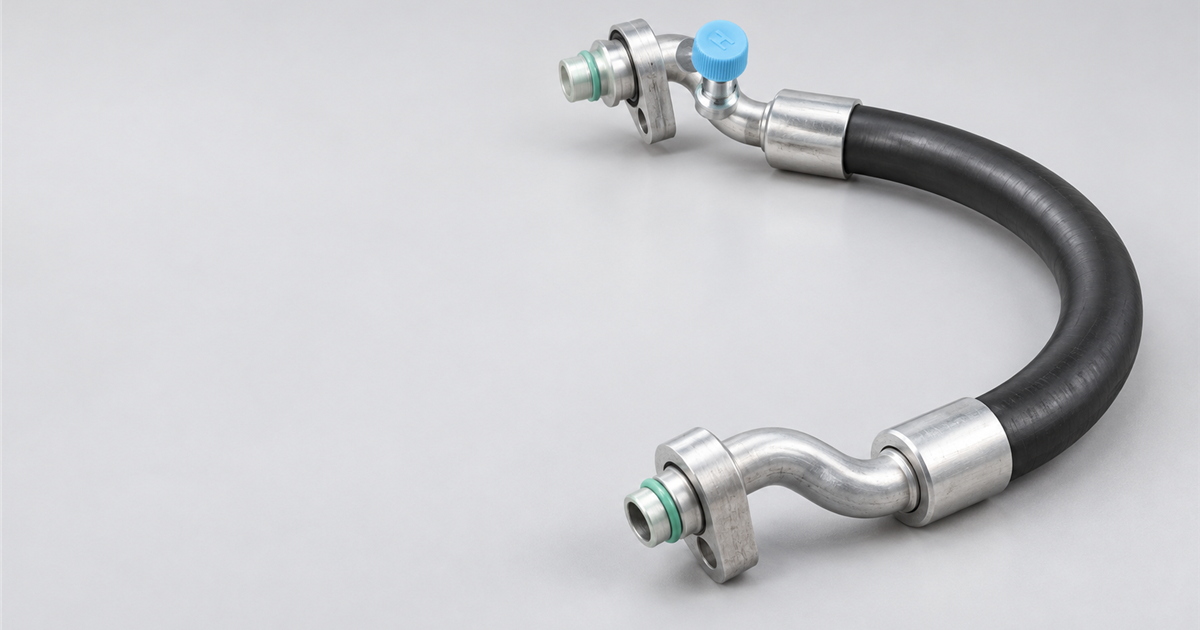
Choosing the wrong AC hose fitting type is one of those sourcing decisions that looks minor until it isn't. If you're running bulk hose assembly production or sourcing fittings for resale, a mismatch between fitting type, hose construction, and crimping tooling can quietly drive up your rework rate and customer complaints — without ever being obvious at the purchasing stage.
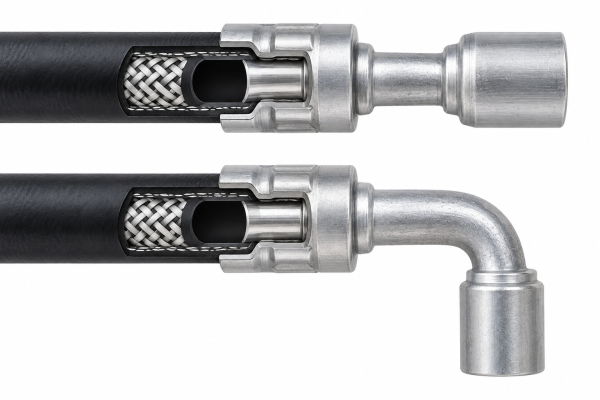
Beadlock and barb AC fittings are two different methods of mechanically connecting a hose to a fitting. A barb fitting grips the hose by deforming it over raised ridges under crimping pressure. A beadlock fitting uses a separate lock ring that physically captures a bead formed in the hose liner during the crimp cycle. The core difference is structural: beadlock creates a mechanical lock; barb relies on friction and hose deformation. This distinction matters most when working with barrier hose or running high-volume production where consistency is critical.
That summary gives you the definition. But the definition alone won't help you make a sourcing decision. The real questions are: which fitting suits your hose type, what tooling does each one require, and which choice makes more sense if you're managing assembly production at scale? Let's go through it section by section.
What Is a Beadlock AC Hose Fitting?
Most people sourcing AC fittings for the first time encounter beadlock as a label — but the mechanism behind the name isn't always explained. That leads to assumptions about compatibility that cause problems downstream.
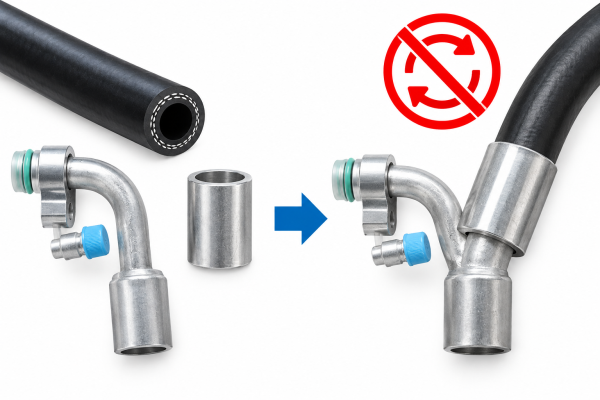
A beadlock AC fitting includes an inner fitting body and a separate outer lock ring. During assembly, the hose end is inserted over the fitting, the lock ring is positioned over the hose, and the crimping machine compresses the ring onto the hose. The crimp force creates a mechanical bead lock1 — the ring physically traps the hose material against the fitting body. This creates a seal and a mechanical retention structure at the same time.
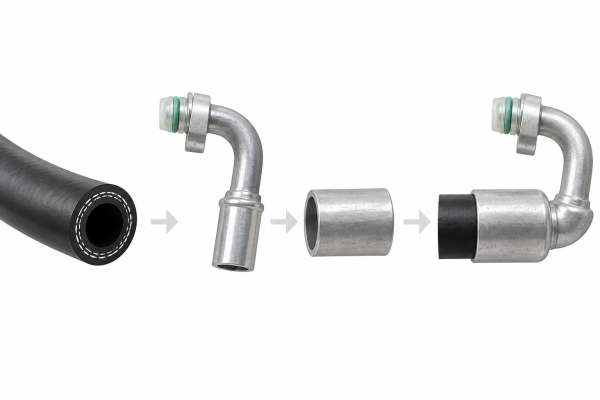
The reason this matters for production is consistency. Because the lock ring is a separate, controlled component, the crimp geometry is more predictable across repeated assemblies — assuming the crimping die is correctly matched to the fitting's lock ring diameter and profile.
How the Lock Mechanism Actually Works
The term "beadlock" refers to the locking bead formed when the ring is crimped onto the hose. The fitting body has a specific retention groove or shoulder, and the ring collapses inward over it. This traps the hose liner between the fitting stem and the ring wall.
The practical result:
- The hose cannot pull off the fitting without destroying the lock ring
- The sealing interface is defined by crimp geometry, not just hose stiffness
- The seal path is more resistant to refrigerant permeation compared to a friction-based barb grip
One thing buyers often get wrong: beadlock does not mean reusable. Once crimped, the lock ring is permanently deformed. The fitting is not designed to be removed and re-crimped. This is a common misunderstanding worth addressing before it becomes a customer complaint.
What Is a Barb AC Hose Fitting?
Barb fittings have been around longer and are still widely used — particularly in lower-pressure applications and non-barrier hose assemblies. Understanding how they work makes it easier to evaluate where they're appropriate.
A barb AC fitting has a serrated or ridged stem profile. When the hose is pushed over the stem and a ferrule or crimp sleeve is compressed around the outside, the hose material deforms into the barb ridges. This deformation creates the seal and the pull-off resistance. There is no separate lock ring — the crimp sleeve and hose deformation do all the work.
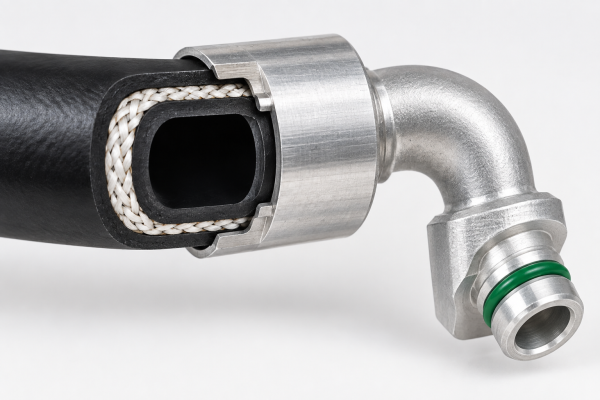
This is a simpler, lower-cost construction. For non-barrier hose — where the inner liner is softer and more deformable — this works reliably when properly crimped.
Where Barb Fittings Are Still Common
- Budget-tier or entry-level A/C hose assemblies
- Applications using standard rubber hose without a barrier layer
- Markets where beadlock tooling hasn't been adopted
- Low-volume or one-off repair assemblies
The limitation becomes clear when the hose liner is stiffer. If the material doesn't deform fully into the barb profile, the seal depends entirely on surface contact — and refrigerant, especially R-134a and R-1234yf2, will find the path of least resistance.
Beadlock vs Barb AC Fittings: Key Differences
Here's a direct comparison across the factors that matter most to buyers and assembly operations:
| Factor | Beadlock Fitting | Barb Fitting |
|---|---|---|
| Sealing mechanism | Mechanical lock ring + crimp geometry | Hose deformation over barbed stem |
| Separate lock ring | Yes — required component | No |
| Barrier hose compatibility | Strong — validated in production use | Risk of incomplete seal with stiff liner |
| Crimp tooling required | Dedicated die matched to lock ring OD | Standard crimp die for sleeve OD |
| Tooling interchangeability | Not interchangeable with barb dies | Not interchangeable with beadlock dies |
| Assembly consistency | High — geometry-controlled | Moderate — depends on hose deformability |
| Component cost | Slightly higher (lock ring adds cost) | Lower |
| Rework/leak risk | Lower in barrier hose production | Higher if hose liner is not fully deformable |
| Reusability after crimp | No | No |
The tooling row is the one most buyers don't read carefully enough. It has real procurement consequences, which we'll cover directly in section 6 and 7.
Which Fitting Provides Better Sealing?
Sealing performance is the most common search intent behind this topic — but "better sealing" is only meaningful in context. The answer depends on the hose construction.
Beadlock fittings provide more reliable sealing with barrier hose because they don't depend on liner deformability. The mechanical lock ring captures the hose regardless of how stiff the inner barrier layer is. With barb fittings, a stiff liner may not fully conform to the barb ridges, leaving a micro-gap that creates a refrigerant permeation path over time3.
To be clear about the mechanism: barrier hose is designed to prevent refrigerant from migrating through the hose wall4. It does this by including a low-permeability inner liner — often a nylon or PTFE layer5 — that is significantly stiffer than standard rubber. This stiffness is the problem for barb fittings.
Why Liner Stiffness Changes the Equation
A standard rubber hose inner layer will deform under crimp pressure and flow into barb ridges reliably. A barrier liner resists that deformation. The result:
- Less surface contact between hose and barb ridges
- More reliance on ferrule compression force to maintain seal
- Higher sensitivity to crimp diameter variation or die wear over production cycles
Beadlock eliminates this dependency. The lock ring physically captures the hose bead under crimp pressure, so the seal geometry is defined by the ring and die — not by how much the liner deformed.
This is not a lab test result I'm citing. It's what our customers who run barrier hose assembly production have told us, consistently, after switching from barb to beadlock: their complaint and rework rate dropped.
Which Fitting Is Better for Barrier AC Hose?
If you're specifically assembling barrier hose — the kind required for R-1234yf systems6 and increasingly specified across modern vehicle platforms7 — the fitting choice has direct implications for system integrity.
For barrier AC hose assembly, beadlock fittings are the correct choice. Barrier hose is designed to prevent refrigerant permeation through the hose wall, but that protection is only effective if the end fittings seal equally well. A barb fitting that doesn't achieve full contact with the stiff barrier liner creates a permeation path at the most vulnerable point of the assembly — the hose end.
Customers running barrier hose assembly who have made the switch to beadlock consistently report better results in production leak checks. I've had direct conversations with assembly workshop buyers who moved to beadlock after unexplained leak rates with barrier hose — and the issue traced back to incomplete barb engagement, not the hose itself.
What to Consider Before Making the Switch
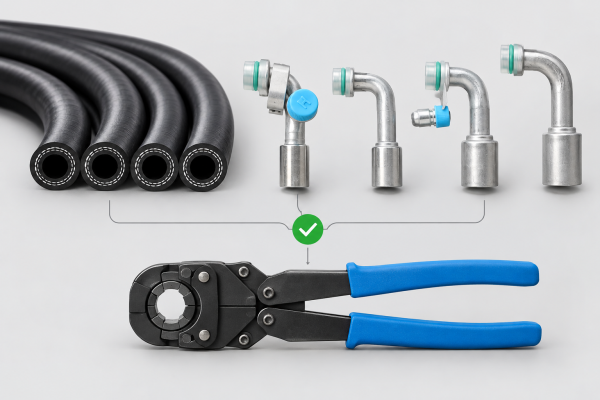
- Verify your crimping machine supports beadlock dies. Not all machines do. Some older machines don't have the jaw range or die profile options required.
- Source fitting and die from the same supplier where possible. This eliminates compatibility ambiguity and reduces setup time.
- Check your existing hose stock. If you're mid-run on a barb-compatible hose spec, evaluate whether switching mid-production is practical or whether you complete that run first.
The switch is a setup investment — but for barrier hose production, it's the right one.
Can Beadlock and Barb Fittings Use the Same Ferrule?
This question comes up often, and the short answer is no — but buyers deserve a clear explanation of why.
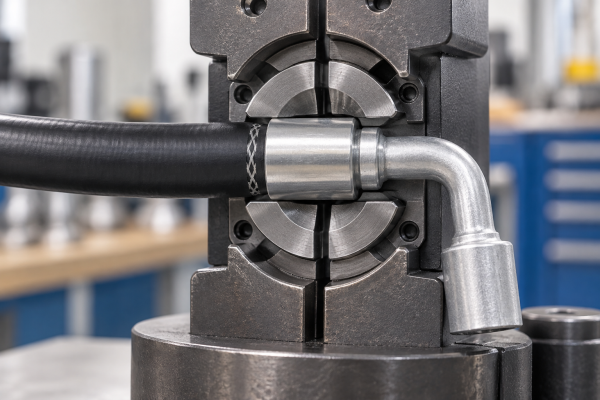
Beadlock and barb fittings are not compatible with the same crimp dies or ferrules. Beadlock fittings use a lock ring with a specific outer diameter and crimp profile that requires a dedicated die set. Barb fittings use a standard crimp sleeve. Using a barb die on a beadlock fitting will produce an incorrect crimp geometry, which may look assembled but will not create a proper mechanical lock.
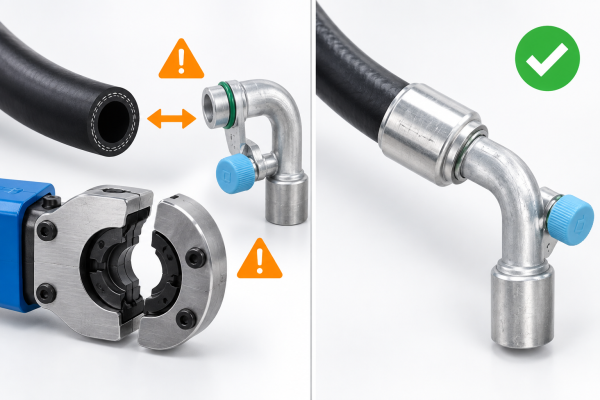
In our production experience, the crimping die profile for a beadlock lock ring differs from a barb sleeve in both inner diameter dimension and the shape of the jaw engagement zone. The die has to engage the ring at the right point to collapse it evenly. A standard barb die is not engineered for this.
The Practical Risk
The dangerous scenario is this: a buyer has an existing crimping machine with barb dies. They add beadlock fittings to their sourcing list assuming the tooling is shared. The assembly looks correct to the eye. But the crimp is under-formed on the lock ring. The hose passes a static leak check but fails under thermal cycling in vehicle operation8.
This is a real-world failure mode, not a theoretical one. It's why tooling compatibility needs to be confirmed — in writing, from your fitting supplier — before production begins.
Which Fitting Type Is Better for Automotive AC Hose Assembly Production?
This is where the conversation shifts. If you're evaluating fittings for a repair job or a one-off assembly, either fitting type can work in the right application. But if you're running production — whether that's a hose assembly workshop, a distributor building private-label kits, or an importer sourcing pre-made assemblies — the decision framework is different.
For production-scale automotive AC hose assembly, beadlock fittings offer more consistent results when working with barrier hose. The mechanical crimp geometry reduces dependency on hose-to-fitting deformation variables, which means fewer outliers in your crimp quality across a production run. The tooling investment is real but one-time, and it removes a significant source of rework and downstream complaints.
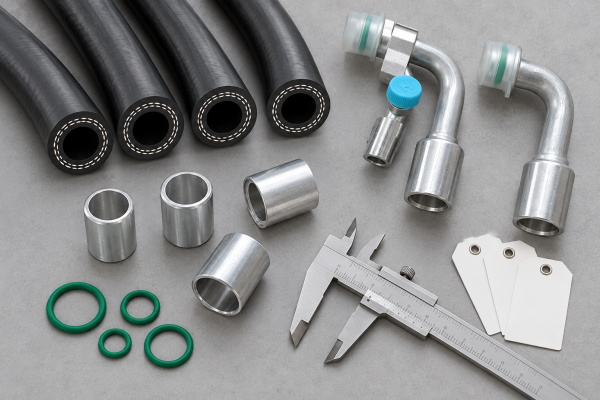
I understand the switching cost argument. Most buyers who are already running barb fittings have stock on the shelf and dies already installed. Switching means:
- Upfront tooling cost — new dies, possibly a new crimper if the current machine isn't compatible
- Transition inventory risk — managing two fitting types during the switchover period
- Team retraining — making sure assembly staff understand the different setup and inspection requirements
These are real frictions. The counterweight is this: every batch of barrier hose assembled on incorrect tooling or with a mismatched fitting type is a liability9. One complaint batch from a distributor customer erases the tooling savings quickly.
For buyers who are setting up a new assembly line or expanding into barrier hose products, there is no reason to build around barb fittings as the standard. Start with beadlock and compatible tooling from the beginning.
What Should Distributors Check When Sourcing AC Fittings?
If you're a distributor sourcing fittings for resale or building hose assembly kits, your evaluation criteria should go beyond price per piece. Fitting type, tooling compatibility, and supplier capability all affect the quality of what ends up in your customer's hands.
Distributors sourcing AC fittings should verify: fitting type and lock ring specification, compatible crimp die availability from the same supplier, hose type compatibility documentation, and whether the supplier can provide both fittings and crimping tooling as a matched solution. Sourcing fittings and tooling from separate suppliers increases compatibility risk and complicates after-sales troubleshooting.
Here's a practical checklist for distributor sourcing evaluation:
Supplier Capability Checklist
- Does the supplier manufacture both beadlock and barb fittings? A single-type supplier may push you toward their offering regardless of what suits your application.
- Do they also manufacture or supply compatible crimping machines? If yes, ask for confirmed die compatibility documentation for each fitting SKU.
- Can they confirm which hose types each fitting is validated for? Not all suppliers have this documentation. Ask directly.
- What is their production MOQ and lead time for beadlock fittings vs barb fittings? Beadlock requires the lock ring as an additional component — this affects lead time and minimum order quantities.
- Do they support OEM or private-label specification? If you're building a branded hose assembly kit, this is essential.
- Can they provide samples for crimp testing before you commit to bulk order? Any serious supplier should support this.
The fragmented sourcing model — fittings from one supplier, crimpers from another, hose from a third — creates gaps in compatibility accountability. When something goes wrong, nobody owns the problem. A supplier who provides fittings, compatible tooling, and hose from the same factory gives you one point of contact and a much cleaner troubleshooting path.
Frequently Asked Questions
What does beadlock mean on an AC fitting?
Beadlock refers to the mechanical locking structure used to secure the hose to the fitting. A separate outer ring is crimped over the hose end, physically trapping the hose material against the fitting body. This creates both the seal and the pull-off retention. The term describes the locking mechanism, not the fitting's reusability.
Are beadlock fittings reusable?
No. Once a beadlock fitting is crimped, the lock ring is permanently deformed. It cannot be removed and re-crimped without destroying the component. If an assembly is cut or disassembled, the fitting must be replaced. This applies to barb fittings as well — neither type is designed for reuse after crimping.
Can beadlock fittings be used with barrier hose?
Yes — and for barrier hose, beadlock is the recommended fitting type. Barrier hose has a stiff inner liner that may not deform fully over barb ridges under crimp pressure. Beadlock fittings use a mechanical lock ring that doesn't depend on liner deformability, which makes them more reliable for achieving consistent seals on barrier hose assemblies.
Do beadlock fittings require a special crimper?
Yes. Beadlock fittings require a crimping die matched to the lock ring's outer diameter and crimp profile. Standard barb crimp dies are not interchangeable with beadlock dies. Before sourcing beadlock fittings, confirm that your existing crimping machine supports the correct die profile — or source the crimper and fittings together from a supplier who can confirm compatibility.
Which AC fitting is better for bulk hose assembly?
For barrier hose bulk assembly, beadlock fittings provide more consistent results because the crimp geometry is controlled by the lock ring, not by hose deformability. For standard rubber hose in lower-spec applications, barb fittings can still perform well. The most important factor in bulk production is ensuring your fitting type, hose type, and crimping tooling are all matched and sourced from a supplier who can confirm
<!--[googlesitekit-end-of-content]-->
"How to Properly Crimp a Beadlock Style AC Fitting", https://www.youtube.com/watch?v=ua3PygixtNM. Beadlock-type hose fittings achieve mechanical retention through controlled deformation of an outer ferrule or lock ring, which captures the hose assembly against a fitting shoulder when compressed to specified dimensional tolerances during the crimping process. Evidence role: mechanism; source type: institution. Supports: mechanical locking mechanism achieved through controlled crimp geometry. Scope note: Source describes general beadlock principle; specific crimp force values and dimensional tolerances are typically proprietary to fitting manufacturers and application standards. ↩
"Acceptable Refrigerants and their Impacts | US EPA", https://www.epa.gov/mvac/acceptable-refrigerants-and-their-impacts. R-1234yf (HFO-1234yf) has been adopted as a replacement for R-134a in automotive air conditioning systems in many markets due to its significantly lower global warming potential, driven by environmental regulations in the European Union and other jurisdictions. Evidence role: historical_context; source type: government. Supports: refrigerant types used in automotive air conditioning systems and their regulatory context. Scope note: Source addresses regulatory drivers and environmental properties; does not directly discuss hose fitting compatibility. ↩
"Chemical permeation testing of air-supply hoses", https://pubmed.ncbi.nlm.nih.gov/16484175/. Refrigerant permeation through hose assemblies can occur at the hose-to-fitting interface when seal compression is insufficient, as refrigerant molecules migrate through microscopic pathways created by incomplete material contact or crimp geometry variations. Evidence role: mechanism; source type: research. Supports: how incomplete sealing interfaces enable refrigerant permeation. Scope note: Source addresses general permeation mechanisms in elastomer seals; direct quantification of permeation rates at barb versus beadlock interfaces would require application-specific testing. ↩
"Flexible air conditioning barrier or veneer suction hose", https://patents.google.com/patent/US10837580B2/en. Barrier hoses for automotive air conditioning systems incorporate low-permeability inner liners—typically nylon or fluoropolymer materials—to prevent refrigerant migration through the hose wall, a design requirement formalized in automotive industry standards. Evidence role: mechanism; source type: research. Supports: barrier hose construction and refrigerant permeation prevention mechanism. Scope note: Source describes general barrier hose design principles; specific liner materials and permeation rates vary by manufacturer and refrigerant type. ↩
"Hydrogen Permeability of Polyamide 6 Used as Liner Material for Type IV ...", https://pmc.ncbi.nlm.nih.gov/articles/PMC10534423/. Nylon (polyamide) and fluoropolymer materials such as PTFE exhibit low permeability to refrigerant gases due to their molecular structure and high crystallinity, making them suitable as barrier liner materials in applications requiring minimal refrigerant loss over extended service periods. Evidence role: mechanism; source type: research. Supports: low-permeability properties of nylon and fluoropolymer liner materials. Scope note: Source describes material properties; actual permeation rates depend on liner thickness, temperature, refrigerant type, and pressure differential. ↩
"Protection of Stratospheric Ozone: Listing of HFO-1234yf ...", https://www.regulations.gov/document/EPA-HQ-OAR-2021-0347-0025. Automotive industry specifications establish permeation limits for air conditioning hoses used with low-GWP refrigerants, effectively requiring barrier construction to meet containment thresholds over the system's service life. Evidence role: general_support; source type: institution. Supports: barrier hose requirements for refrigerants with low permeation tolerance. Scope note: Source describes performance standards rather than explicit mandates; specific requirements vary by market and vehicle manufacturer. ↩
"Explore the Automotive Trends Data", https://www.epa.gov/automotive-trends/explore-automotive-trends-data. The automotive industry's transition to low-GWP refrigerants has driven increased specification of barrier hose construction in air conditioning systems, particularly in markets with stringent refrigerant emission regulations and in vehicles designed for global platform compliance. Evidence role: general_support; source type: institution. Supports: trend toward barrier hose specification in automotive applications. Scope note: Source addresses regulatory drivers and industry direction; specific market penetration percentages or year-over-year adoption rates would require proprietary industry analysis. ↩
"Vehicle Transient Air Conditioning Analysis", https://docs.nrel.gov/docs/fy01osti/30715.pdf. Automotive air conditioning systems undergo repeated thermal cycling between ambient and operating temperatures, with refrigerant-side components experiencing temperature variations that can affect seal integrity and material dimensional stability over the vehicle service life. Evidence role: general_support; source type: institution. Supports: thermal cycling conditions experienced by automotive AC components. Scope note: Source describes general thermal environment; specific temperature ranges and cycle counts vary by vehicle design, climate zone, and usage patterns. ↩
"Acceptable Refrigerants and their Impacts", https://www.epa.gov/mvac/acceptable-refrigerants-and-their-impacts. Automotive manufacturers and component suppliers face regulatory obligations regarding refrigerant containment and potential product liability exposure when air conditioning system components fail to meet emission standards or cause refrigerant loss, creating business risk for defective assemblies in the supply chain. Evidence role: general_support; source type: government. Supports: regulatory and liability context for refrigerant containment in automotive systems. Scope note: Source addresses general regulatory framework; specific liability outcomes depend on jurisdiction, contract terms, and whether failures result in regulatory violations or safety incidents. ↩