There's a repair bill that catches people off guard every summer. The AC stops working. The compressor is dead. And the root cause? A hose that looked completely fine.
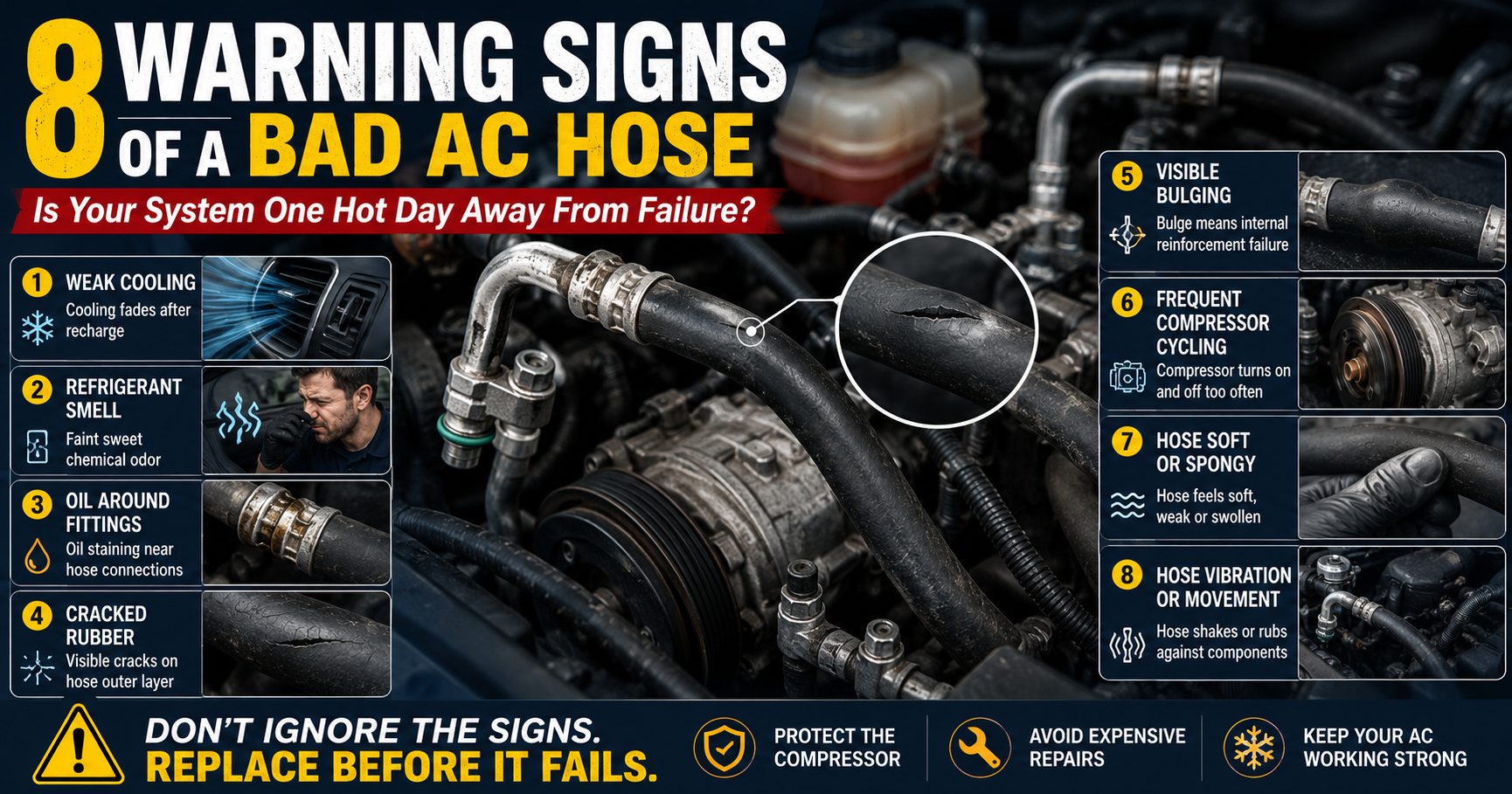
A bad AC hose doesn't always look bad. The most dangerous failures happen inside the hose wall — where you can't see them. If your system shows weak cooling, strange noises, oil near fittings, or compressor cycling, the hose may already be failing. Waiting for a visible break is often too late.
This is the pattern I see come up again and again in customer inquiries. Someone contacts us after a compressor failure. They describe the hose. It looked normal. No cracks. No obvious leaks. But the system had been giving early signals for weeks — signals they didn't connect to the hose.
The goal of this article is simple. I want to help you read those signals earlier, before the bill gets big.
Is Weak Cooling Really a Hose Problem?
Most people blame the refrigerant first. They recharge the system, and the cooling improves for a few days — then fades again.
Weak cooling that returns after a recharge is one of the earliest signs of a failing AC hose. If the hose wall has begun to permeate or a fitting seal is slightly compromised, refrigerant escapes slowly. The system loses capacity gradually, not all at once. Recharging masks the problem without fixing it.
This is an early-stage signal, and it's easy to dismiss. The AC still works. It's just not as cold as it used to be. That's exactly why it's dangerous to ignore.
Why Does Weak Cooling Indicate Hose Failure?
The AC hose is the pathway refrigerant travels through the whole system. When the internal lining starts to degrade, it does two things. First, it allows refrigerant to permeate through the hose wall at a molecular level1 — too slow to see, fast enough to matter. Second, debris from the degraded lining can enter the system and begin to restrict flow or damage the compressor.
| What You Notice | What's Actually Happening | What Happens Next |
|---|---|---|
| AC feels less cold | Refrigerant slowly permeating hose wall | Repeated recharges needed |
| Cooling fades after recharge | Small fitting seal gap | Refrigerant loss accelerates |
| No visible leak found | Internal lining degradation | Compressor receives contaminated refrigerant |
The refrigerant isn't disappearing by magic. It's escaping through a hose that looks fine on the outside. If weak cooling is your current situation, treat it as a hose inspection trigger — not a "wait and see" moment.
Is That Refrigerant Smell a Leak From the Hose?
Refrigerant has a faint, slightly sweet chemical smell2. Most people don't notice it until it's strong. By then, the leak is already significant.
A refrigerant odor inside or near the vehicle is a direct sign of hose wall permeation or fitting seal failure. Modern refrigerants like R-134a and R-1234yf are not supposed to escape the closed system at all3. Any detectable smell means the system is no longer sealed — and the hose is the most likely source.
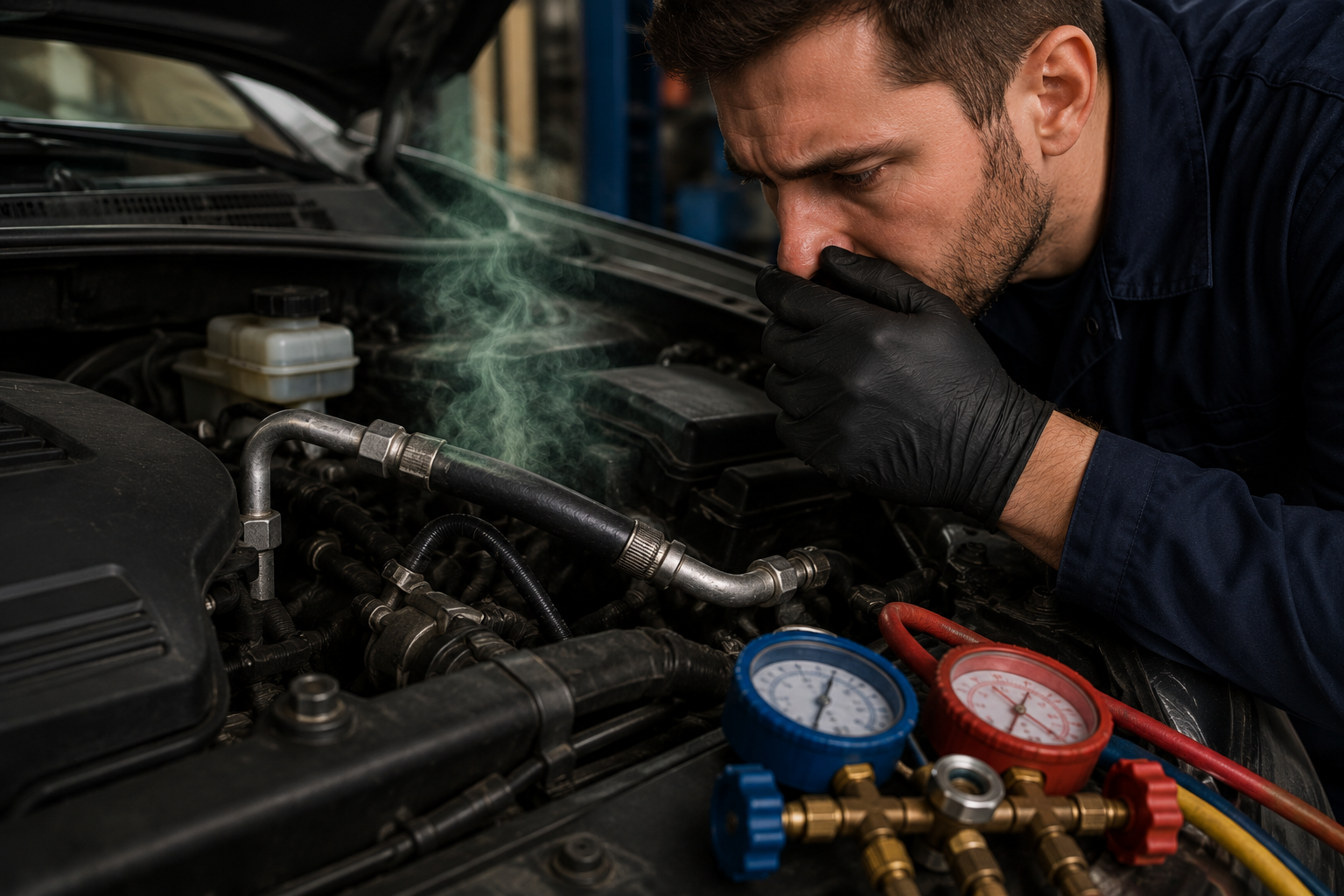
Based on what customers report to us, refrigerant odor is one of the most overlooked early clues. It often appears before any visible leak stain, before cooling drops noticeably, and well before anyone considers checking the hose.
What Does a Refrigerant Leak Actually Cost You?
A small refrigerant leak is not just an environmental issue. It's a compressor protection issue. AC compressors rely on refrigerant to carry lubrication oil through the system4. When refrigerant levels drop, oil circulation is reduced. The compressor runs dry. That's how a small leak becomes a full compressor replacement.
| Leak Stage | System Impact | Repair Cost Range |
|---|---|---|
| Early permeation | Slight refrigerant loss, cooling okay | Low — hose replacement only |
| Fitting seal gap | Detectable odor, recharges needed | Medium — hose + recharge |
| Active leak | Rapid refrigerant loss, compressor stress | High — possible compressor damage |
If you smell refrigerant, don't schedule it for next month. Schedule it now.
Why Is There Oil Around the Hose Fittings?
Oil staining near AC hose fittings is not a cosmetic issue. It is a diagnostic clue.
Refrigerant oil is carried through the AC system mixed with refrigerant. When it appears on the outside of a fitting, it means refrigerant is escaping past the fitting seal — and carrying oil with it. This is an active seal failure, not surface contamination. The fitting connection is no longer holding pressure.
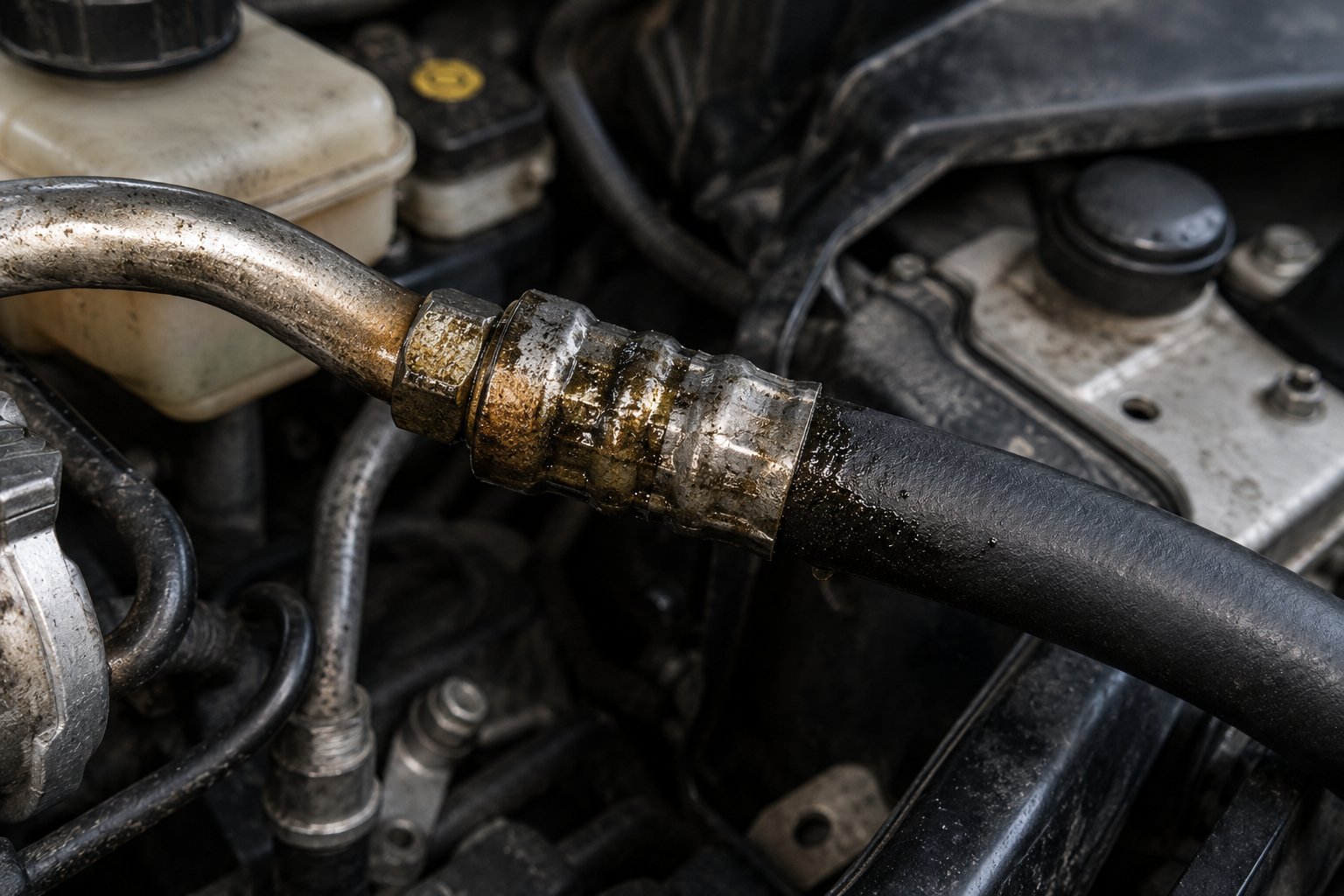
This sign comes up frequently in procurement conversations. A buyer will describe fittings that look "greasy" or "dirty" even on a relatively new hose. In most of those cases, the fitting was either crimped incorrectly, the O-ring has degraded, or the hose end has begun to pull away from the fitting under pressure cycling.
How Do Fitting Failures Develop Over Time?
Fittings experience stress every time the compressor cycles on and off. Pressure goes up, pressure goes down, hundreds of times per day5. Over time, even a well-made fitting can develop micro-movement at the crimp. That movement breaks the O-ring seal.
| Cause | What You See | Risk Level |
|---|---|---|
| O-ring degradation | Faint oil film near fitting | Early — replace before it worsens |
| Poor crimp quality | Fitting slightly loose or misaligned | High — fitting may separate |
| Hose end pull-back | Gap between hose and fitting | Critical — immediate replacement |
Oil around fittings is one of the few signs you can catch early with a visual inspection. Don't wipe it off and forget it. Use it as the reason to replace the hose before the fitting fails completely.
Does Cracked Rubber Mean the Hose Is Already Too Far Gone?
Yes. In most cases, visible cracks on the hose outer layer mean you are past the early warning stage.
Cracked rubber on an AC hose is a late-stage failure sign. The outer rubber layer is the last protective barrier for the internal pressure-carrying layers. Once it cracks, moisture enters, the reinforcement layer begins to corrode6, and the structural integrity of the hose drops quickly. A cracked hose is not a hose you monitor — it is a hose you replace immediately.
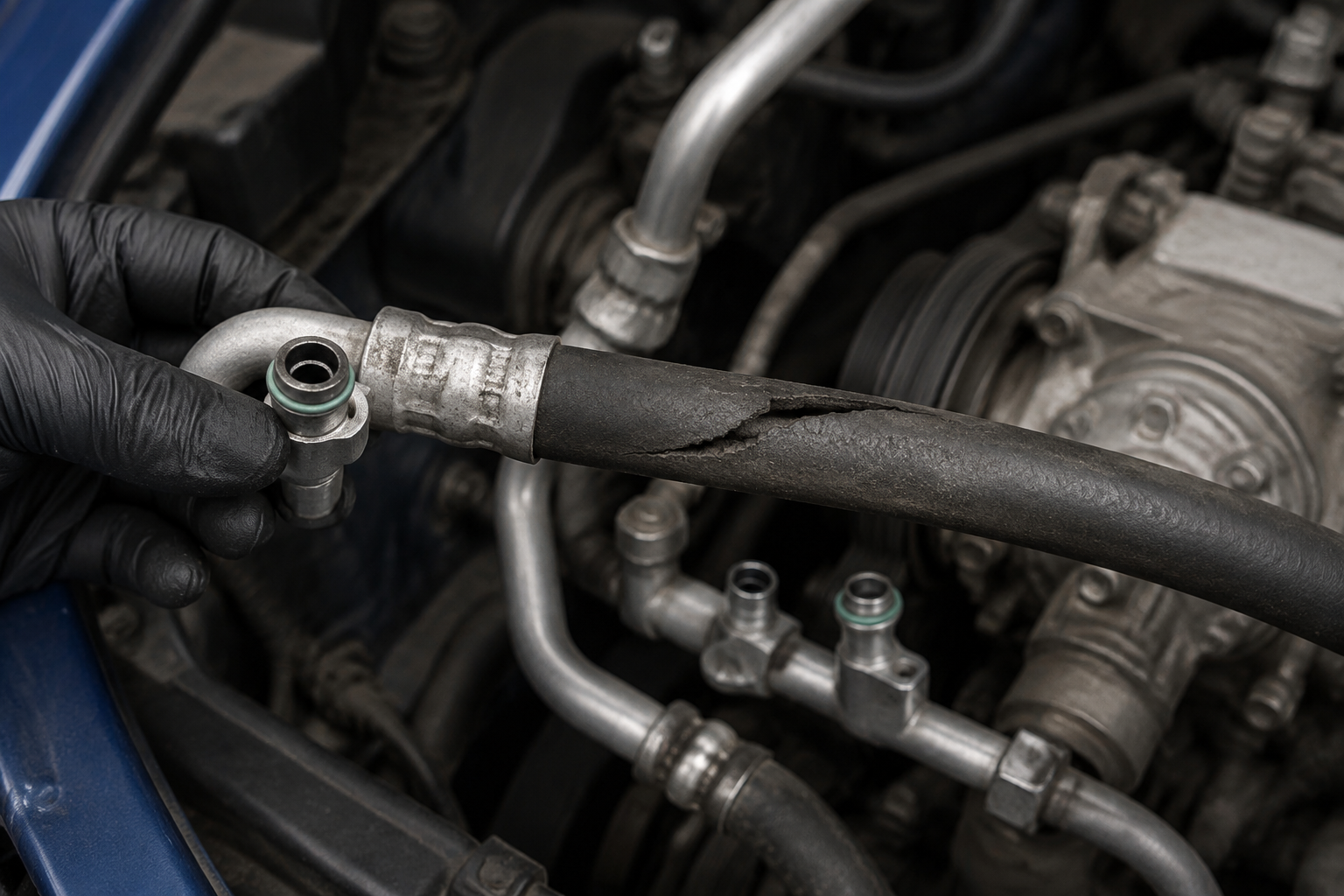
What I want to highlight here is the cost framing. By the time you see cracks, the hose has likely been degrading internally for a longer period. The crack is just the moment the outside caught up with the inside.
What Happens Inside a Cracked Hose?
AC hoses are multi-layer structures. From outside in: rubber jacket, reinforcement braid, and internal lining7. Each layer serves a function. When the outer rubber cracks, it exposes the reinforcement braid to moisture and heat. The braid weakens. Internal pressure — which can exceed 200 PSI on the high side — is now being carried by a compromised structure.
| Hose Layer | Normal Function | Effect of Crack |
|---|---|---|
| Outer rubber jacket | Physical and UV protection | Moisture ingress begins |
| Reinforcement braid | Pressure containment | Corrosion and weakening |
| Internal lining | Refrigerant compatibility | Already likely degraded |
A cracked hose that hasn't burst yet is still a hose under pressure. It will fail — the question is whether it fails on a quiet road or a busy highway.
Is That Hissing Sound Coming From the AC Hose?
A hissing sound from the engine bay when the AC is running is a common early sign. It's also easy to rationalize away.
Hissing from the AC system while it runs is an early indicator of refrigerant escaping under pressure. It typically comes from a small gap at a fitting or a pinhole along the hose wall. The sound is audible because pressurized refrigerant is forcing through a narrow opening. This is an active leak, not a pending one.
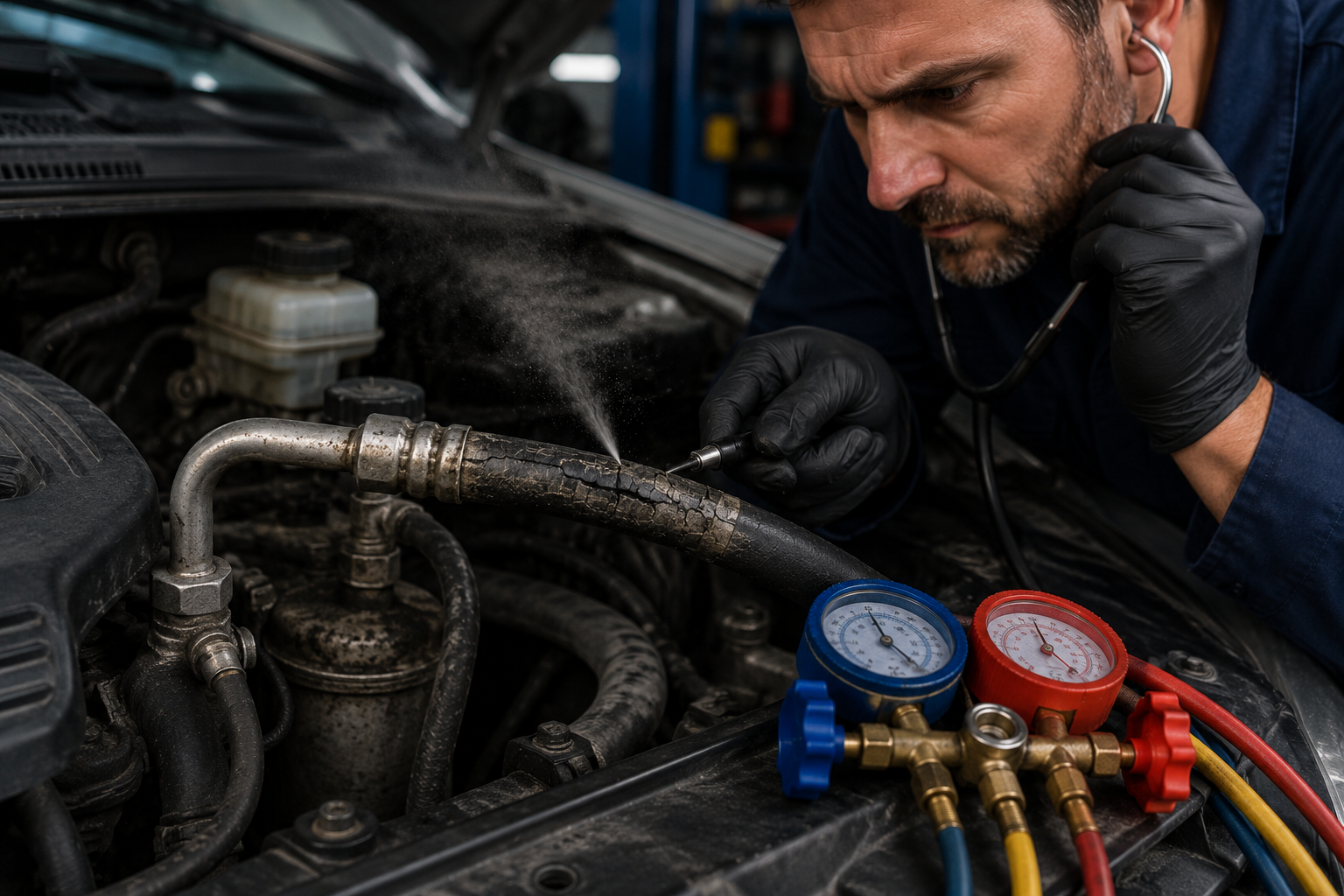
This is one of the earliest-stage signals in this list. The fact that you can hear it means there is enough pressure differential to force gas through a gap. That gap will only get larger with continued pressure cycling.
Where Does the Hissing Usually Come From?
Based on the cases customers bring to us, hissing most often originates at the fitting connection points or at sections of hose that run close to heat sources. Hose rubber softens near exhaust components, and softened rubber loses its grip on fittings over time.
| Source Location | Likely Cause | Urgency |
|---|---|---|
| Near fittings | O-ring failure or crimp gap | High — replace soon |
| Along hose body | Pinhole or wall permeation | Medium — inspect and test |
| Near heat source | Heat-softened rubber with gap | High — heat damage is progressive |
Don't wait until the hissing stops. It doesn't stop because the problem resolved — it stops because the gap got big enough to release pressure without restriction.
What Does a Burning Smell From the AC System Mean?
A burning smell is a late-stage signal. It usually means heat damage has already occurred.
A burning smell from the AC system often indicates that a hose has made contact with a hot engine component. The outer rubber is scorching. This is both a fire risk and a structural failure in progress. A hose that has been heat-damaged externally has very likely also been softened or compromised internally at the same location.
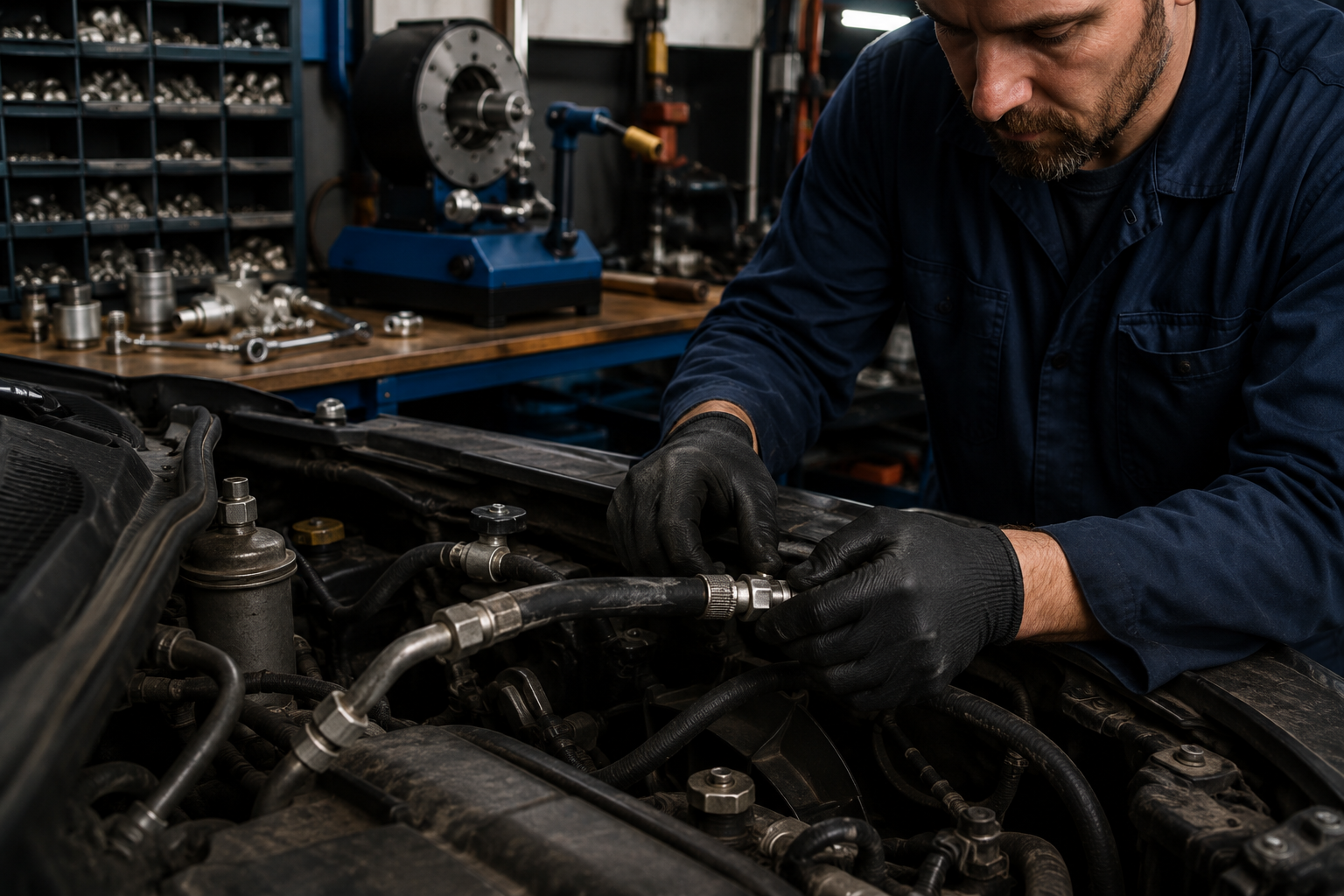
Heat damage is fast. Rubber that reaches high enough temperatures loses flexibility, hardens, and cracks within a short period. If a hose has shifted position and is now resting against an exhaust manifold or hot brake line, it needs to be moved and inspected immediately.
Why Is Heat Damage Worse Than It Looks?
The visible scorch mark on the outside is the smallest part of the problem. Heat transfers inward through the hose wall. The internal lining — which must remain chemically compatible with refrigerant and oil — changes character when exposed to high heat. It can harden, flake, or become brittle8. Those flakes enter the system and reach the compressor.
| Heat Damage Stage | External Sign | Internal Risk |
|---|---|---|
| Early contact | Slight discoloration | Lining integrity reduced |
| Moderate scorching | Visible scorch marks | Lining cracking possible |
| Severe contact | Melted or collapsed hose | Active leak, compressor contamination risk |
A burning smell is not a "check it later" situation. It is a stop-and-inspect situation.
What Does Visible Bulging on a Hose Tell You?
Bulging is a structural emergency. It is the hose telling you it is about to fail.
A bulge in an AC hose means the internal pressure has exceeded the structural capacity of the hose wall at that point. The reinforcement layer has already failed or is failing9. The outer rubber is the only thing holding pressure. This is not an early warning sign — it is an immediate replacement situation.
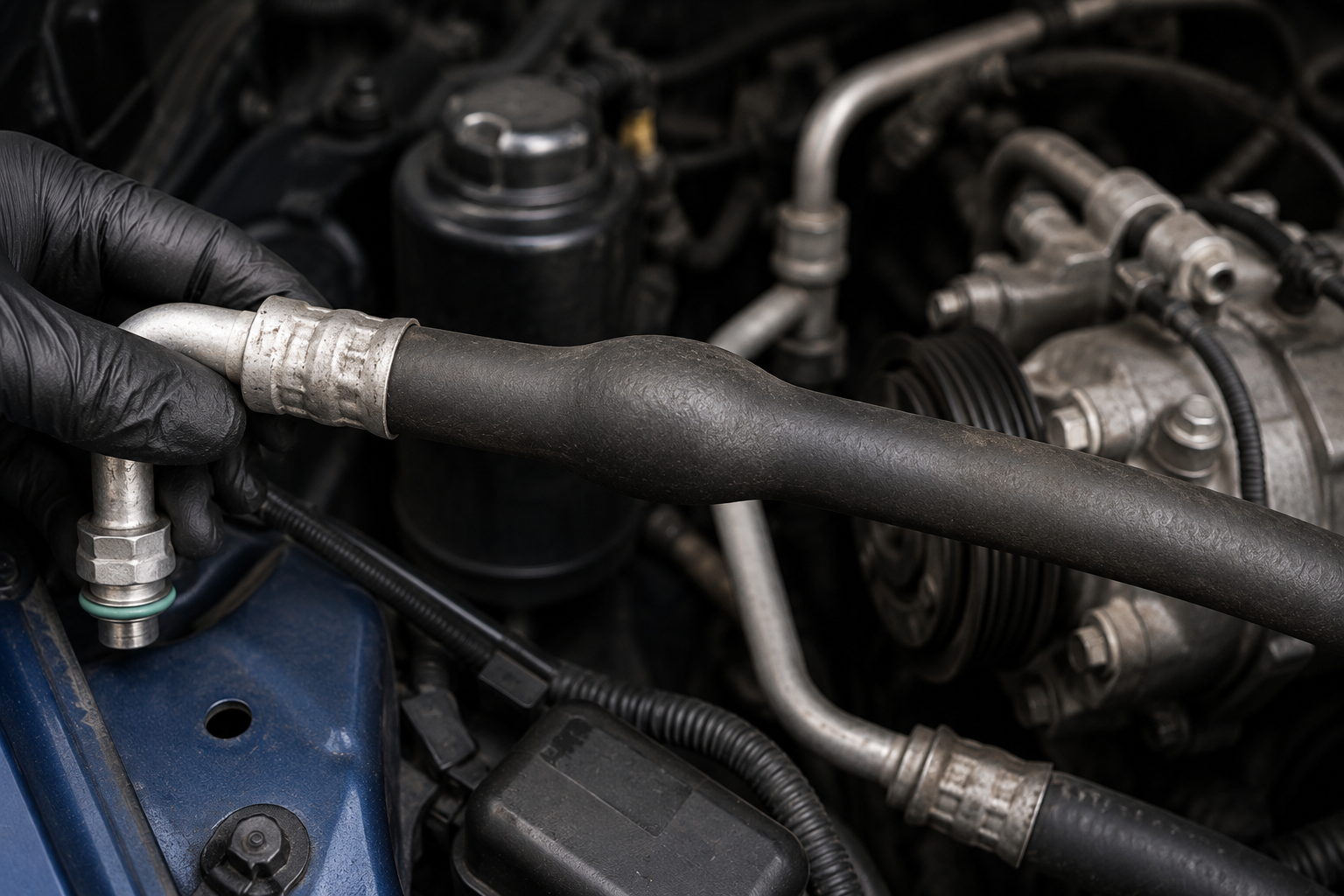
I want to be direct about this one. A bulging hose is not a hose you inspect and monitor. It is a hose you remove from service the same day. The consequence of a high-pressure hose failure under operating conditions is not just a loss of cooling — it is a safety incident.
What Causes a Hose to Bulge?
Bulging happens when the reinforcement braid inside the hose breaks down at a specific point. This can come from a manufacturing defect, physical damage, or long-term degradation from heat and pressure cycling. Once the braid fails locally, the rubber jacket expands outward under system pressure.
| Root Cause | How It Develops | Time to Failure |
|---|---|---|
| Manufacturing defect | Weak crimp or braid gap | Can be sudden |
| Physical impact damage | Pinch, bend, or abrasion point | Days to weeks |
| Long-term degradation | Repeated pressure cycling, heat exposure | Gradual then sudden |
If you see a bulge, the replacement window for a cheap fix has already closed. You are now paying for urgency on top of the hose cost.
Why Is the AC Compressor Cycling On and Off So Often?
Rapid compressor cycling is one of the most misread symptoms in the whole list. It looks like an electrical issue. It's often a pressure issue caused by the hose.
The AC compressor cycles off when system pressure drops below a threshold. If a failing hose is causing slow refrigerant loss, system pressure stays near the low-pressure cutoff point. The compressor turns on, builds pressure, the pressure drops through the leak, and the compressor shuts off again — over and over. This is an early-stage sign that the hose is already costing you in compressor wear.
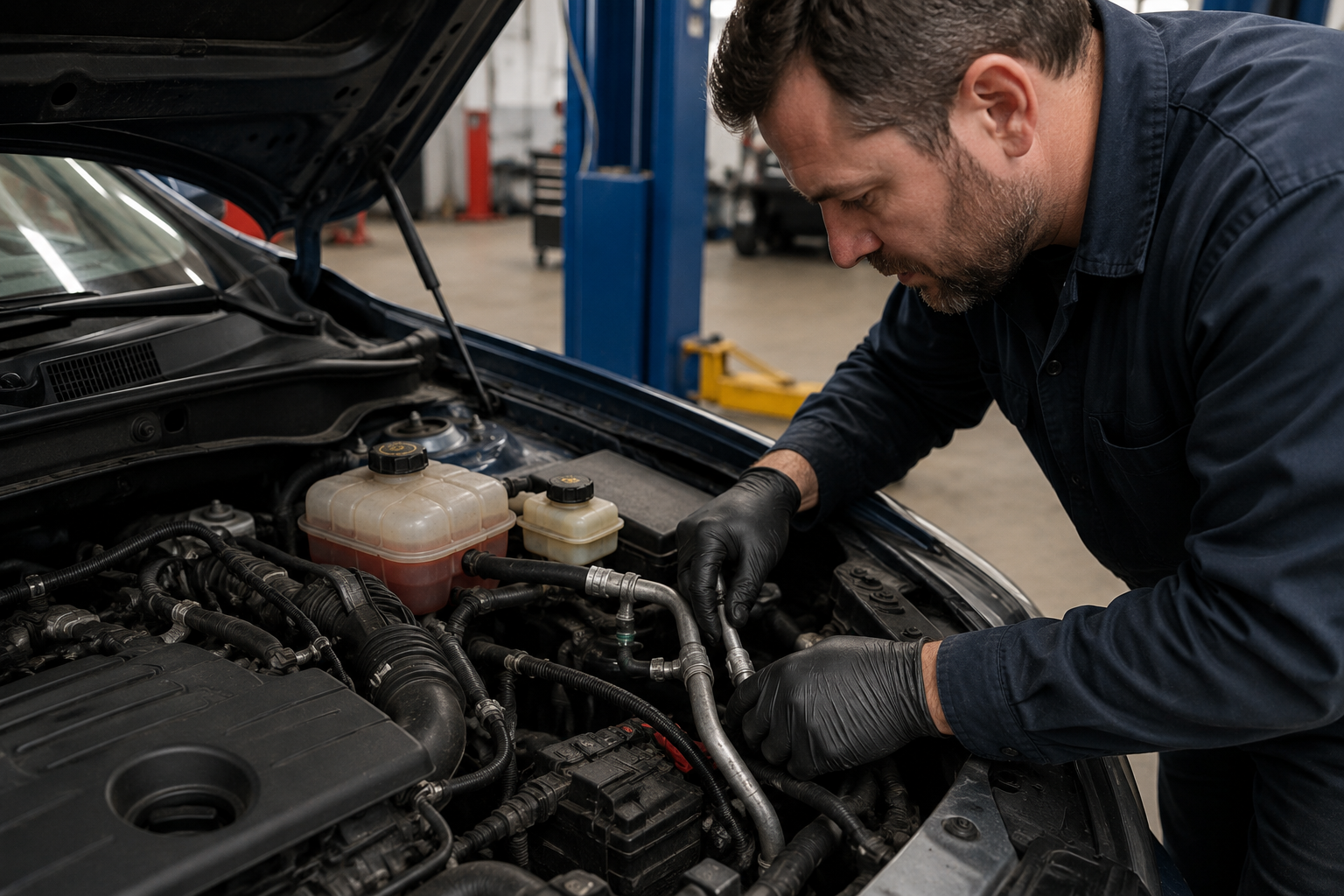
What makes this sign easy to miss is that the AC still works between cycles. Cooling comes and goes. People assume it's a thermostat or electrical relay. But if the compressor is short-cycling and cooling is inconsistent, pressure loss from a hose should be near the top of the inspection list.
What Does Repeated Cycling Do to the Compressor?
Every time the compressor cycles on, it experiences a startup load. That's normal at a regular frequency. When the compressor is cycling every few seconds because pressure keeps dropping, the startup load is happening far more often than the system was designed for10. Compressor wear accelerates. Clutch wear accelerates. What started as a hose problem becomes a compressor problem.
| Cycling Frequency | Likely Cause | Compressor Risk |
|---|---|---|
| Normal (every few minutes) | System operating as designed | Low |
| Frequent (every 30–60 seconds) | Low refrigerant from slow leak | Medium — inspect hose now |
| Rapid (every few seconds) | Significant pressure loss | High — compressor wear increasing |
Compressor cycling is an early signal. It is also one of the most useful ones, because it gives you time to act before the compressor is involved in the repair bill.
Conclusion
A bad AC hose rarely announces itself clearly. The real question isn't whether your hose looks damaged — it's whether your system is already showing you the early signs. If two or more of these warning signs are present, the hose replacement threshold has already been crossed. Act before the compressor is part of the conversation.
<!--[googlesitekit-end-of-content]-->
"Description of Gas Transport in Polymers - PMC - NIH", https://pmc.ncbi.nlm.nih.gov/articles/PMC12389465/. Research on polymer permeability demonstrates that refrigerant molecules can diffuse through elastomeric materials at rates dependent on temperature, pressure differential, and material composition, though permeation rates vary significantly by refrigerant type and hose construction. Evidence role: mechanism; source type: research. Supports: the molecular permeation of refrigerants through elastomeric hose materials. Scope note: Studies typically focus on specific refrigerant-polymer combinations under controlled conditions rather than installed automotive hose assemblies ↩
"Reference Guide To Odor Thresholds For Hazardous Air Pollutants ...", https://nepis.epa.gov/Exe/ZyPURL.cgi?Dockey=2000BHG5.TXT. Safety data sheets describe R-134a as having a faint ethereal odor at high concentrations, though both R-134a and R-1234yf have relatively high odor thresholds that may not provide reliable leak detection at low concentrations. Evidence role: general_support; source type: government. Supports: the odor characteristics of common automotive refrigerants. Scope note: Odor perception varies significantly among individuals and may not be detectable at concentrations present during small leaks ↩
"Motor Vehicle Air Conditioning System Servicing - Regulations.gov", https://www.regulations.gov/document/EPA-HQ-OAR-2013-0597-0001. Environmental regulations and industry standards establish maximum allowable refrigerant leak rates for automotive AC systems, with modern systems designed for minimal permeation loss over their service life. Evidence role: general_support; source type: government. Supports: regulatory requirements for refrigerant containment in automotive AC systems. Scope note: Standards typically specify acceptable annual loss rates rather than absolute zero leakage ↩
"[PDF] Oil Effects On Performance Of Automobile A/C System", https://docs.lib.purdue.edu/cgi/viewcontent.cgi?article=2647&context=iracc. Automotive AC systems use refrigerant flow to transport compressor oil throughout the circuit, with adequate refrigerant charge essential for maintaining proper lubrication of compressor components during operation. Evidence role: mechanism; source type: education. Supports: the role of refrigerant in circulating compressor lubricant throughout automotive AC systems. ↩
"A/C compressor cycling on and off - Cummins Diesel Forum", https://www.cumminsforum.com/threads/a-c-compressor-cycling-on-and-off.540487/. Automotive AC compressor cycling frequency varies widely based on ambient conditions, vehicle operation, and system design, with compressors in active use cycling from dozens to hundreds of times during extended operation periods. Evidence role: general_support; source type: research. Supports: the frequency of pressure cycling in automotive AC systems during normal operation. Scope note: Actual cycling frequency depends heavily on specific driving conditions and climate control settings ↩
"Rebar corrosion and its interaction with concrete degradation in ...", https://pubmed.ncbi.nlm.nih.gov/32622125/. Studies of reinforced hose failure mechanisms show that damage to outer protective layers can allow moisture and contaminant ingress, potentially leading to corrosion of metallic reinforcement and accelerated degradation, though failure progression depends on reinforcement material and environmental exposure. Evidence role: mechanism; source type: research. Supports: the progression of hose degradation following outer cover damage. ↩
"Automotive Air Conditioner Hose Type C | AC Hose for Car - Sinopulse", https://www.sinopulse.cn/automotive-air-conditioner-hose/. Industry standards for automotive refrigerant hoses specify multi-layer construction including an inner barrier layer compatible with refrigerant and oil, reinforcement for pressure containment, and an outer protective cover, though specific constructions vary by application and pressure rating. Evidence role: general_support; source type: institution. Supports: the multi-layer construction of automotive AC hoses. ↩
"Study on the Mechanical Behavior of Nitrile Rubber Materials Under ...", https://pmc.ncbi.nlm.nih.gov/articles/PMC12941664/. Research on elastomer aging demonstrates that elevated temperature exposure accelerates oxidative degradation, cross-linking, and chain scission in rubber compounds, leading to hardening, loss of flexibility, and potential surface cracking or particle generation. Evidence role: mechanism; source type: research. Supports: thermal degradation mechanisms in elastomeric hose materials. Scope note: Degradation rates and mechanisms vary significantly by polymer type, compounding, and specific thermal exposure conditions ↩
"Failure Analysis of High Pressure Hose in Hydraulic Loading System", https://iopscience.iop.org/article/10.1088/1742-6596/2468/1/012109/pdf. Industry guidance on pressure hose inspection identifies bulging or blistering as indicators of reinforcement failure, where localized loss of reinforcement integrity allows the inner tube to expand outward under system pressure, representing imminent hose failure. Evidence role: mechanism; source type: institution. Supports: the structural failure mechanism that produces visible bulging in reinforced pressure hoses. ↩
"[PDF] Failure Modes and Risk Assessment of Rotary Compressor Under ...", https://docs.lib.purdue.edu/cgi/viewcontent.cgi?article=2381&context=icec. Technical literature on compressor operation indicates that startup events impose higher mechanical and thermal stresses than steady-state operation, with excessive cycling frequency potentially accelerating wear on clutch mechanisms, bearings, and seals beyond normal design expectations. Evidence role: general_support; source type: research. Supports: the relationship between cycling frequency and compressor component wear. Scope note: Quantitative relationships between cycling frequency and component life depend on specific compressor design and operating conditions ↩