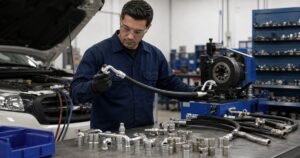
You replaced the hose six months ago. Now it's leaking again. The problem might not be the hose itself — it might be how it got there.
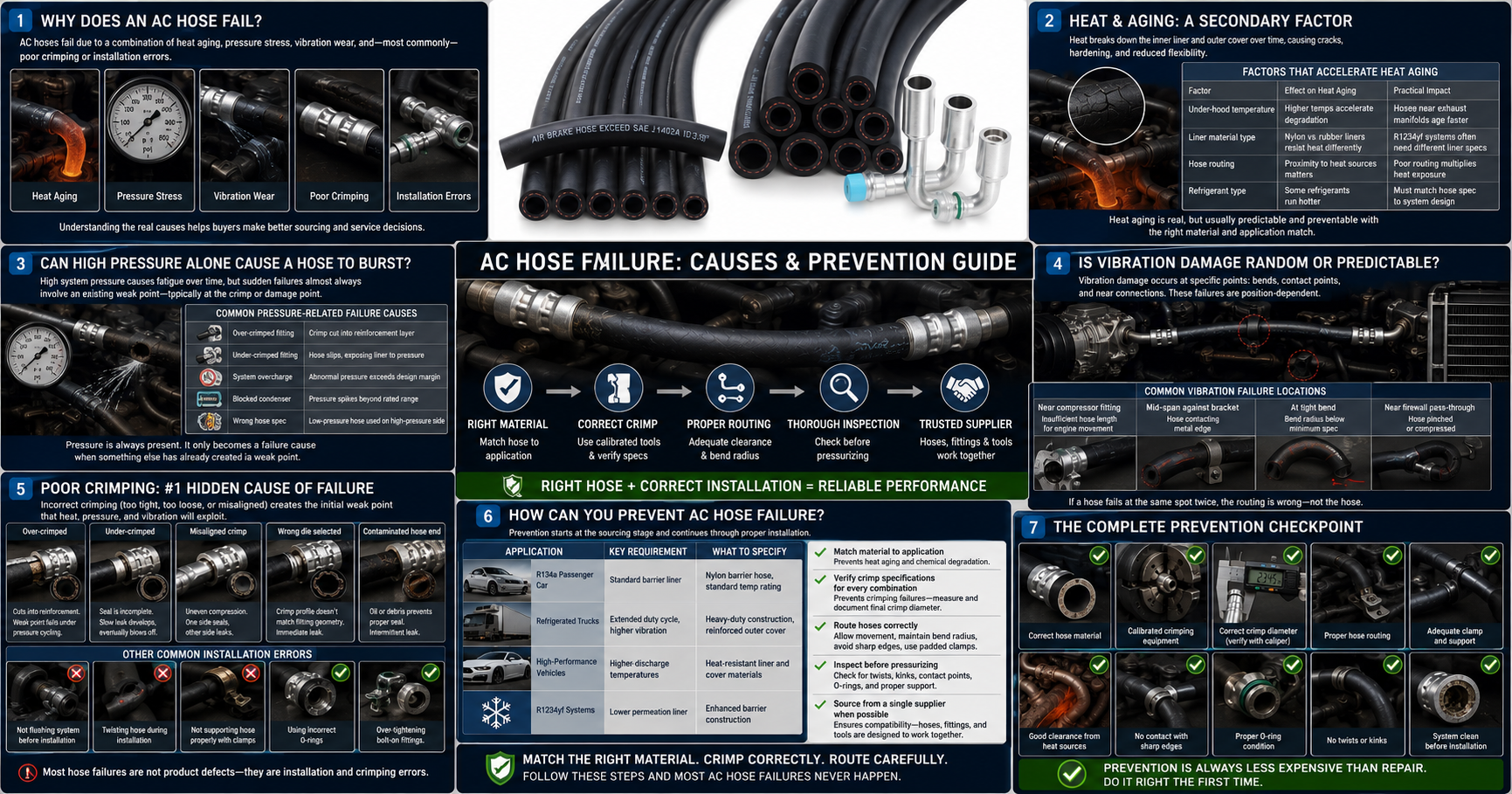
AC hoses fail due to a combination of heat aging, pressure stress, vibration wear, and — most commonly — poor crimping or installation errors. In complaints we've handled, the majority of failures trace back to installation issues, not the hose body. Understanding the real causes helps buyers make better sourcing and service decisions.
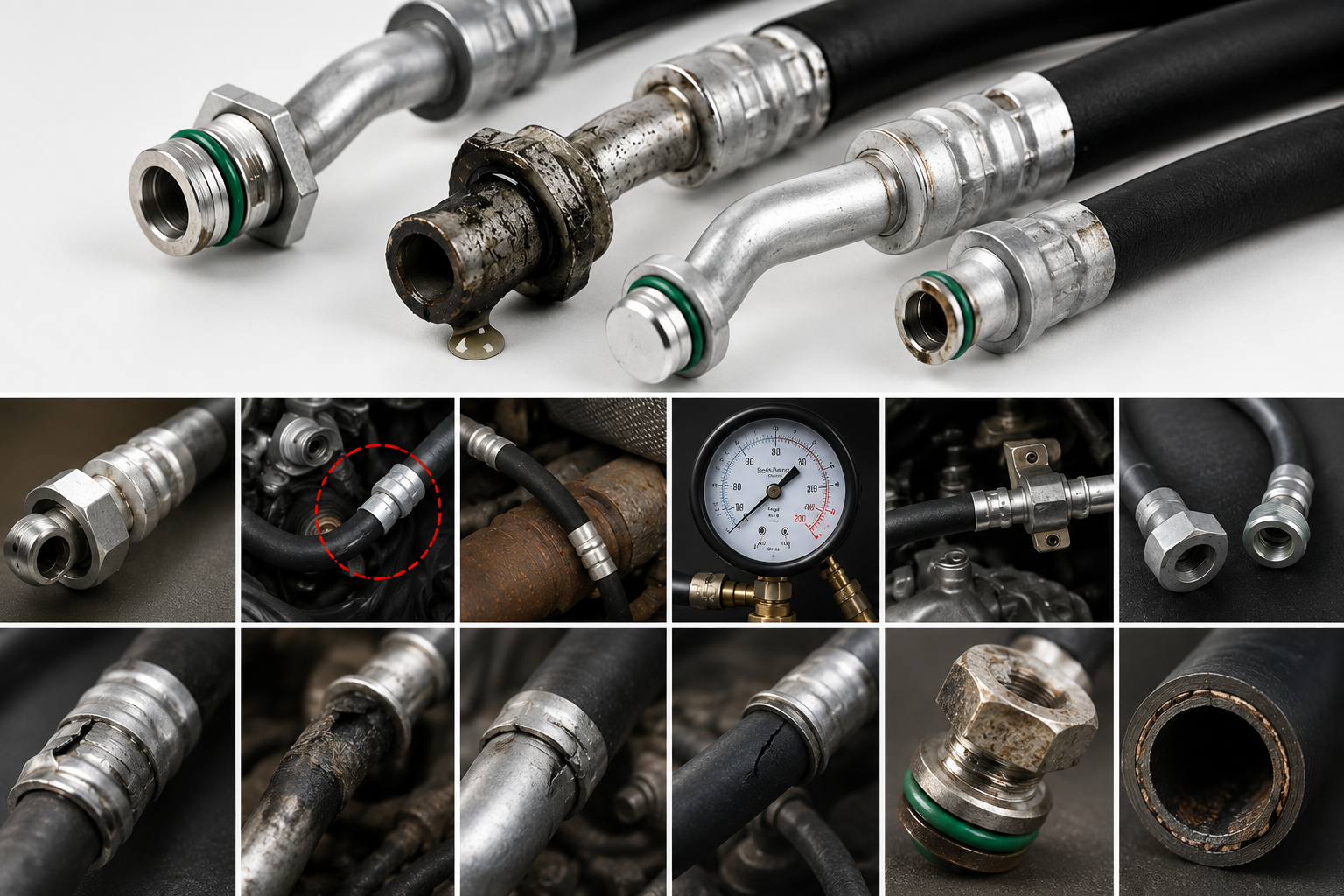
I've been manufacturing automotive AC hoses and crimping tools for years. In that time, I've seen thousands of returned hoses. What surprised me early on was how rarely the hose material itself was the root problem. Most of the time, the failure started somewhere else — at the fitting, at the crimp, or in the routing. This article breaks down the real reasons AC hoses fail, based on what we actually see coming back to our factory.
Does Heat and Aging Really Kill AC Hoses?
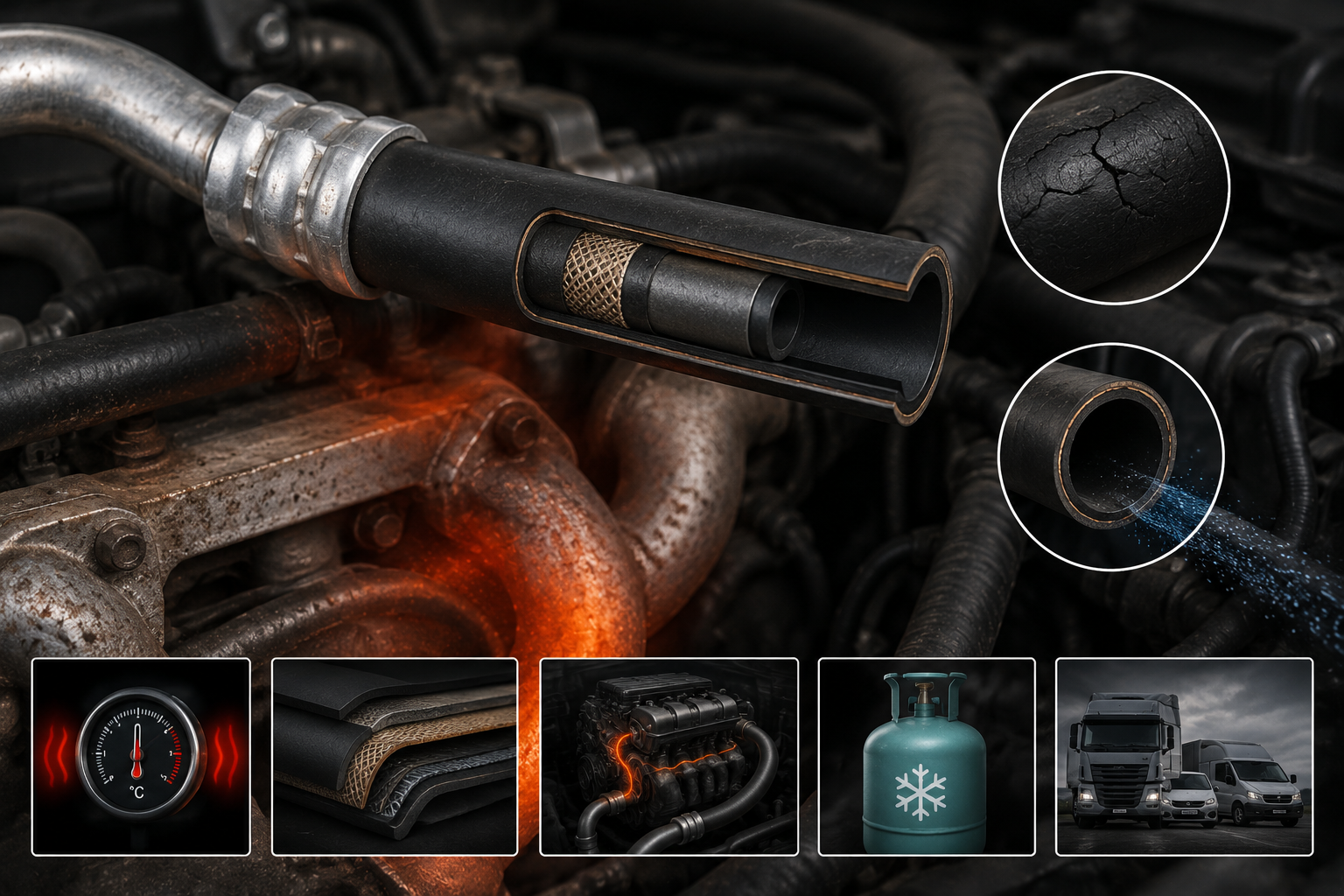
Under-hood temperatures punish rubber and barrier materials every single day1. Over time, this heat breaks down the inner liner and outer cover of an AC hose.
Heat aging causes the hose liner to harden, crack, and lose flexibility. This is a gradual process — typically taking years under normal conditions. It shortens service life but rarely causes sudden catastrophic failure unless the hose was already compromised by material mismatch or poor installation.
How heat aging actually works
The inner barrier layer of an AC hose is designed to contain refrigerant and resist permeation. Heat accelerates the chemical breakdown of this layer. Over thousands of engine cycles, the rubber loses elasticity. Micro-cracks form. Refrigerant begins to permeate through the liner at a higher rate.
But here's what matters for buyers: heat aging is predictable. A properly specified hose in a standard passenger car application will typically last the expected service life — unless something else went wrong first.
| Factor | Effect on Heat Aging | Practical Impact |
|---|---|---|
| Under-hood temperature | Higher temps accelerate degradation | Hoses near exhaust manifolds age faster |
| Liner material type | Nylon vs. rubber liners resist heat differently | R1234yf systems often need different liner specs2 |
| Hose routing | Proximity to heat sources matters | Poor routing multiplies heat exposure |
| Refrigerant type | Some refrigerants run hotter | Must match hose spec to system design |
The key point: heat aging is real, but it's a secondary factor. In most cases we've observed, a hose that fails "from heat" was already in trouble because the wrong material was selected for that application. A standard R134a hose used in an R1234yf system, or a general-purpose hose installed on a refrigerated truck, will degrade faster than expected3 — not because the hose is defective, but because the spec was wrong.
Can High Pressure Alone Cause an AC Hose to Burst?
AC systems generate significant pressure, especially on the high-pressure discharge side. But pressure alone rarely destroys a properly rated hose.
High system pressure causes fatigue over time, weakening the reinforcement layer of the hose. However, sudden pressure failures almost always involve an existing weak point — typically at the crimp zone or at a spot where the hose was already damaged during installation.
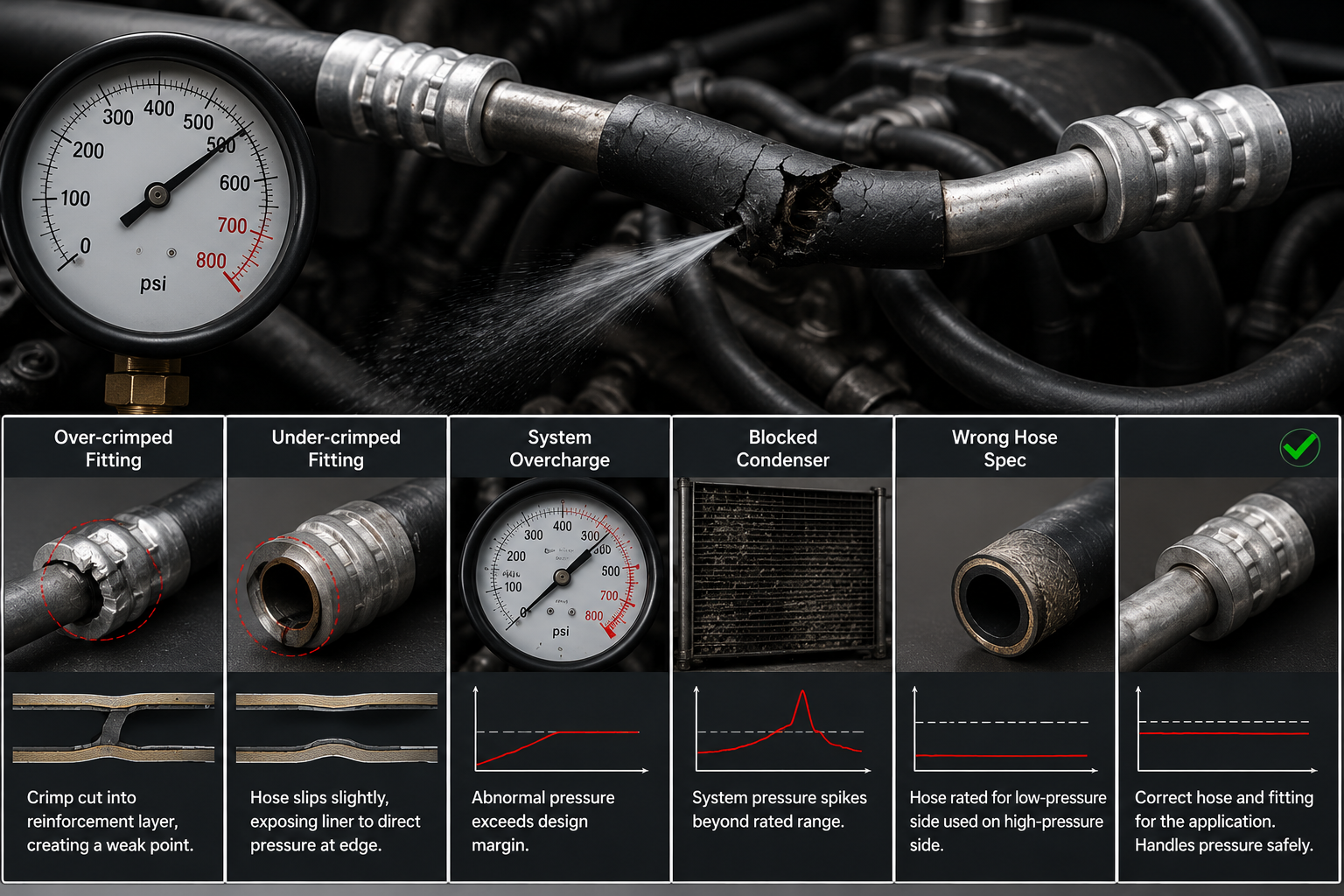
Understanding pressure fatigue
Every AC hose has a burst pressure rating well above the system's normal operating pressure4. The braided or spiral reinforcement layer is engineered to handle pressure cycling — the repeated rise and fall of pressure as the compressor engages and disengages5.
Over years of service, this cycling creates fatigue in the reinforcement. The hose doesn't burst suddenly from normal pressure. It weakens gradually.
So why do we see pressure-related blowouts? In nearly every case I've investigated, there was a contributing factor:
| Scenario | Why Pressure Caused Failure |
|---|---|
| Over-crimped fitting | Crimp cut into reinforcement layer, creating a weak point |
| Under-crimped fitting | Hose slips slightly, exposing liner to direct pressure at edge |
| System overcharge | Abnormal pressure exceeds design margin |
| Blocked condenser | System pressure spikes beyond rated range |
| Wrong hose spec | Hose rated for low-pressure side used on high-pressure side |
The lesson here is simple. Pressure is always present in the system. It only becomes a failure cause when something else has already reduced the hose's ability to handle it. Buyers who focus only on price and ignore pressure ratings for specific line positions are setting themselves up for early failure. A hose that "works fine" on the suction side will not survive on the discharge side — even if it looks identical.
Is Vibration Damage Random or Predictable?
Engine vibration and road shock constantly stress AC hoses. But the damage doesn't happen everywhere equally — it concentrates at specific points.
Vibration damage occurs at routing bends, contact points with body panels or brackets, and near the compressor connection. These failures are position-dependent and predictable. They signal an installation geometry problem, not a material defect.
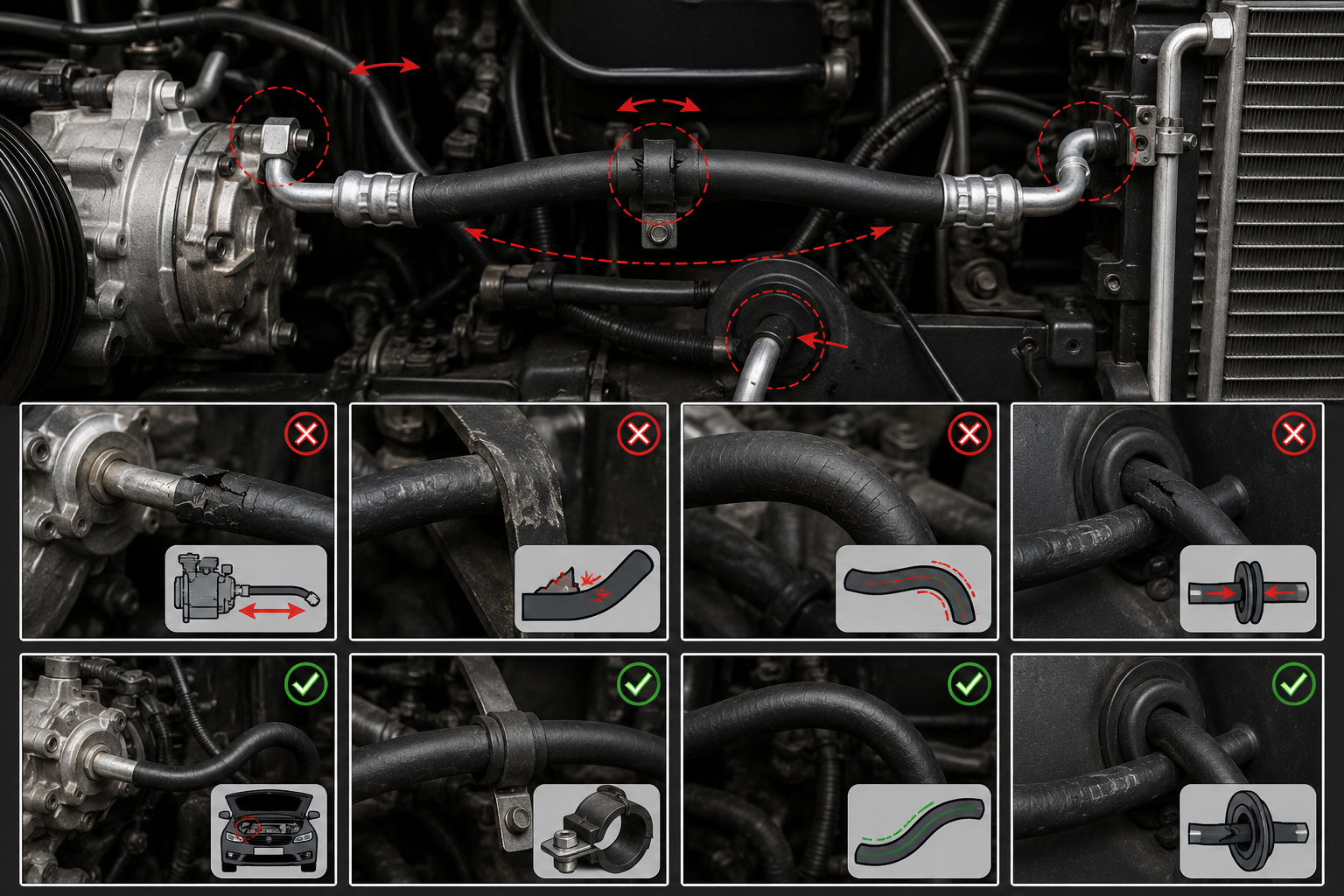
Where vibration actually causes damage
The compressor is bolted to the engine. The condenser is mounted to the body. These two components move relative to each other every time the engine runs.6 The hose connecting them absorbs that movement. If the hose is routed with adequate length and proper bend radius, it handles this movement fine.
Problems start when:
- The hose is routed too tight, with no slack for movement
- The hose contacts a sharp bracket edge or body panel
- A clamp is too tight and restricts natural flex
- The hose rubs against another component during operation
How to identify vibration failure
| Failure Location | Likely Cause | Prevention |
|---|---|---|
| Near compressor fitting | Insufficient hose length for engine movement | Allow proper service loop |
| Mid-span against bracket | Hose contacting metal edge | Use proper clamps with rubber padding |
| At tight bend | Bend radius below minimum specification | Re-route with larger radius |
| Near firewall pass-through | Hose pinched or compressed | Ensure grommet protection |
I've had customers contact us about repeated failures at the same spot. When we asked for photos of the installation, the answer was always clear — the hose was rubbing, pinched, or bent too sharply. Replacing the hose without fixing the routing just restarts the same failure cycle. This is not a product problem. It's an installation design problem.
Why Is Poor Crimping the Number One Hidden Cause of AC Hose Failure?
Most buyers assume hose failure means the hose was bad. In our experience, that assumption is wrong more often than it's right.
Poor crimping is the leading cause of AC hose failure in complaints we've handled. An incorrect crimp — too tight, too loose, or misaligned — creates the initial weak point that heat, pressure, and vibration then exploit. The hose body is often perfectly fine when we inspect returns.
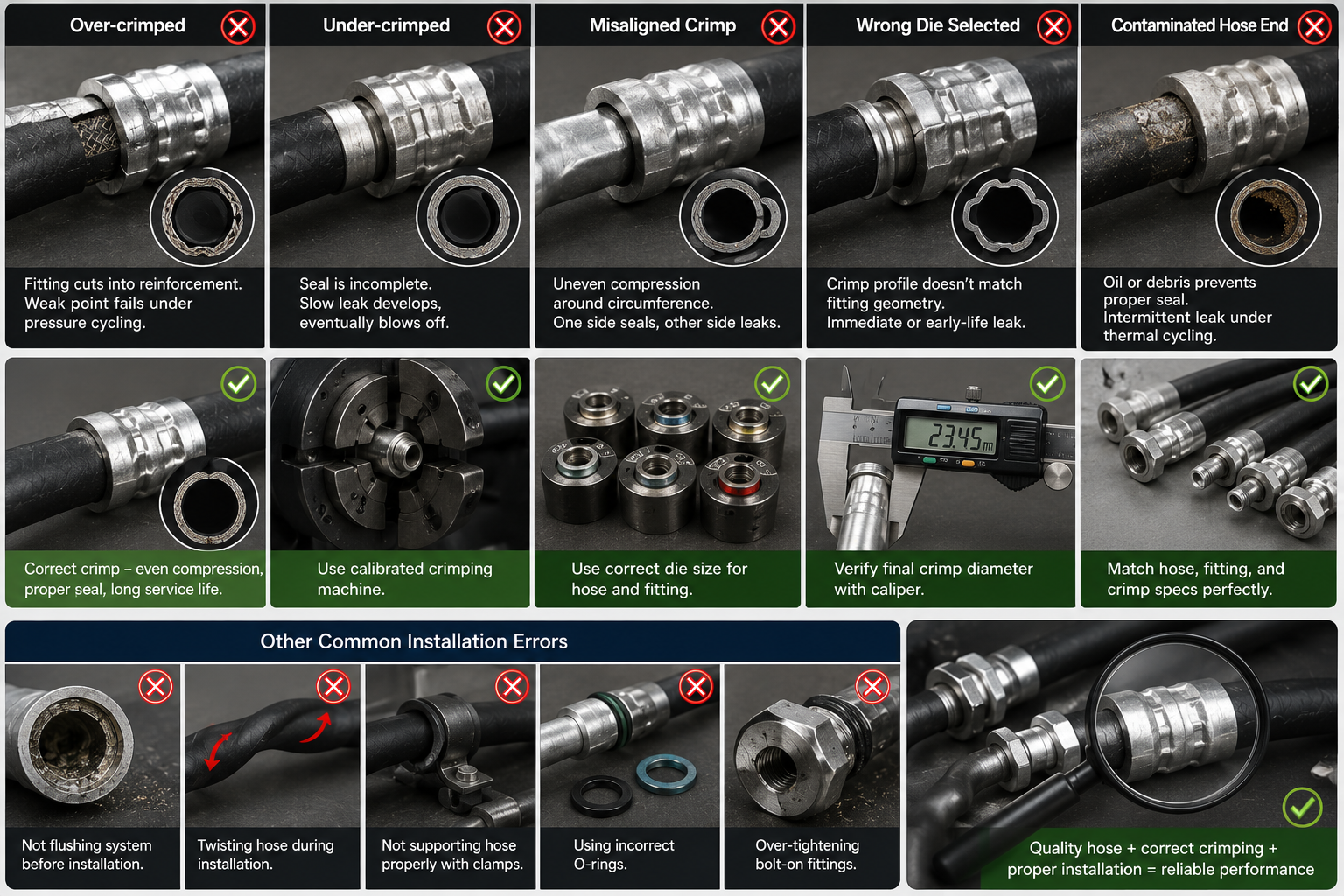
What goes wrong during crimping
Crimping connects the fitting to the hose. It must compress the fitting sleeve evenly around the hose, creating a leak-proof seal without damaging the internal layers.7 This sounds simple. In practice, it requires the right die size, correct crimp diameter for the specific hose and fitting combination, and a calibrated crimping machine.
Here's what we see in returned hoses:
| Crimping Error | What Happens | End Result |
|---|---|---|
| Over-crimped | Fitting sleeve cuts into reinforcement braid | Weak point fails under pressure cycling |
| Under-crimped | Seal is incomplete | Slow leak develops, eventually blows off |
| Misaligned crimp | Uneven compression around circumference | One side seals, other side leaks |
| Wrong die selected | Crimp profile doesn't match fitting geometry | Immediate or early-life leak |
| Contaminated hose end | Oil or debris prevents proper seal | Intermittent leak under thermal cycling |
Why this matters for buyers
When customers contact us about leaking hoses, our first question is always about the crimping process. What machine did you use? What die size? What was the final crimp diameter? In most cases, the answer reveals the problem. The hose liner was intact. The reinforcement was undamaged. The failure was at the crimp zone.
This has direct implications for sourcing decisions. A buyer who purchases the cheapest hose but pairs it with a poorly calibrated crimping machine, or who doesn't verify crimp specifications for each hose-and-fitting combination, will experience repeated failures. They'll blame the hose. But the hose was never the problem.
I always tell my customers: the crimping machine is as important as the hose itself. We manufacture both for exactly this reason — so the crimp specs match the hose specs perfectly. When buyers source hoses from one supplier and fittings from another and use a third-party crimping machine with generic dies, they introduce variables that nobody controls.
Installation errors beyond crimping
Crimping isn't the only installation risk. Other common mistakes include:
- Failing to flush debris from the system before connecting a new hose8
- Twisting the hose during installation (puts torsional stress on the crimp)9
- Not supporting the hose properly with clamps
- Using incorrect O-rings at the fitting connection10
- Over-tightening bolt-on fittings, which distorts the sealing surface
Each of these creates a condition that will eventually cause a leak or failure — and none of them are the hose's fault.
How Can You Prevent AC Hose Failure Before It Happens?
Prevention isn't a generic checklist. Each step directly addresses a specific failure mode.
Preventing AC hose failure requires matching the hose material to the refrigerant type, using calibrated crimping equipment with verified specifications, routing hoses with adequate clearance and bend radius, and inspecting contact points during installation. Prevention starts at the sourcing stage, not the workshop.
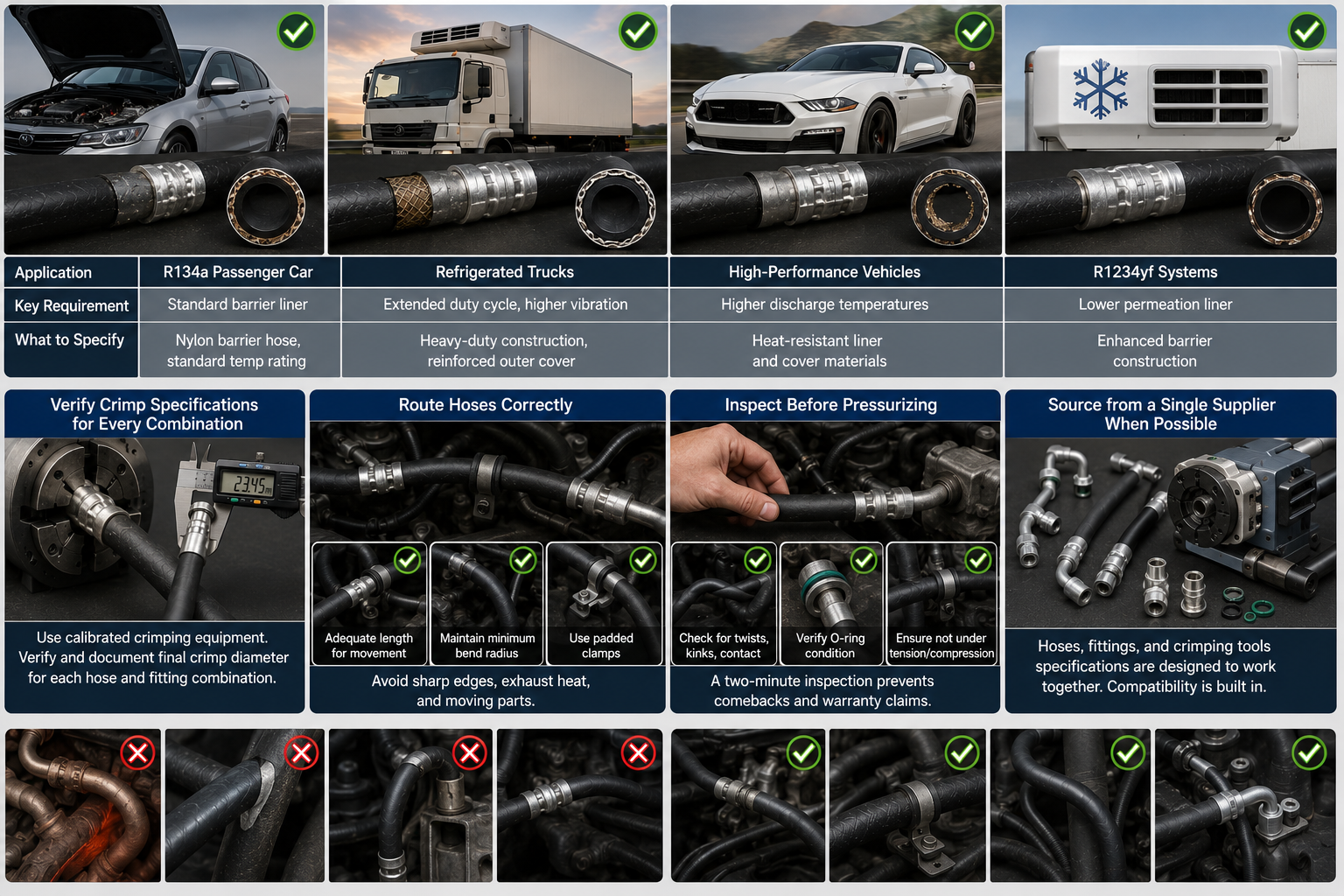
Match material to application
This prevents heat aging and chemical degradation failures. R134a and R1234yf have different permeation characteristics11. Refrigerated truck applications impose different temperature and duty-cycle demands than passenger cars. Ask your supplier which liner material is specified for your exact application. A "standard" hose is only standard for one context.
| Application | Key Requirement | What to Specify |
|---|---|---|
| R134a passenger car | Standard barrier liner | Nylon barrier hose, standard temp rating |
| R1234yf systems | Lower permeation liner | Enhanced barrier construction |
| Refrigerated trucks | Extended duty cycle, higher vibration | Heavy-duty construction, reinforced outer cover |
| High-performance vehicles | Higher discharge temperatures | Heat-resistant liner and cover materials |
Verify crimp specifications for every combination
This prevents crimping failures — the number one hidden cause. Don't assume one die fits all. Every hose diameter and fitting combination has a specific final crimp diameter. Document it. Measure it. If you change hose suppliers, re-verify every crimp spec.
Route hoses correctly
This prevents vibration and mechanical damage. Allow sufficient length for engine movement. Maintain minimum bend radius. Use padded clamps. Keep hoses away from exhaust components and sharp edges. If a hose fails at the same spot twice, the routing is wrong — not the hose.
Inspect before pressurizing
This prevents early-life failures from installation errors. Check for twists, kinks, and contact points. Verify O-ring condition at connections. Confirm the hose is not under tension or compression. A two-minute visual inspection before charging the system can save a callback and a warranty claim.
Source from a single supplier when possible
This isn't just a sales pitch — it's risk management. When your hoses, fittings, and crimping tools all come from the same manufacturer, the specifications are designed to work together. There are no gaps between one supplier's tolerance and another's. Compatibility is built in, not assumed.
Conclusion
AC hose failure is a selection and installation problem, not just a product problem. Match the right material to the application, crimp correctly, route carefully, and most failures never happen.
<!--[googlesitekit-end-of-content]-->
"Ignition > Autoigntion > Surf Temperatures Detailed Info and ...", https://depts.washington.edu/vehfire/ignition/autoignition/surftemperdetail.html. Automotive thermal environment studies document under-hood temperatures that can range from ambient to well above 100°C in proximity to heat sources such as the exhaust manifold and engine block, with sustained exposure at these temperatures known to accelerate oxidative degradation in elastomeric components. Evidence role: statistic; source type: paper. Supports: That under-hood temperatures in typical passenger vehicles reach levels sufficient to accelerate thermal degradation of rubber and polymer hose materials. Scope note: Temperature distribution varies substantially by vehicle design, engine type, and hose routing position; peak temperatures near exhaust components are not representative of all hose locations. ↩
"[PDF] Compatibility of R1234yf and R134a and Lubricants used in ...", https://docs.lib.purdue.edu/cgi/viewcontent.cgi?article=3057&context=iracc. SAE International standards and industry technical documentation distinguish hose barrier requirements for R1234yf and R134a refrigerants, reflecting differences in molecular size, permeation rate, and chemical compatibility with liner materials. Evidence role: expert_consensus; source type: institution. Supports: That R1234yf refrigerant systems impose different hose permeation and material compatibility requirements compared to R134a systems. Scope note: Specific SAE standard revisions and their applicability to aftermarket hose sourcing decisions should be verified against the current published version of the relevant standard. ↩
"[PDF] Materials Compatibility of HVACR System Materials with Low GWP ...", https://docs.lib.purdue.edu/cgi/viewcontent.cgi?article=2368&context=iracc. Chemical compatibility studies on HFO-1234yf (R1234yf) document differences in interaction with elastomeric and barrier materials relative to HFC-134a (R134a), with some liner formulations showing elevated swelling, permeation, or degradation rates when exposed to R1234yf. Evidence role: mechanism; source type: paper. Supports: That R1234yf refrigerant has different chemical compatibility characteristics with hose liner materials compared to R134a, potentially causing accelerated degradation in non-specified hoses. Scope note: Compatibility outcomes are highly dependent on specific liner formulation; general findings may not predict performance for all hose constructions marketed as R134a-compatible. ↩
"Surface Vehicle Standard: (R) Coupled Automotive Refrigerant Air ...", https://www.scribd.com/document/595640483/J2064-202104. SAE J2064, the primary industry standard governing automotive refrigerant hose construction and performance, specifies minimum burst pressure requirements that substantially exceed typical system operating pressures to provide a defined safety margin. Evidence role: definition; source type: institution. Supports: That automotive AC hoses are manufactured and tested to burst pressure ratings substantially above normal operating pressures, as defined by industry standards. Scope note: Actual safety factor multiples vary by hose type, line position, and standard revision; the article's characterization of 'well above' is qualitative and may not reflect the precise margins specified in current standards. ↩
"(PDF) Failure analysis of flexible metal hose at compressor discharge", https://www.academia.edu/49254243/Failure_analysis_of_flexible_metal_hose_at_compressor_discharge. Engineering studies on flexible hose fatigue demonstrate that cyclic pressure loading progressively degrades reinforcement braid or spiral layers through fatigue crack initiation and propagation, with failure likelihood increasing as a function of cycle count and pressure amplitude. Evidence role: mechanism; source type: paper. Supports: That repeated pressure cycling induces fatigue in the reinforcement layer of flexible hoses, gradually reducing structural integrity over service life. Scope note: Published fatigue studies often address hydraulic or industrial hoses; direct data specific to automotive AC refrigerant hose cycling conditions may be limited in open literature. ↩
"[PDF] Analysis of Mounting Layouts for Improved Vibration Isolation ...", https://kb.osu.edu/bitstreams/3e2e2a75-4641-5fd1-a9a2-903adc4b8bbc/download. Automotive NVH engineering literature documents that engine mounts permit controlled relative displacement between the powertrain and vehicle body across a range of frequencies, imposing cyclic bending and tensile loads on flexible components spanning the two structures. Evidence role: mechanism; source type: paper. Supports: That differential motion between engine-mounted and body-mounted components subjects connecting flexible lines to repeated dynamic displacement and stress. Scope note: The magnitude of relative displacement varies significantly by vehicle design, engine mount condition, and operating speed; the article's claim is directionally supported but not quantified. ↩
"[PDF] Introduction to Hydraulic Hose and Fittings", https://dlnr.hawaii.gov/mk/files/2017/01/Freitas-S-18-a.pdf. Industry standards for hose and fitting assembly, including those published by SAE International and the Fluid Power Society, specify crimp diameter tolerances, die selection criteria, and inspection requirements to ensure consistent sealing performance without internal layer damage. Evidence role: definition; source type: institution. Supports: That hose crimping standards define specific dimensional and process requirements for achieving a leak-proof seal without compromising hose structural integrity. Scope note: Standards for hydraulic hose crimping are more extensively documented in open literature than those specific to automotive refrigerant hose; applicability should be confirmed against refrigerant-specific assembly specifications. ↩
"Handling Contaminated Automotive Refrigerants | US EPA", https://www.epa.gov/mvac/handling-contaminated-automotive-refrigerants. Automotive service guidelines from organizations such as SAE International and vehicle manufacturer service manuals specify system flushing as a required step when replacing AC components, citing contamination from compressor debris or moisture as a cause of premature failure in replacement parts. Evidence role: expert_consensus; source type: institution. Supports: That flushing the AC system to remove debris and contamination before installing replacement components is a recognized industry service requirement. Scope note: Flushing requirements and procedures vary by system design and failure type; the article's general statement may not reflect the specific conditions under which flushing is mandated versus recommended. ↩
"[PDF] Introduction to Hydraulic Hose and Fittings", https://dlnr.hawaii.gov/mk/files/2017/01/Freitas-S-18-a.pdf. Engineering analyses of flexible hose assemblies identify torsional stress as a contributor to crimp zone fatigue and seal degradation, as twisting introduces non-uniform loading at the fitting interface that the crimp geometry is not designed to accommodate. Evidence role: mechanism; source type: paper. Supports: That torsional loading applied to a hose during or after installation creates stress concentrations at the crimp zone that can compromise seal integrity and accelerate failure. Scope note: Quantitative torsion limits for automotive AC hose assemblies are not widely published in open literature; this mechanism is more extensively documented for hydraulic hose applications. ↩
"[PDF] Compatibility of R1234yf and R134a and Lubricants used in ...", https://docs.lib.purdue.edu/cgi/viewcontent.cgi?article=3057&context=iracc. SAE standards and vehicle manufacturer service documentation specify O-ring material compatibility and dimensional requirements for refrigerant fitting connections, noting that substitution with non-specified O-rings can result in inadequate sealing due to material incompatibility with the refrigerant or lubricant, or dimensional mismatch at the sealing interface. Evidence role: definition; source type: institution. Supports: That AC refrigerant fittings require O-rings of specified material and dimensions, and that incorrect O-ring selection is a documented cause of refrigerant leaks. Scope note: O-ring specifications differ between R134a and R1234yf systems and across fitting designs; the article's general statement should be understood as applicable to specific system and fitting combinations rather than universally. ↩
"Protection of Stratospheric Ozone: Listing of HFO-1234yf Under the ...", https://www.federalregister.gov/documents/2022/05/04/2022-08923/protection-of-stratospheric-ozone-listing-of-hfo-1234yf-under-the-significant-new-alternatives. Published permeation studies comparing HFC-134a and HFO-1234yf through barrier hose constructions report differences in permeation flux attributable to variations in molecular properties and solubility in liner materials, informing hose specification requirements for each refrigerant. Evidence role: statistic; source type: paper. Supports: That R134a and R1234yf differ measurably in their permeation rates through automotive hose barrier materials. Scope note: Permeation rates are sensitive to liner material formulation, temperature, and pressure conditions; published values from laboratory studies may not directly translate to field service conditions. ↩