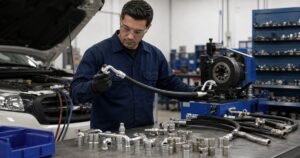
You just got quoted $300 for an AC hose replacement. The hose itself costs $40 online. Where does the rest of your money go?
AC hose replacement typically costs between $150 and $6001, depending on labor rates, vehicle type, and hose location. The hose itself costs $30-$100, but labor accounts for 60-80% of total expense2 because mechanics must evacuate refrigerant, remove surrounding components, and recharge the system.

Most people focus on the hose price tag. That's the smallest part of what you pay. I'll show you exactly where your money goes and how to make better decisions when your AC hose fails.
What Factors Affect AC Hose Replacement Cost?
You see two quotes for the same car. One says $200. The other says $450. Both shops use similar hoses.
Cost depends on five variables: hose location accessibility, refrigerant type (R134a vs R1234yf), whether the system needs flushing, local labor rates, and whether you use OEM or aftermarket parts. Rear AC hoses cost more because mechanics need extra disassembly time.

Hose Location Changes Everything
I see this pattern with distributor customers. They order hoses without asking where it goes on the vehicle. A suction hose between the compressor and evaporator takes 45 minutes to replace in most sedans. A liquid line behind the dashboard takes 4 hours because the mechanic removes the entire dash assembly.
Here's what drives labor differences:
| Hose Position | Average Labor Time | Disassembly Required |
|---|---|---|
| Compressor to condenser | 1-2 hours | Hood area access only |
| Evaporator to compressor | 2-3 hours | Partial dash removal |
| Rear AC lines | 3-4 hours | Interior trim and carpet |
One customer returned an order because they bought budget hoses for a rear AC system. The shop quoted them $600 labor. They assumed front system pricing. I ask location now before confirming any distributor order.
Refrigerant Type Multiplies Costs
R134a systems cost less to service than R1234yf systems. The refrigerant itself costs more. R1234yf runs $80-$120 per pound versus $30-$50 for R134a3. Shops need different recovery machines. They charge you for the equipment investment.
Some mechanics add flush service when they see contaminated refrigerant. Flushing removes debris that caused the original hose failure. That adds $100-$200. You need it if metal particles appear in the old refrigerant or if the compressor failed before the hose leaked.
OEM vs Aftermarket Parts Gap
OEM hoses cost 40-60% more than aftermarket equivalents. The markup isn't just brand name. OEM hoses come with exact-fit fittings already crimped. Aftermarket hoses sometimes require fitting adaptation. I've handled returns where distributors bought cheap hoses without checking fitting thread sizes. The shop couldn't install them without retrofit adapters.
The quality gap shows up in barrier layer construction. OEM hoses use specific permeation-resistant materials4. Cheaper hoses lose refrigerant faster through molecular seepage. You save $30 on the part and spend $150 more per year on refrigerant top-ups.
AC Hose Repair vs Replacement Cost
Your mechanic says the hose just needs new fittings. Another shop says replace everything. Who's right?
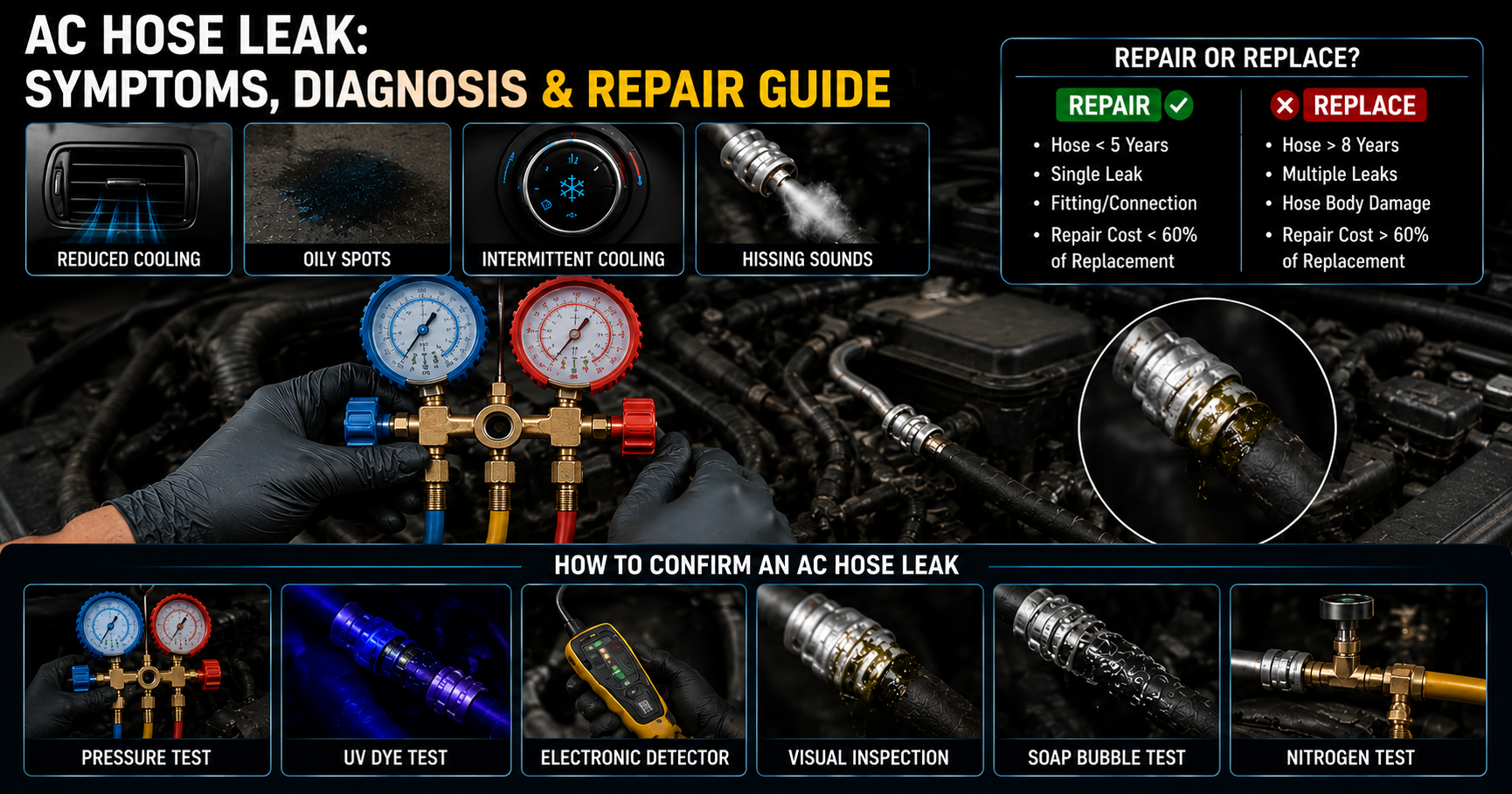
Repair costs $80-$150 when only fittings fail. Full replacement costs $150-$600. Repair makes sense for fitting leaks with undamaged hose body. Replace when you see cracks, bulges, or refrigerant stains on the hose rubber. Repair delays fail within 1-2 years on deteriorated hoses.
When Repair Actually Works
Fitting failures happen at crimp points. The ferrule loses compression. Refrigerant leaks at the connection, not through the hose wall. I see this in customer photos they send when ordering replacement fittings.
Repair involves cutting off the old fitting, cleaning the hose end, installing a new fitting and ferrule, then crimping with proper die specs. The hose itself stays intact. This works if:
- The hose shows no surface cracks or weather checking
- Refrigerant stains only appear at fitting areas
- The hose hasn't exceeded its service life (typically 10-12 years5)
- The rubber remains flexible without hardening
One distributor learned this the hard way. They sold repair fittings for aged hoses. Customers crimped new fittings onto brittle hoses. The hose body failed within months. They returned entire batches. I now ask hose age before recommending repair components.
Hidden Costs in Partial Repairs
Repair seems cheaper. You pay for fittings, ferrules, and crimping service. You skip the hose cost. But the mechanic still evacuates the system, removes the hose, and recharges refrigerant. Labor costs stay nearly identical to replacement.
The calculation changes when you add these factors:
| Cost Element | Repair | Replace |
|---|---|---|
| Parts | $15-30 | $40-100 |
| Labor | $120-300 | $130-320 |
| Refrigerant | $40-80 | $40-80 |
| Warranty period | 30-90 days | 1-3 years |
You save $25-50 on parts. You risk a repeat failure that costs another $200 in labor and refrigerant when the weakened hose body gives out. Replacement includes the entire assembly under warranty.
System-Wide Failure Indicators
I tell distributor customers to check companion hoses when one fails. AC hoses age as a group. They face identical heat cycles and refrigerant exposure. If the high-pressure hose shows cracks, the suction hose probably has similar damage.
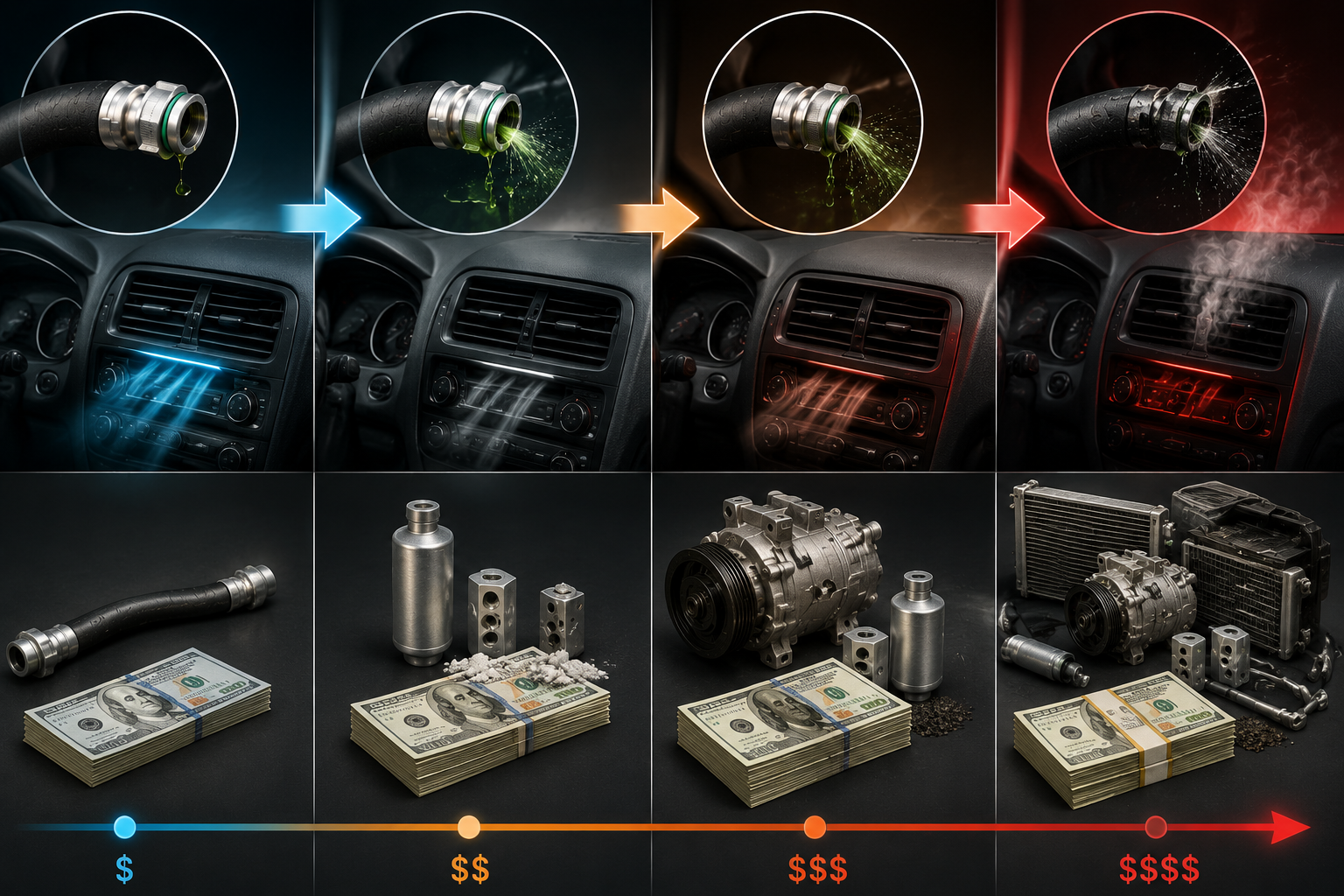
Replacing only the failed hose means you'll replace its neighbor within 6-18 months. Some customers order complete hose sets after I show them this pattern. They spend 40% more upfront and avoid repeat service visits. The second repair would cost more than buying all hoses in the first job.
Labor Cost for AC Hose Replacement
The hose costs $50. The shop charges $250 for labor. You wonder what takes so long.
Labor costs $80-$400 depending on book hours, local rates, and system complexity. Mechanics spend time on refrigerant recovery (30-45 minutes), hose removal with fitting access (1-3 hours), and system recharge with leak testing (45-60 minutes). Hourly rates range from $70 to $150 across regions.

What You Actually Pay For
Shops don't just swap hoses. They perform a complete refrigerant circuit service. I learned this when distributors asked why their customers complained about high repair bills even with cheap hoses.
The process involves mandatory steps:
First, the mechanic connects a recovery machine. This captures refrigerant into a storage tank. You can't vent R134a or R1234yf to atmosphere. It's illegal in most regions.6 Recovery takes 30-45 minutes as the machine slowly pulls refrigerant from the entire system. You pay for this even on a simple hose job.
Second, they access the failed hose. Front hoses near the condenser take minimal disassembly. Rear hoses or evaporator connections require removing interior panels, carpets, or dashboard sections. I've seen customer photos where mechanics removed front seats to access rear AC lines in SUVs. That's where hours pile up.
Third, they install the new hose with proper fitting torque. Aluminum fittings crush easily. The mechanic uses torque wrenches and applies thread sealant compatible with refrigerant. Over-tightening cracks the fitting. Under-tightening causes leaks. This precision work takes longer than basic bolt-on repairs.
Fourth, they vacuum the system for 30-45 minutes. This removes air and moisture that entered when the hose was disconnected. Moisture in refrigerant circuits causes corrosion and reduces cooling capacity7. Shops can't skip this step without creating warranty claims later.
Finally, they recharge refrigerant to manufacturer specs and leak-test every connection. The mechanic adds UV dye, runs the system, and checks for refrigerant traces with detection lights. This verification prevents immediate comebacks.
Geographic Rate Variations
Labor rates vary dramatically. Urban shops charge $120-$150 per hour. Rural mechanics charge $70-$95 per hour. You can pay double for identical work based purely on location.
I ship hoses to customers across the US. California distributors report $450-$600 average replacement costs. Midwest distributors report $180-$300 for the same vehicles. The hose price stays constant. Labor multiplies your total bill.
Dealerships charge premium rates. They justify it with OEM training and specialized equipment. Independent shops charge 30-40% less for equivalent work. One distributor switched from selling to dealerships to targeting independent shops. Their customer feedback improved because end users paid less for the same quality hoses.
Book Time vs Actual Time
Shops use published book times to estimate jobs8. A repair manual says "2.5 hours" for rear AC hose replacement. The mechanic finishes in 2 hours. You still pay for 2.5 hours.
Book time represents average completion under normal conditions. It includes steps most people don't see:
- Looking up refrigerant capacity specs for your exact vehicle year
- Preparing the recovery machine and confirming tank capacity
- Disposing of contaminated refrigerant properly
- Documenting the service for environmental compliance records
Some jobs exceed book time. Corroded fittings snap during removal. The mechanic needs to extract broken threads. Brittle hoses shred when they try to pull them from clips. These complications aren't your fault, but you pay for the extra time.
Cost Differences Between Vehicle Types
Your friend paid $180 for AC hose replacement on their sedan. Your SUV quote says $420. Same hose failure, different vehicles.
Compact cars cost $150-$250 for typical hose replacement. Full-size trucks and SUVs cost $300-$600 because they use longer hoses, dual-zone climate systems with multiple lines, and require more disassembly for access. Luxury vehicles add 30-50% cost premium for specialized fittings and refrigerant specifications.

Size and Configuration Impact
Small vehicles use simpler AC layouts. The compressor, condenser, and evaporator sit close together. Hoses run 2-4 feet maximum. Large SUVs and trucks stretch these components across 6-8 feet. Longer hoses cost more. They also fail more often because length creates additional vibration stress points.
Dual-zone systems multiply complexity. You have separate hoses for front and rear cooling. Some vehicles add third-row climate controls with dedicated lines. I've shipped orders where distributors needed six different hose assemblies for one vehicle model. Each line adds labor time and component cost.
Here's what I see across vehicle categories:
| Vehicle Type | Typical Hose Count | Access Difficulty | Average Total Cost |
|---|---|---|---|
| Compact sedan | 3-4 hoses | Easy front access | $150-$250 |
| Midsize SUV | 4-6 hoses | Moderate | $250-$380 |
| Full-size truck | 4-5 hoses | Engine bay crowded | $280-$450 |
| Luxury sedan | 4-5 hoses | Complex electronics | $320-$550 |
| Large SUV | 6-8 hoses | Multiple zones | $400-$600 |
One customer didn't understand why their Suburban cost triple their previous Honda Civic repair. I sent them photos of both hose layouts. The Civic has one 3-foot suction hose. The Suburban has a 7-foot main line plus four auxiliary hoses for rear climate control. The parts alone cost four times more before labor.
Luxury Vehicle Premiums
European and luxury brands use proprietary fittings. You can't install generic aftermarket hoses without adapter fittings. Some require specialized crimping dies that standard shops don't stock.
I remember one distributor who bought bulk BMW hoses without checking fitting specs. The local shop couldn't install them. Their crimping machine didn't have the right die profile. The distributor had to reorder OEM-spec fittings and return the incompatible parts.
Luxury vehicles also specify tighter refrigerant capacity tolerances. The mechanic adds refrigerant in precise increments, checking pressure sensors at each step. This attention extends labor time. You pay for the precision that prevents sensor faults and performance complaints.
Hybrid and Electric Vehicle Considerations
Hybrids add electric compressor systems. Some use high-voltage components near AC lines. Mechanics need electrical safety certification before working on these systems.9 Shops charge extra for certified technicians.
Electric vehicles like Tesla use heat pump systems instead of traditional AC10. Their "hoses" are rigid tubes with specialized quick-connect fittings. Standard crimping equipment doesn't work. You need factory tooling. This limits which shops can perform repairs and increases hourly rates.
How to Reduce AC Hose Replacement Expenses
You need the work done. You want to spend less without compromising quality.
Reduce costs by obtaining 3-4 competitive quotes, supplying quality aftermarket hoses yourself if shops allow customer parts, scheduling repairs during off-season (fall/winter) for better rates, and replacing multiple aging hoses in one service visit to avoid repeat labor charges. Verify shop certification before choosing based purely on price.

Quote Comparison Reveals Markup Patterns
Get written estimates from independent shops, chain service centers, and at least one dealership. Request itemized breakdowns showing parts cost, labor hours, and refrigerant quantity.
I've seen customer quotes vary by $200-$300 for identical work. One distributor shared three estimates their customer received for rear AC hose replacement on a Honda Pilot:
- Dealership: $580 (2.5 hours labor at $145/hour, OEM hose $95)
- Chain shop: $420 (2.5 hours at $110/hour, aftermarket hose $65)
- Independent: $310 (2.0 hours at $95/hour, quality aftermarket $55)
The independent shop had a technician who specialized in Honda AC systems. Experience let them complete the job faster. The hose quality matched the chain shop option. The customer saved $270.
Don't choose based only on lowest price. Verify the shop lists refrigerant recovery and system vacuum in their estimate. If they don't mention these steps, they're either skipping critical procedures or hiding costs in vague line items.
Supplying Your Own Parts Strategy
Some shops accept customer-supplied parts. Others refuse because they can't warranty parts they didn't source. Ask this question before buying hoses independently.
If you supply parts, purchase from distributors who serve professional shops, not generic online marketplaces. I decline retail customers who want to buy single hoses for DIY repairs. I sell to distributors because they understand matching requirements. Poor hose selection creates installation failures that damage shop reputations.
Make sure your supplier confirms:
- Hose barrier layer type matches your refrigerant (R134a vs R1234yf)
- Fitting thread sizes match your vehicle's ports exactly
- Ferrules are included and sized correctly for the hose diameter
- Crimping specs are provided if the shop needs to verify compatibility
One customer bought "universal AC hoses" online. The fittings were metric thread on a vehicle with SAE fittings. The shop charged $80 diagnostic fee to identify incompatibility. The customer then paid full price for proper hoses from the shop's supplier. They lost money trying to save money.
Timing Your Repair Strategically
AC repairs spike in late spring and summer. Shops charge full rates because demand exceeds capacity.11 Winter and early spring see lower volume. Some shops offer 10-15% discounts during slow periods.
I notice distributor order patterns follow this cycle. March through May orders triple compared to November through January. Smart buyers stock inventory in fall when suppliers offer better pricing. The same strategy works for end users booking service.
Call shops in January or February. Ask if they offer off-season rates for AC work. Explain your system still works but you know a hose shows early wear. Proactive replacement during slow season saves money and prevents summer breakdown when prices peak.
Bundle Multiple Hoses in One Service
If your vehicle is 10+ years old and one hose failed, others are near failure. Replacing multiple hoses in one service visit eliminates duplicate labor charges.
The mechanic only evacuates refrigerant once. They only recharge once. You pay for disassembly once. Adding a second or third hose increases parts cost but only adds
<!--[googlesitekit-end-of-content]-->
"Car A/C Repair Costs | Kelley Blue Book", https://www.kbb.com/service-repair-guide/car-ac-repair-costs/. Industry surveys and consumer automotive repair databases document typical AC hose replacement costs, though regional variation and vehicle-specific factors create wide ranges in actual pricing. Evidence role: statistic; source type: research. Supports: typical price ranges for automotive AC hose replacement services. Scope note: Price ranges vary significantly by region, vehicle type, and service provider, making national averages contextual rather than predictive for individual cases ↩
"Average Mechanic Labor Rate: Repair Costs in Your State 2026 - AAA", https://www.aaa.com/autorepair/articles/average-mechanic-labor-rate-repair-costs-in-your-state-2026. Automotive service industry analyses indicate that labor typically constitutes the majority of repair costs for refrigerant system work, reflecting the technical complexity and time requirements of proper refrigerant handling procedures. Evidence role: statistic; source type: research. Supports: the proportion of labor costs relative to parts in automotive AC repairs. Scope note: The exact percentage varies based on parts pricing, regional labor rates, and specific repair complexity ↩
"R-1234yf - Refrigerants Center", https://refrigerantscenter.com/collections/r-1234yf?srsltid=AfmBOooML01qDftAyNK2Lr8IF25hQ1RN7MAlRErA3YOvQAUiXm_sG6-6. Automotive service industry reports document significant price differences between R134a and R1234yf refrigerants, with the newer R1234yf commanding premium pricing due to patent protections and lower production volumes. Evidence role: statistic; source type: research. Supports: comparative pricing between different automotive refrigerant types. Scope note: Refrigerant prices fluctuate based on market conditions, regulatory changes, and supply chain factors ↩
"Car Air Conditioning Hose, A/C Refrigerant Line - StrongFlex", https://www.strongflex.com/project/air-condition-hose/. Automotive engineering standards specify barrier layer requirements for AC hoses to minimize refrigerant loss through molecular permeation, with materials selection based on compatibility with specific refrigerant types and temperature ranges. Evidence role: mechanism; source type: education. Supports: the use of barrier materials in automotive AC hoses to prevent refrigerant permeation. ↩
"Automotive air conditioning - Wikipedia", https://en.wikipedia.org/wiki/Automotive_air_conditioning. Automotive maintenance research indicates that AC system hoses generally experience material degradation after a decade of service due to heat cycling, refrigerant exposure, and environmental factors, though actual lifespan varies with operating conditions. Evidence role: statistic; source type: research. Supports: typical service life expectations for automotive AC hoses. Scope note: Service life depends heavily on climate, usage patterns, and maintenance history ↩
"[PDF] Section 608 of the Clean Air Act: Stationary Refrigeration and ... - EPA", https://www.epa.gov/sites/default/files/2018-09/documents/section_608_of_the_clean_air_act.pdf. The U.S. Environmental Protection Agency prohibits the intentional venting of refrigerants under Section 608 of the Clean Air Act, with similar regulations adopted in many other jurisdictions to prevent ozone depletion and greenhouse gas emissions. Evidence role: general_support; source type: government. Supports: legal prohibitions on venting automotive refrigerants. ↩
"How Does Car AC Work? | UTI - Universal Technical Institute", https://www.uti.edu/blog/automotive/air-conditioning. HVAC engineering principles establish that moisture in refrigerant systems reacts with refrigerant and lubricants to form corrosive acids, while also freezing at expansion devices and reducing heat transfer efficiency. Evidence role: mechanism; source type: education. Supports: the detrimental effects of moisture contamination in refrigerant systems. ↩
"Flat-Rate vs. Hourly Pay: What Auto Mechanics Should Know", https://www.uti.edu/blog/automotive/hourly-rate-vs-flat-rate-how-auto-mechanics-are-paid. The automotive service industry commonly relies on published labor time guides that provide standardized repair duration estimates based on manufacturer specifications and industry testing, forming the basis for labor cost calculations. Evidence role: general_support; source type: research. Supports: the widespread use of standardized labor time guides in automotive repair pricing. ↩
"Electric & Hybrid Automotive Technician Training - EMCC", https://www.emcc.edu/workforce-development/non-credit-and-continuing-education-classes/electric-hybrid-automotive-technician-training/. Automotive service organizations and safety standards require specialized training and certification for technicians working on hybrid and electric vehicle high-voltage systems, including those integrated with climate control components, to prevent electrical hazards. Evidence role: expert_consensus; source type: education. Supports: safety training and certification requirements for working on hybrid and electric vehicle high-voltage systems. ↩
"Recent advances on air heating system of cabin for pure electric ...", https://pmc.ncbi.nlm.nih.gov/articles/PMC9568831/. Many electric vehicles employ reversible heat pump systems for climate control, which can both heat and cool the cabin more efficiently than separate heating and cooling systems, thereby extending vehicle range. Evidence role: mechanism; source type: research. Supports: the use of heat pump technology in electric vehicle climate control systems. Scope note: Not all electric vehicles use heat pumps; some models still use traditional AC with resistive heating ↩
"How Seasonal Changes Impact HVAC/R Technicians ...", https://obc.edu/how-seasonal-changes-impact-hvac-r-technicians-workload/. Automotive service industry data shows predictable seasonal patterns in AC repair requests, with peak demand during warmer months when system failures become immediately apparent to vehicle owners. Evidence role: general_support; source type: research. Supports: seasonal variation in automotive AC repair demand and its effect on service availability. Scope note: Pricing strategies vary by shop; not all service providers implement seasonal rate adjustments ↩