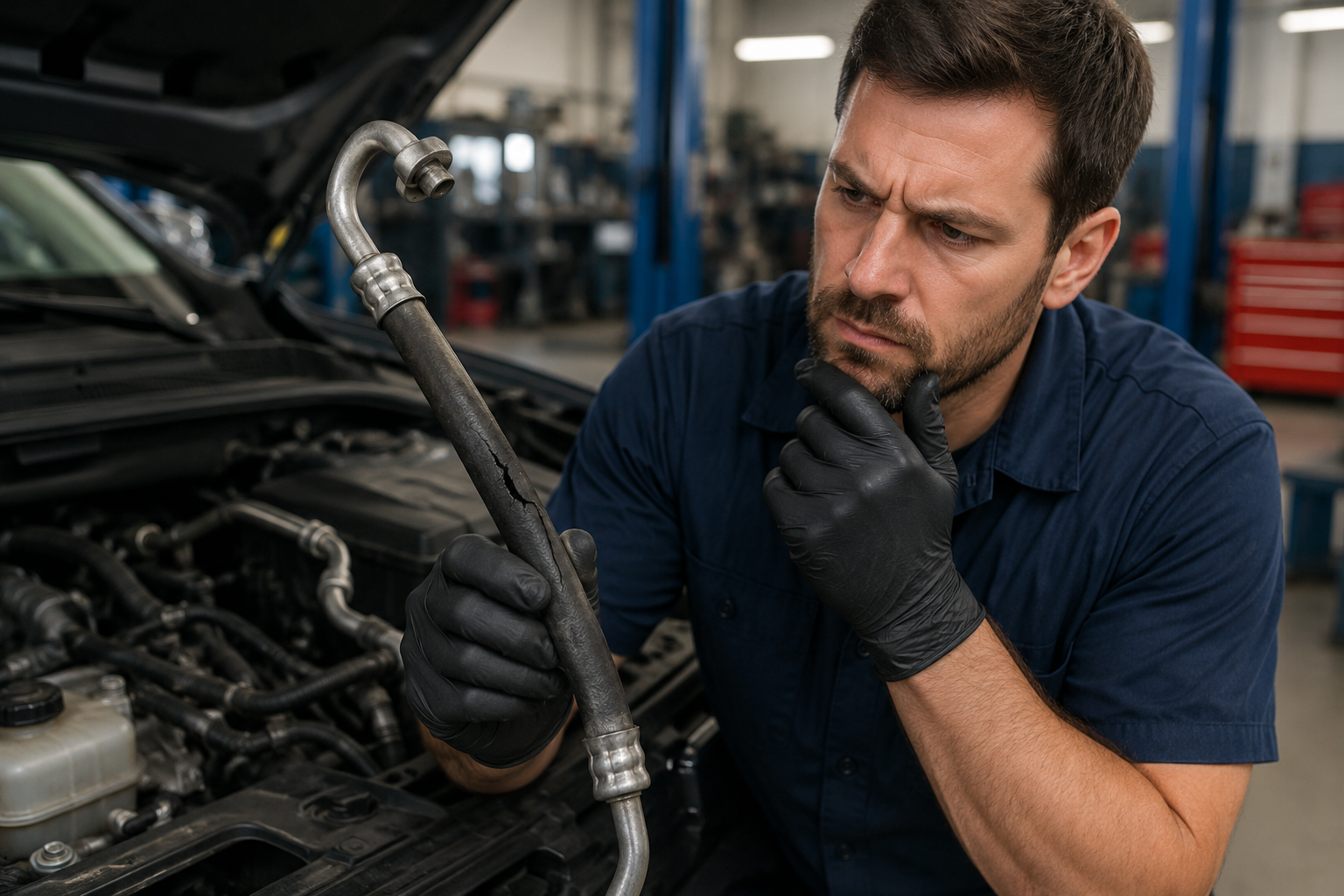
There is a crack in your AC hose. You are staring at it and wondering if you can fix it or if you need a new one. The wrong call costs you time and money.
The honest answer is: it depends on the damage type. A minor fitting leak or surface chafe mark may be repairable. But an inner liner crack, a chemically degraded wall, or a collapsed hose section cannot be reliably fixed. Those need replacement.
This question comes up constantly in conversations with workshops and distributors we work with. And every time, the answer starts in the same place — what kind of damage are we actually talking about? Get that wrong, and everything that follows goes wrong too.
Which Damage Can Be Repaired?
You look at a damaged hose and you want a quick answer. But the damage type is the only thing that gives you a real answer.
Surface chafing and minor fitting leaks are the two damage types that may genuinely tolerate a repair. Everything else is a different category. Fitting connections that have worked slightly loose can be re-crimped with proper tooling1. A chafed outer jacket with no breach to the inner liner can be sleeved.
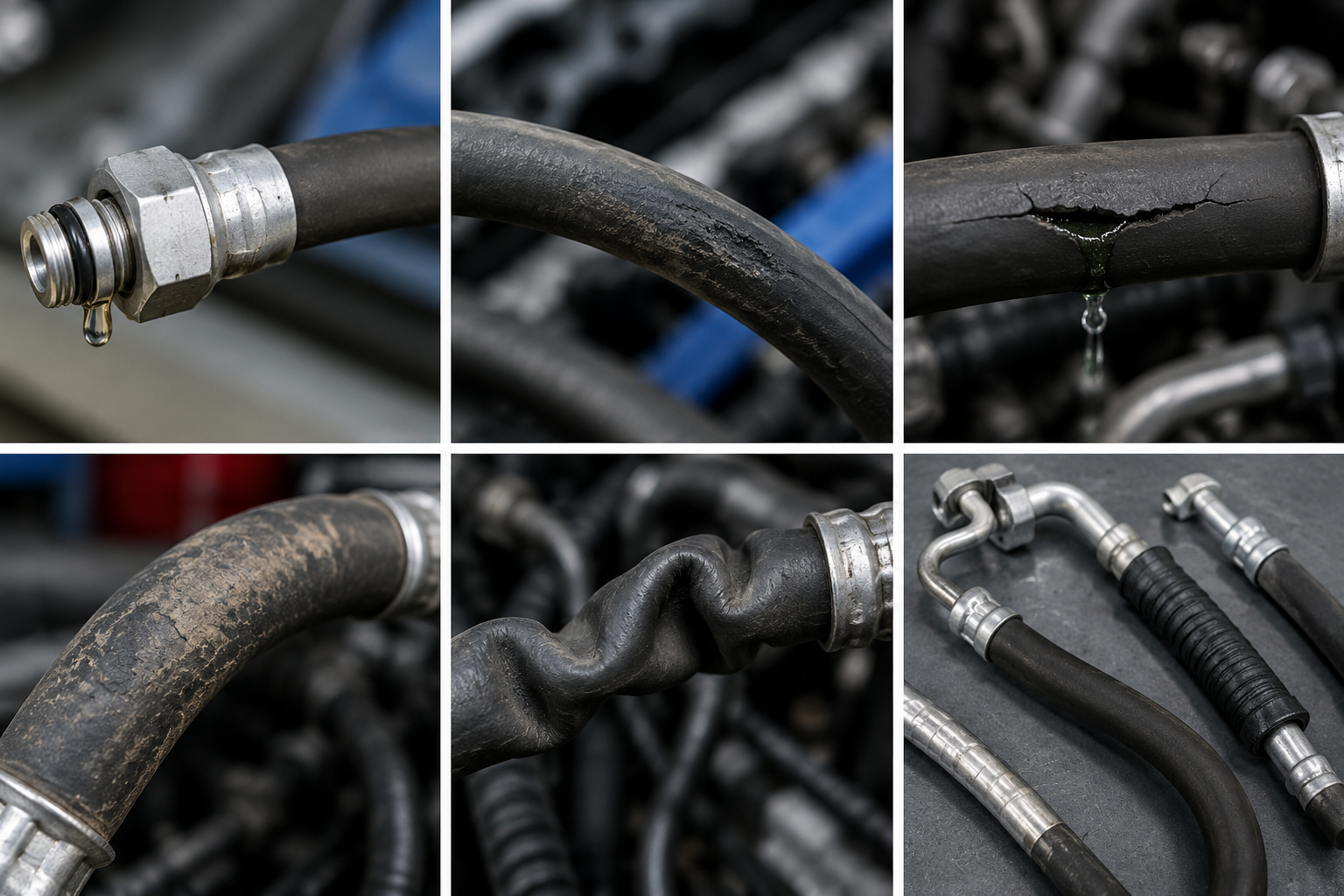
Here is how we break it down when customers ask us directly.
What Does "Repairable" Actually Mean?
There are four common damage types. Each one has a different answer.
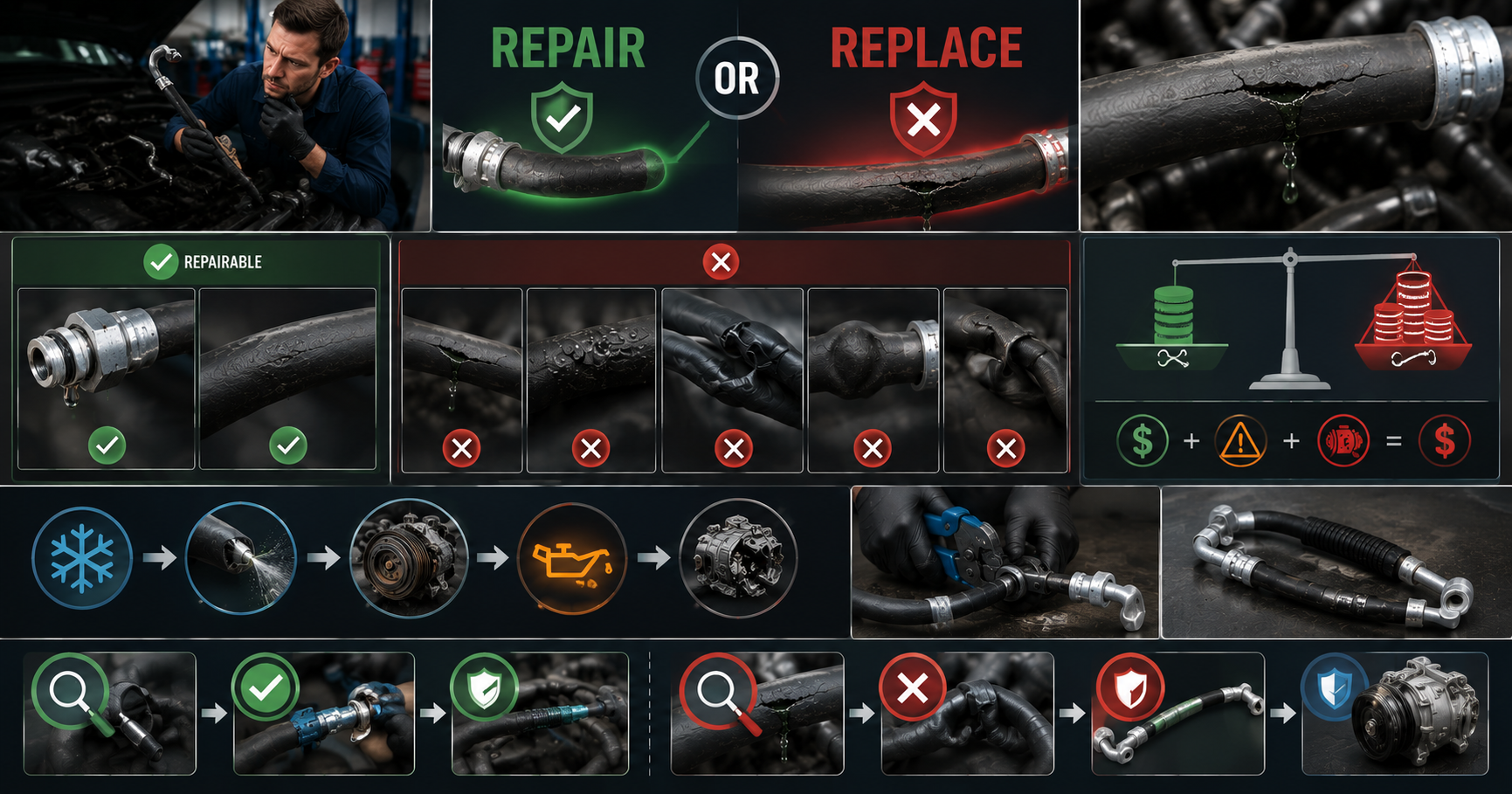
| Damage Type | What It Looks Like | Repair Viable? |
|---|---|---|
| Fitting leak | Refrigerant trace at the connection point, fitting slightly loose | Yes — re-crimp with correct tooling |
| Surface chafe | Outer jacket worn, no cut through to inner liner | Yes — protective sleeve or jacket repair |
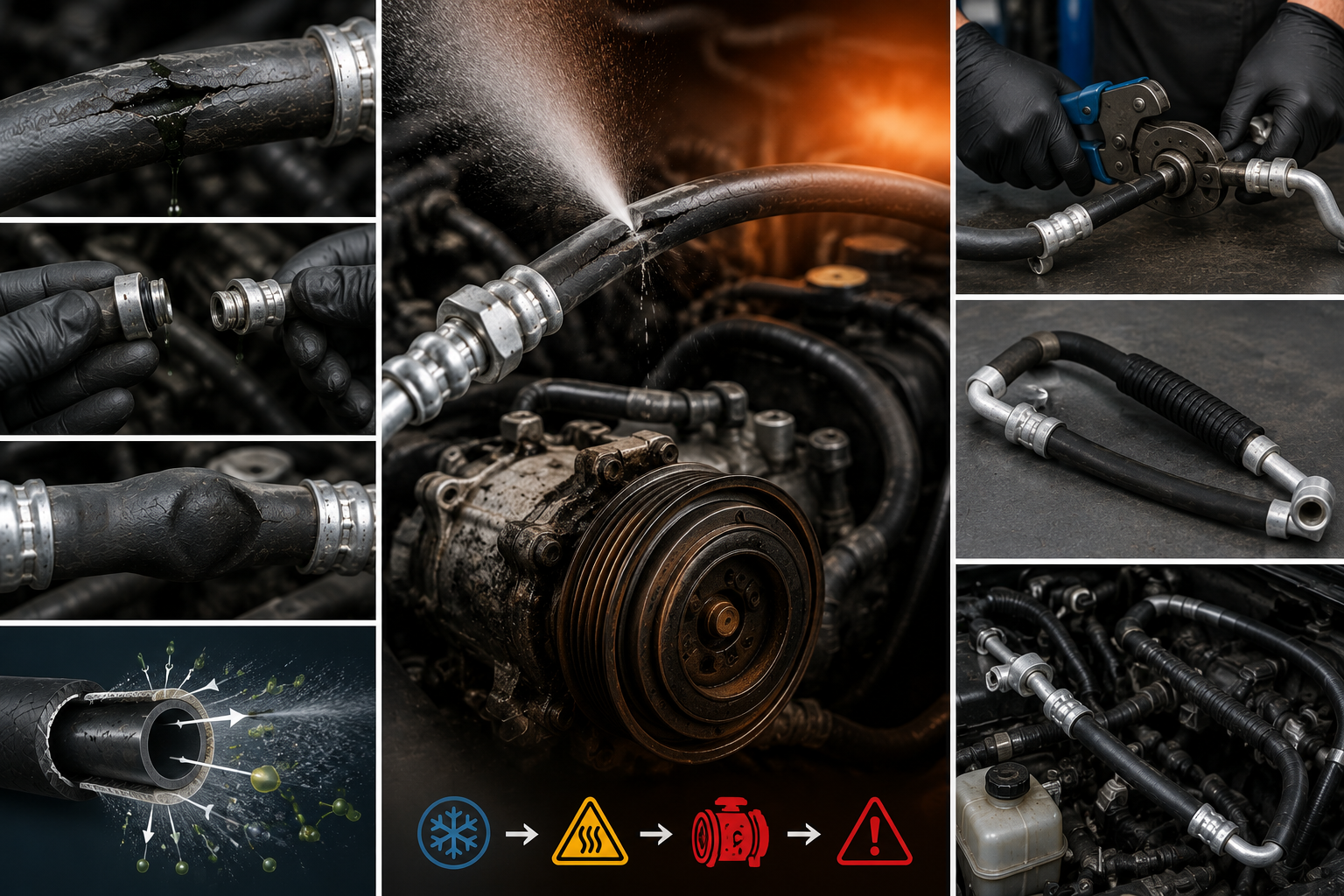
| Inner liner crack | Hose wall breach, refrigerant escaping through the hose body | No — liner integrity is gone |
| Chemical degradation | Hose wall softened, swollen, or sticky | No — material structure has broken down |
| Collapsed hose wall | Hose kinked or crushed, internal diameter reduced | No — flow restriction is a system risk |
The first two rows have a conditional yes. The last three do not.
Here is why the inner liner matters so much. The inner liner is the layer that actually contains the refrigerant. It is designed to hold pressure2 — on the high side of a typical automotive A/C system, that pressure runs somewhere between 200 and 400 psi depending on the refrigerant and operating conditions3. If the liner is cracked or chemically broken down, no external patch changes that. The pressure finds the weak point. It always does.
From what we hear from workshops, the most commonly misjudged situation is a hose that looks fine on the outside but has a degraded liner. The outer jacket can look intact. The hose can feel normal. But if refrigerant has been slowly permeating4 or if incompatible oil has been circulating in the system, the liner may already be compromised5. A visual inspection from the outside does not catch that.
When Replacement Is Necessary
Some hoses look borderline. The damage is not obvious. You wonder if a repair could still work.
Replace the hose when there is any breach to the inner liner, when the hose wall has softened or swollen from chemical exposure, or when the hose has collapsed and the internal diameter is visibly reduced. These are not judgment calls — the hose cannot perform its function safely in any of these states.
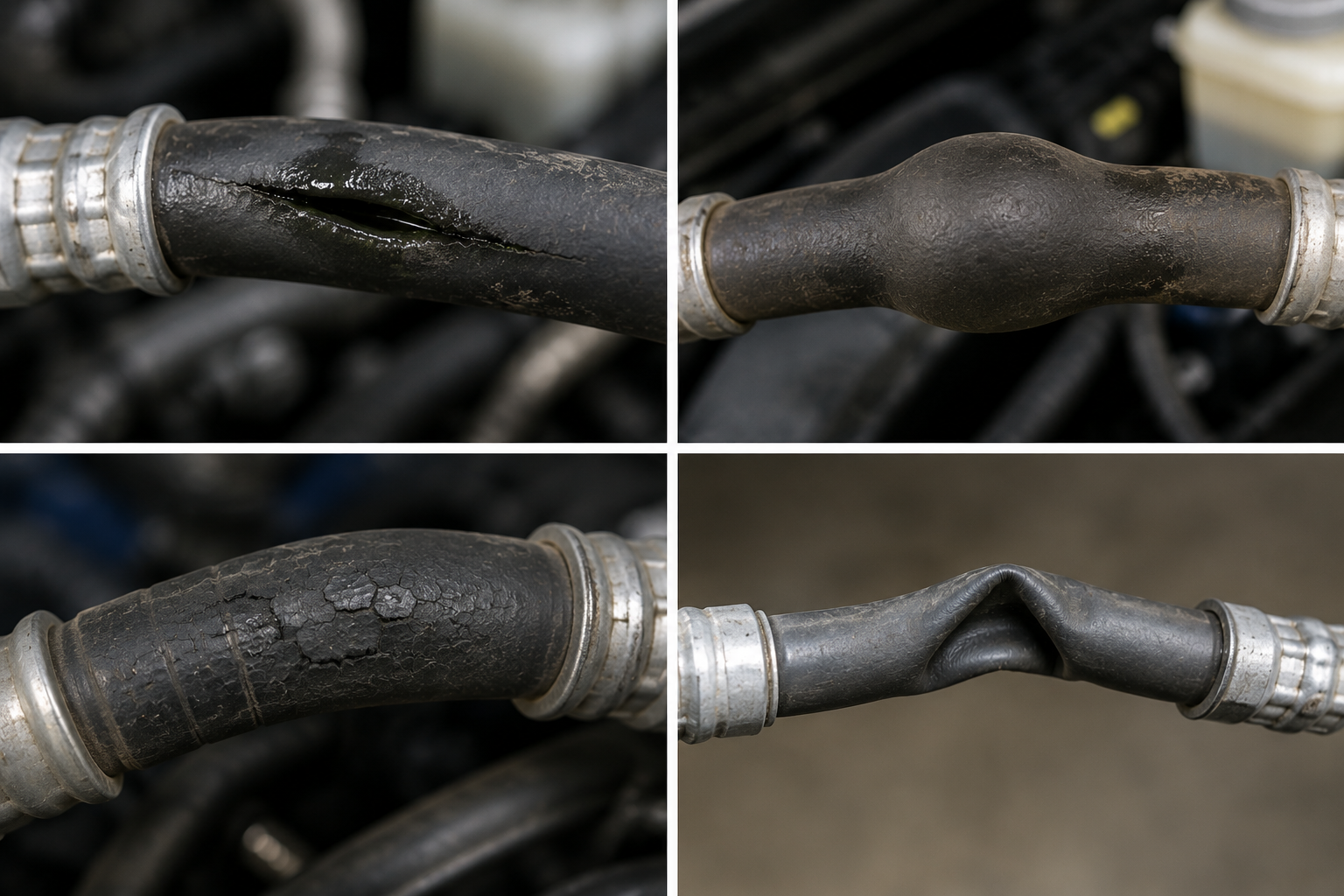
How to Recognize a Hose That Cannot Be Saved
The clearest cases are physical breaches — you can see refrigerant staining or oily residue on the hose body, not just at the fittings. That is a liner failure until proven otherwise.
Chemical degradation is trickier to spot. Here are the signs we tell customers to look for:
- Hose wall feels softer than normal — the rubber has lost structural integrity
- Swelling or bubbling on the outer jacket — internal pressure from liner breakdown
- Sticky or tacky surface — the material has started to break down chemically
- Unusual flexibility near fittings — the hose is losing its shape retention
A collapsed hose is a flow restriction problem as much as a leak problem. Even if it is not actively leaking, a crushed hose section reduces refrigerant flow and puts the compressor under load. That does not show up as a visible leak. It shows up as poor cooling and, eventually, compressor damage.
The pattern we see from distributors and importers is that collapsed hoses are more common in older vehicles where the hose has been rerouted, kinked, or caught under a component6. The hose looks attached and intact. But the system is underperforming and no one is looking at the hose routing.
If a hose has any of these signs, the repair conversation is already over. The only question is what replacement spec is needed.
Hose Repair Methods
You have confirmed the damage is repairable — surface chafe or a fitting leak. Now what are the actual options?
Two repair methods are used in practice: protective sleeve wrapping for chafed outer jackets, and re-crimping for fitting leaks. Both require correct materials and proper tooling. Neither method is reliable without matching the hose spec and using a calibrated crimping machine.
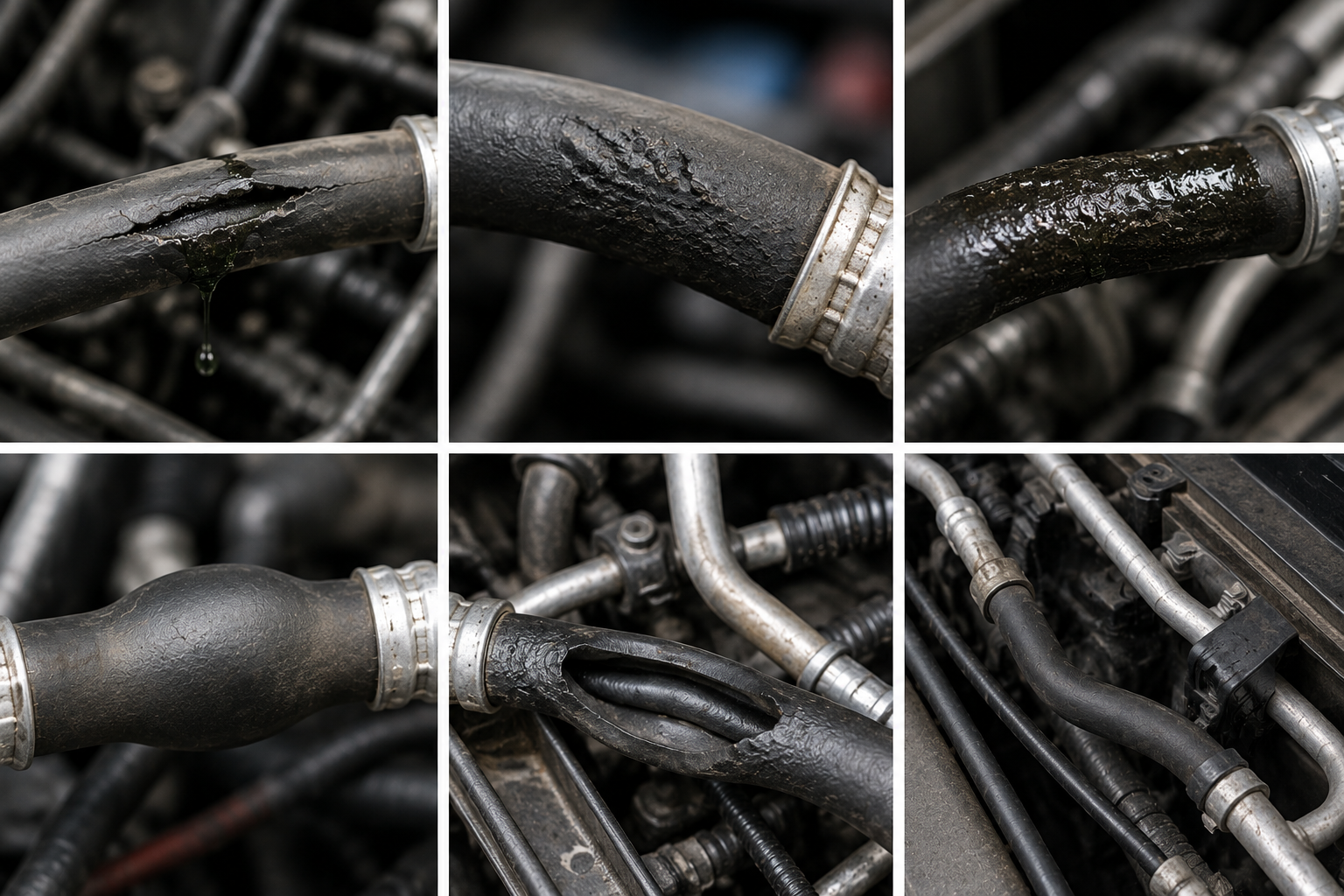
What a Proper Repair Actually Requires
This is where the field reality matters. A tape wrap around a chafed section is not a repair — it is a temporary cover. It does not restore the hose jacket's abrasion resistance and it will not stay in place under engine heat and vibration7. We see this described as a fix in a lot of online content. It is not.
A proper sleeve repair uses a compatible protective sleeve that matches the hose diameter and is secured correctly at both ends. It addresses the chafe problem. It does not address any damage below the outer jacket.
Re-crimping a fitting is a legitimate repair for a connection leak — but only under specific conditions:
| Condition | Why It Matters |
|---|---|
| Correct fitting spec | Wrong fitting ID or material causes immediate or delayed failure |
| Hose end in good condition | If the hose end itself is cracked or deformed, re-crimping does not fix it |
| Calibrated crimping machine | Crimp diameter must be within spec — over-crimping crushes the liner, under-crimping leaves a leak |
| Correct crimp die | Die size must match the fitting and hose OD exactly |
From a manufacturing standpoint, the crimp dimension is the variable that matters most. Our customers who do their own hose assembly work know this — a crimp that is 0.2mm off specification behaves very differently under pressure cycling than one that is within tolerance8. The fitting may hold at low pressure and fail at operating pressure.
If the workshop does not have a calibrated crimping machine and the correct die set, the re-crimp is not a reliable fix. It is a guess.
Cost Comparison
Repair costs less than replacement. That is true on the invoice. It is not always true over time.
The real cost comparison is: repair cost plus the risk of re-failure versus replacement cost plus system reliability. A repair that fails means refrigerant loss, potential compressor damage, and the labor cost of doing the job twice. That changes the math.
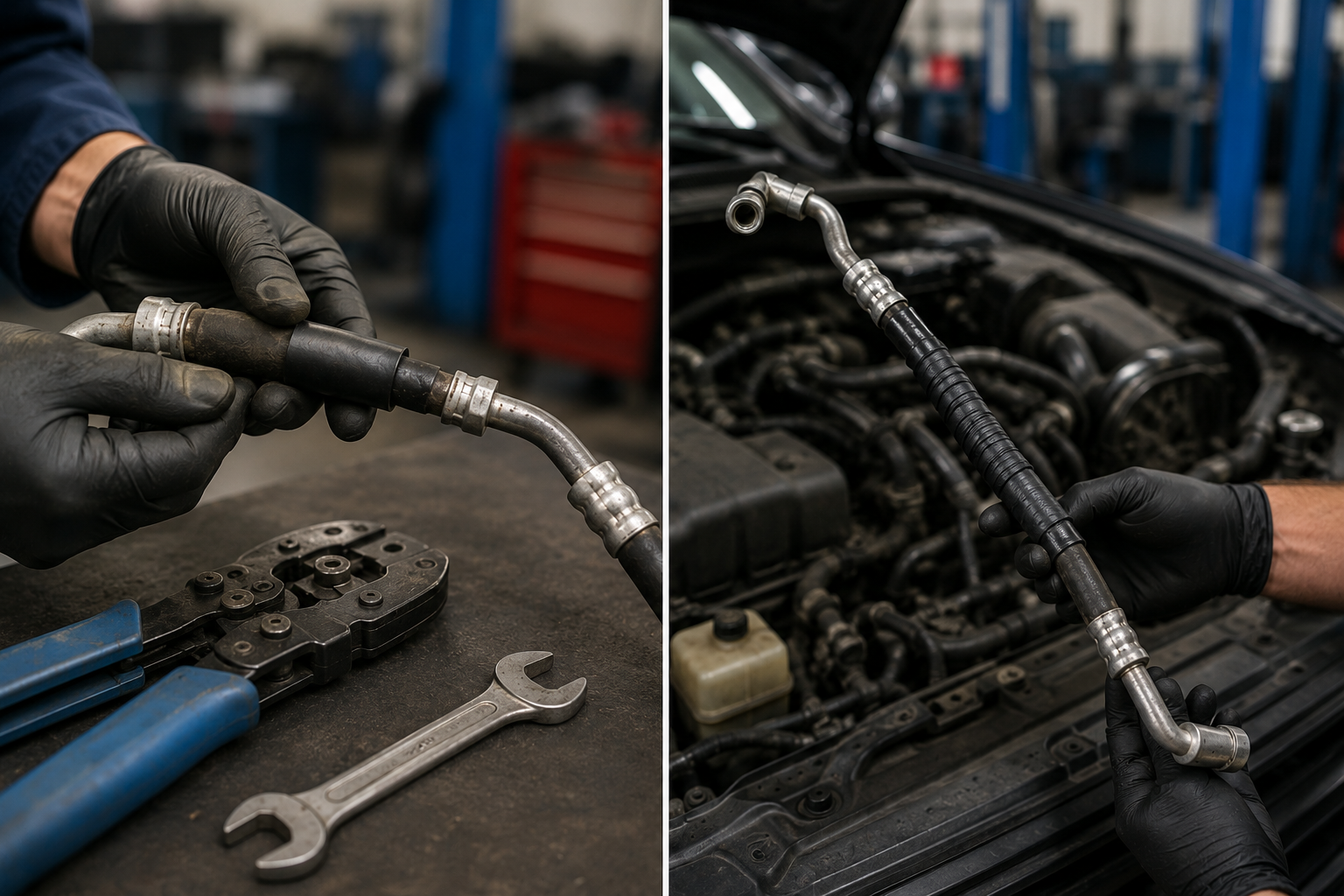
How to Frame the Cost Decision
We do not publish fixed cost figures because the variables are too wide — labor rates differ by market, hose specs differ by vehicle, refrigerant type affects both the cost of loss and the urgency of containment. But the framework is consistent.
| Cost Factor | Repair | Replacement |
|---|---|---|
| Upfront material cost | Lower | Higher |
| Labor time | Shorter (if tooling is ready) | Slightly longer |
| Risk of re-failure | Depends on damage type and method | Low if correct spec hose is used |
| Cost of re-failure | Refrigerant loss + labor again + possible compressor damage | Not applicable |
| Long-term reliability | Conditional | High |
The workshops that contact us for replacement hose supply are often the ones who tried a repair first and it did not hold. By the time they come to us, they have already paid for the repair attempt, lost refrigerant, and now need the replacement hose anyway. The total cost is higher than if they had replaced the hose the first time.
The repair-first decision makes sense when the damage is genuinely surface-level and the repair is done correctly. It does not make sense as a default cost-saving move on a hose that is already showing liner compromise.
Safety Considerations
A failed hose repair is not just a cost problem. It is a system failure under pressure.
A liner crack that is patched externally will re-leak under operating pressure. Refrigerant release near engine heat is a real risk9. Refrigerant loss starves the compressor of lubrication — compressors run on refrigerant-carried oil, and a slow leak means the compressor is running dry before the loss is visible in cooling performance10.
Specific Failure Chains to Know
The safety concerns here are concrete, not general. Here is what actually happens when a repair fails in each scenario.
Scenario 1: Liner crack patched externally The patch holds at idle. Under high-side pressure at operating temperature, the crack propagates. Refrigerant escapes. If the leak is slow, the system runs low on refrigerant. The compressor is now circulating oil-lean refrigerant. Bearing wear accelerates. The driver notices poor cooling weeks later. By then, compressor damage has already started.
Scenario 2: Under-crimped fitting re-repair The fitting holds at low pressure during a bench test. Under operating pressure cycling — which happens every time the compressor clutch engages — the fitting works loose incrementally. The leak starts small. It gets larger. The refrigerant loss timeline is unpredictable.
Scenario 3: Degraded hose that was not identified The outer jacket looks intact. The hose passes a visual inspection. A sleeve is applied over a surface chafe mark. But the inner liner was already chemically degraded from incompatible oil or long service life. The sleeve changes nothing about the liner condition. The hose fails at the liner.
The common thread in all three is that the failure mode is not visible until it is already happening. That is different from a hose that fails immediately and obviously — those are easy to catch. The ones that pass a quick check and fail later are the ones that cause compressor damage.
From a supply standpoint, the safest operating model for a workshop or distributor is: repair only what is clearly repairable, and have a reliable source for replacement hoses so that the replace decision is not delayed by sourcing friction.
Conclusion
Repair is viable for surface damage and fitting leaks — with proper tooling. Any liner failure means replacement. Know the difference, and have a reliable hose supply ready for the cases that cannot be saved.
<!--[googlesitekit-end-of-content]-->
"[PDF] Introduction to Hydraulic Hose and Fittings", https://dlnr.hawaii.gov/mk/files/2017/01/Freitas-S-18-a.pdf. Industry guidance from hose assembly standards bodies and automotive HVAC training materials acknowledges re-crimping as a viable repair for fitting connection leaks when the hose end is undamaged, the correct crimp specification is applied, and a calibrated crimping machine with the appropriate die set is used; re-crimping is not recommended as a universal repair and is subject to the same dimensional tolerances as original assembly. Evidence role: general_support; source type: institution. Supports: The conditions under which re-crimping of automotive AC hose fittings is an accepted repair practice, including tooling and specification requirements. Scope note: Acceptance of re-crimping as a repair method varies by manufacturer, warranty terms, and jurisdiction; some OEM and fleet maintenance standards require full hose replacement regardless of damage location ↩
"Air Conditioning Hose for Car | OEM & Wholesale Supplier", https://www.strongflex.com/project/air-condition-hose/. SAE J2064, the standard specification for automotive refrigerant hose assemblies, defines hose construction requirements including the inner tube (liner) as the primary barrier against refrigerant permeation and the principal pressure-containing element, with reinforcement layers and outer jacket providing mechanical protection. Evidence role: definition; source type: institution. Supports: The structural role of the inner liner as the primary refrigerant-containment and pressure-bearing layer in multi-layer automotive AC hose construction. Scope note: Hose construction varies by manufacturer and application; the description of the inner liner as the sole pressure-containing layer is a simplification of multi-layer hose mechanics ↩
"[PDF] R-1234yf A/C Update - Regulations.gov", https://downloads.regulations.gov/EPA-HQ-OAR-2014-0198-0244/attachment_15.pdf. SAE International and automotive HVAC engineering references document high-side operating pressures for common automotive refrigerants, with values varying by refrigerant type, ambient temperature, and system load; the 200–400 psi range cited here reflects typical field conditions rather than a single fixed specification. Evidence role: statistic; source type: institution. Supports: Typical high-side operating pressure ranges in automotive refrigerant systems for common refrigerants such as R-134a and R-1234yf. Scope note: Exact pressure ranges vary by refrigerant type, ambient temperature, and vehicle system design; a single cited range may not cover all operating scenarios ↩
"Listing of HFO-1234yf under the Significant New Alternatives Policy ...", https://www.regulations.gov/document/EPA-HQ-OAR-2021-0347-0025. SAE standards for automotive refrigerant hoses, including SAE J2064, address refrigerant permeation as a key performance criterion, acknowledging that hose materials must resist diffusion of refrigerant through the hose wall over service life. Evidence role: mechanism; source type: institution. Supports: The phenomenon of refrigerant permeation through automotive AC hose walls and its effect on hose material integrity. Scope note: Permeation rates and resulting liner degradation depend on hose construction, refrigerant type, and operating temperature; the cited claim is a general characterization ↩
"Compatibility of Refrigerants and Lubricants With Elastomers. Final ...", https://digital.library.unt.edu/ark:/67531/metadc1315968/. Materials compatibility studies in automotive HVAC engineering document that certain elastomers used in hose inner liners are susceptible to swelling, softening, or chemical attack when exposed to lubricants outside their design specification, such as mineral oil in systems designed for PAG or POE lubricants. Evidence role: mechanism; source type: research. Supports: Chemical incompatibility between certain compressor lubricants and hose inner liner materials, leading to material degradation. Scope note: Compatibility outcomes depend on specific elastomer formulation and lubricant chemistry; general statements may not apply to all hose and oil combinations ↩
"AC Hose Collapse? Expert Troubleshooting & Repair Guide", https://www.justanswer.com/buick/pe7i3-one-hoses-collapsing-not-allowing-ac-work.html. Automotive maintenance and failure analysis literature notes that rubber hose assemblies are subject to progressive stiffening and loss of flexibility with age and thermal cycling, increasing susceptibility to permanent deformation when subjected to routing constraints or mechanical interference. Evidence role: general_support; source type: research. Supports: The relationship between vehicle age, hose routing conditions, and increased incidence of hose collapse or deformation in automotive AC systems. Scope note: The claim is based on field observation reported by distributors rather than systematic failure data; no quantitative incidence rate is cited ↩
"Xinhan (Gold,Silver,Black) Aluminum Foil Heat Shielding Tape High ...", https://www.amazon.com/Gold-Silver-Adhesive-Temperature-Reflective-Compatible/dp/B0C13X2QVV. Materials testing data on adhesive tapes indicate that most general-purpose and even automotive-grade tapes experience significant adhesion loss and mechanical degradation at sustained temperatures above 100–120°C, conditions routinely encountered in engine bays, supporting the characterization of tape wrapping as a temporary rather than durable repair. Evidence role: mechanism; source type: research. Supports: The limitations of adhesive tape as a durable repair medium in high-temperature, high-vibration automotive engine environments. Scope note: Performance varies widely by tape type and formulation; some specialized high-temperature tapes may perform better, though none are recognized as a structural hose repair method ↩
"[PDF] Introduction to Hydraulic Hose and Fittings", https://dlnr.hawaii.gov/mk/files/2017/01/Freitas-S-18-a.pdf. Industry standards for hose assembly, such as those published by SAE International and the Fluid Power Society, specify crimp diameter tolerances and note that deviations affect pull-off strength and pressure retention; the 0.2mm figure cited is illustrative of the order of magnitude at which tolerance deviations become consequential. Evidence role: mechanism; source type: institution. Supports: The sensitivity of crimped hose fitting performance to dimensional tolerances under pressure cycling conditions. Scope note: The specific 0.2mm threshold is presented as an illustrative example; actual critical tolerances vary by fitting size, hose type, and manufacturer specification ↩
"Experimental and Theoretical Study on the Thermal Decomposition ...", https://pmc.ncbi.nlm.nih.gov/articles/PMC12902977/. Regulatory and safety data sheets from agencies such as the US EPA and OSHA note that fluorinated refrigerants, including R-134a and R-1234yf, can decompose at elevated temperatures to produce hydrogen fluoride and other toxic compounds, supporting the characterization of refrigerant release near heat sources as a safety concern. Evidence role: general_support; source type: government. Supports: Safety hazards associated with automotive refrigerant exposure to high-temperature engine components, including potential formation of toxic decomposition products. Scope note: The severity of the hazard depends on refrigerant type, quantity released, and proximity to ignition or high-heat surfaces; the article's general statement does not distinguish between refrigerant types ↩
"[PDF] Oil Effects On Performance Of Automobile A/C System", https://docs.lib.purdue.edu/cgi/viewcontent.cgi?article=2647&context=iracc. Engineering literature on automotive refrigeration systems describes the role of refrigerant as a carrier medium for compressor lubricating oil; reduced refrigerant charge diminishes oil return to the compressor, accelerating bearing and seal wear. Evidence role: mechanism; source type: research. Supports: The mechanism by which refrigerant circulates compressor lubricating oil in automotive AC systems, and how refrigerant loss leads to inadequate lubrication. Scope note: The rate of compressor damage from a slow leak depends on system design, oil type, and operating duty cycle, which are not captured in a general statement ↩