
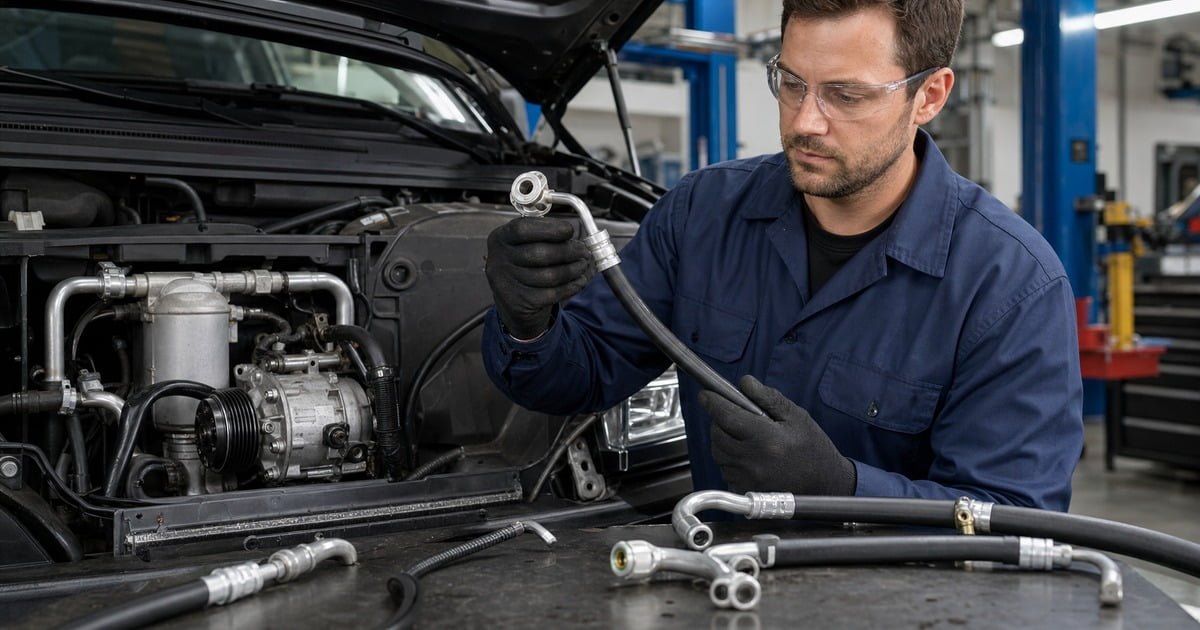
Automotive AC systems run under significant pressure — and every connection point is a potential failure1. If you're sourcing AC hose assemblies or individual components, you've probably noticed that fittings seem interchangeable at first glance. They're not. A wrong fitting doesn't just look out of place — it leaks, and a leaking AC system loses refrigerant, loses performance, and costs your customer time and money.
An automotive AC hose fitting is a precision connector that joins the flexible hose to a fixed port on the compressor, condenser, or evaporator. It controls refrigerant flow direction, seals the junction against pressure, and provides a mechanically stable connection point. The right fitting depends on hose size, port thread type, system pressure, routing geometry, and refrigerant compatibility — not just shape2.
There's more to this than picking the right angle. The sections below break down how fittings work, what types exist, why material matters, and — most importantly — how to specify the right one before you place an order.
What Is an AC Hose Fitting?
Most buyers come to us asking for "the fitting that connects the hose to the compressor." That's a starting point, not a specification. The fitting is a precision interface component — and its job goes well beyond mechanical connection.
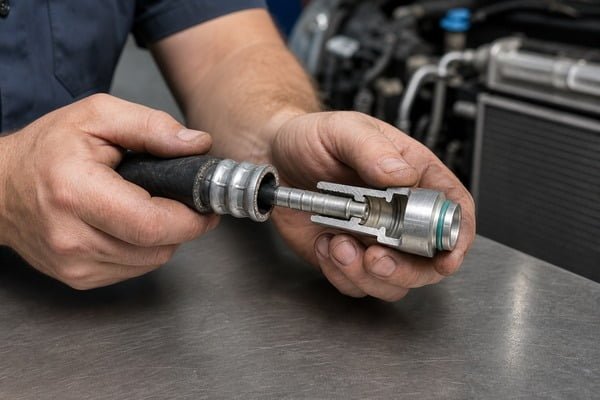
An automotive AC hose fitting is a metal connector crimped or threaded onto one end of a refrigerant hose. It creates a sealed, pressure-rated junction between the flexible hose and a fixed system port.
The fitting has three functional zones that work together to keep the system sealed and stable:
The Hose End
This is the portion inserted into the hose during assembly. It typically features barbs, beads, or a shaped stem that the hose material grips around when crimped. The geometry here determines how well the hose and fitting bond — and whether the joint holds under pressure cycling.
The Body
The body gives the fitting its shape — straight, angled, or custom. It also carries the refrigerant from the hose bore to the port. In high-vibration environments, the body absorbs mechanical stress that would otherwise be transferred to the sealing surface.
The Port End
This is where the fitting meets the system component. It may be threaded (to accept a bolt or union), or it may use a face seal, flare, or block fitting interface. The port end geometry must match the mating surface exactly — this is where most sealing failures originate in orders I've seen come back with leak complaints.
A fitting that looks right from the outside can still be wrong at the port end. Buyers who overlook the end-form type — O-ring face seal vs. flare vs. beadlock — are the ones who end up with assemblies that pass a visual check but fail under real operating pressure.
How Does an AC Hose Fitting Work?
Pressure is the operating condition that defines everything about how a fitting must perform. AC systems run at pressures that vary significantly between the high side and low side — and the fitting has to hold that seal through temperature swings, vibration, and years of use.
A fitting works by creating a leak-free interface between two components. When properly crimped onto the hose and torqued onto the port, the fitting compresses a sealing element — typically an O-ring or a machined face — against the mating surface. That compression creates a seal that resists refrigerant escape under normal operating pressure.
Here's what actually happens across the assembly:
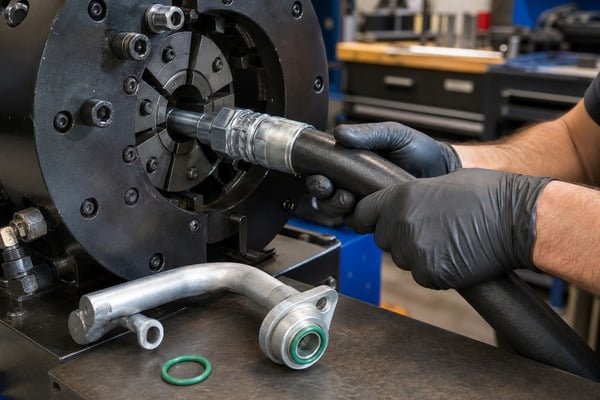
Crimping at the Hose End
A crimping machine compresses the fitting shell around the hose, forcing the hose material into the barbs or beads on the fitting stem. This creates a mechanical bond that resists pull-out and prevents refrigerant from tracking back along the hose wall. The crimp diameter must be controlled precisely — over-crimping collapses the hose bore, under-crimping creates a leak path3.
Sealing at the Port End
The fitting threads or bolts into the system port. The seal itself comes from one of these interface types:
| Seal Type | How It Works | Common Application |
|---|---|---|
| O-ring Face Seal (OFS) | O-ring compressed between two flat faces | Modern passenger vehicles, R134a / R1234yf systems |
| Flare | Metal-to-metal cone contact | Older systems, some commercial equipment |
| Beadlock | Hose bead retained by fitting shell | High-pressure hose assemblies |
| Block Fitting | Flat face with O-ring, bolt-mounted | Firewall and chassis connection points |
The O-ring face seal is the most common interface we supply for passenger vehicle applications4. When buyers specify a fitting without confirming the seal type, they often receive something dimensionally close but functionally incompatible.
Pressure Holding Over Time
A properly assembled fitting doesn't just seal once — it holds through thermal expansion cycles, vibration, and refrigerant pressure swings. The fitting material, O-ring compound, and crimp quality all contribute to long-term performance. Specification-dependent pressure ratings vary — always verify against the system requirements for the vehicle or equipment you're servicing.
What Types of AC Hose Fittings Are Common?
Routing space inside the engine bay determines which fitting angle works. The angle is a geometry solution — it tells you nothing about sealing performance on its own.
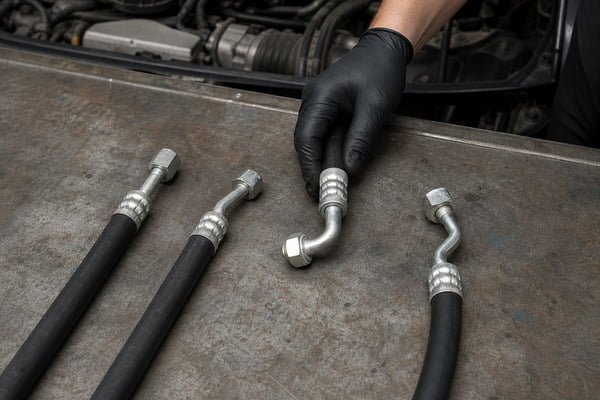
The four main fitting types are straight, 45°, 90°, and custom. Each solves a different routing problem, and each is available in the same range of port interfaces and hose sizes.
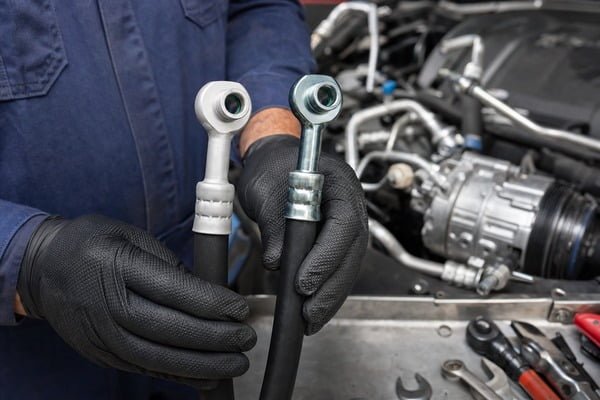
Straight Fittings
Straight fittings connect hose and port in a direct line. They work well in open engine bays where the hose can run without sharp direction changes. They're the simplest to assemble and the easiest to inspect after installation.
Best for: Long hose runs with adequate clearance, applications where bending radius isn't constrained.
Procurement note: Straight fittings are the most standardized — widest availability, shortest lead times, lowest MOQ thresholds for stocked sizes.
45° Fittings
The 45° fitting introduces a moderate directional change. It's useful when the hose needs to clear an adjacent component without a tight bend. It reduces stress on the hose at the connection point compared to forcing a straight fitting into an angled run.
Best for: Moderate routing changes, compact engine bays where a straight run would cause the hose to contact other components.
90° Fittings
The 90° fitting makes a right-angle turn at the connection point. This is essential when the port faces one direction and the hose must immediately route in another — common at compressor inlets and near firewall penetrations.
Best for: Tight spaces, ports mounted flush against walls or brackets, applications where the hose must change direction immediately after the fitting.
Caution: A 90° fitting places more lateral stress on the port thread. Make sure the mating port thread type and the fitting material can handle the mechanical load in that mounting position.
Custom Fittings
Custom fittings cover non-standard angles (e.g., 30°, 135°), unusual port configurations, or OEM-specific geometry. We get these inquiries regularly — and the most important thing I tell buyers is this: custom fittings are a lead-time and MOQ decision, not just a design option.
Tooling for a custom angle or port configuration takes time to set up. Delivery windows for custom fittings are longer than stocked items — often significantly so. Minimum order quantities also apply because custom tooling runs aren't economical at low volumes.
If you're planning a product line or a fleet application that requires a non-standard fitting, factor this into your procurement timeline early. Buyers who treat custom fittings as a quick substitution for a hard-to-find standard part often run into delays they didn't anticipate.
Why Does Fitting Material Matter?
The two most common materials we supply are aluminum alloy and steel. Buyers sometimes treat this as a cost choice. It's not — it's an application decision.
Aluminum alloy is lighter and resists corrosion well in refrigerant environments typical of R134a and R1234yf systems. It's the dominant choice for passenger vehicle AC hose assemblies where weight reduction matters and operating pressures fall within the aluminum rating range.
Steel offers higher mechanical strength. In high-vibration applications — heavy equipment, commercial vehicles, systems with significant engine movement — steel fittings better resist fatigue at the port connection. Steel also handles higher pressure ratings in applications where the system design pushes beyond typical passenger vehicle parameters.
Neither material is better in absolute terms. The right choice depends on:
- System pressure class — confirm the fitting's rated pressure matches or exceeds the system specification
- Vibration exposure — higher vibration favors steel at connection points that bear mechanical stress
- Refrigerant compatibility — verify the material is compatible with the refrigerant and any lubricant in the system
- Port material — mismatched metals at the interface can accelerate corrosion over time5
I've seen buyers default to aluminum across a full order because it's lighter and cheaper, then receive feedback that fittings at high-vibration connection points loosened over time. That's a material-application mismatch, not a material quality problem.
How to Select the Right AC Hose Fitting?
Most fitting failures I've seen trace back to specification mismatches, not defective parts. Here's how to build a complete specification before you order.
Each point below connects to a real failure mode — not just a checklist item.
1. Confirm Hose OD and ID
The fitting stem must match the hose inner diameter. A stem that's even slightly oversized tears the hose during assembly. Undersized creates a weak bond that pulls out under pressure. Always specify hose OD and ID together — the wall thickness matters too.
2. Verify the Port Thread Type and Size
Thread standards vary by vehicle market and manufacturer — metric, SAE, and application-specific threads are all in use6. A fitting that threads in by hand but doesn't match the thread form will cross-thread under torque and destroy the port. Confirm thread pitch and form, not just nominal diameter.
3. Match the End-Form to the Port Interface
This is the most commonly overlooked specification. Confirm whether the port uses an O-ring face seal, flare, block fitting, or other interface — and make sure the fitting you order matches exactly. A fitting with the right angle and wrong end-form produces an assembly that will leak from day one.
4. Check the Pressure Rating Against System Requirements
Pressure ratings are specification-dependent and vary by fitting design and material. Confirm that the fitting you're sourcing is rated for the operating pressure of the system — both high-side and low-side if the fitting is used in either position.
5. Confirm Refrigerant Compatibility
R134a and R1234yf are the dominant refrigerants in current passenger vehicle service7, but commercial and specialty systems use others. Material compatibility — including the O-ring compound — must be verified for the refrigerant in use.
6. Plan Lead Time for Custom Requirements
If your application requires a non-standard angle, port configuration, or OEM-specific geometry, start the conversation early. Custom tooling affects delivery windows, and procurement timelines that assume standard lead times will slip.
Frequently Asked Questions
Can I use the same fitting for R134a and R1234yf systems?
Not always. R1234yf operates at higher pressures and has different material compatibility requirements than R134a8. O-ring compounds and fitting ratings that are acceptable for R134a may not be suitable for R1234yf systems. Always verify compatibility against the refrigerant you're working with.
What's the difference between a beadlock fitting and a standard crimp fitting?
A beadlock fitting mechanically retains the hose bead within the fitting shell before crimping, which improves consistency in high-pressure applications9. Standard crimp fittings rely on barbs and crimp pressure alone. Beadlock designs are more common in demanding or high-pressure hose assemblies.
How do I know if a fitting is the right size without the original part?
Measure the hose OD and ID, identify the port thread type and pitch, and confirm the end-form interface at the port. These three measurements — together with the required angle — define the specification. Don't rely on visual comparison alone.
Does fitting angle affect sealing performance?
No. The angle determines routing geometry — it has no direct effect on the seal. Sealing depends on the end-form type, O-ring condition, surface finish at the port interface, and correct assembly torque. A 90° fitting seals exactly as well as a straight fitting when the interface is correctly matched.
What's a realistic MOQ for custom AC hose fittings?
MOQ for custom fittings depends on the complexity of the tooling and the specific configuration. In most cases, custom angles or non-standard port configurations carry higher MOQs than stocked items. Contact us early in your product planning phase to understand tooling requirements and realistic delivery timelines.
Conclusion
Automotive AC hose fittings are not interchangeable shape options — they are sealing and compatibility decisions that determine whether a system holds pressure or leaks. The angle solves a routing problem. The end-form, material, thread type, and pressure rating determine whether the fitting actually works in the system it's installed in.
Specify hose dimensions, port interface, pressure class, and refrigerant compatibility before you order. If your application requires custom geometry, start the conversation early — tooling affects lead time in ways that standard-catalog thinking doesn't account for.
We supply a full range of automotive AC hose fittings — straight, 45°, 90°, and custom configurations — in aluminum alloy and steel, for both standard and OEM applications. If you're building a specification or comparing options for an upcoming order, contact us directly. We'll help you get the right part the first time.
<!--[googlesitekit-end-of-content]-->
"R-1234yf A/C Update", https://downloads.regulations.gov/EPA-HQ-OAR-2014-0198-0244/attachment_15.pdf. Automotive AC systems typically operate at low-side pressures of approximately 25–45 psi and high-side pressures of 150–250 psi under normal conditions, with variations depending on refrigerant type and ambient temperature; see SAE technical literature on refrigerant system design for reference values. Evidence role: statistic; source type: research. Supports: Typical operating pressure ranges for automotive AC high-side and low-side circuits. Scope note: Exact values vary by vehicle, refrigerant, and operating conditions; a cited source would provide general ranges rather than system-specific guarantees. ↩
"Automotive Refrigerant Air-Conditioning Hose Requirements", https://saemobilus.sae.org/standards/j3062_202101-automotive-refrigerant-air-conditioning-hose-requirements. SAE J2064, the primary industry standard for refrigerant hose and fittings in mobile air conditioning applications, specifies selection criteria encompassing hose dimensions, pressure ratings, end-form interface types, and refrigerant compatibility, consistent with the multi-parameter framework described in this article. Evidence role: expert_consensus; source type: institution. Supports: Industry standards codify multi-parameter selection criteria for automotive AC refrigerant hose fittings. Scope note: SAE J2064 addresses standardized hose and fitting configurations; OEM-specific and custom configurations may require additional manufacturer specifications beyond what the standard covers. ↩
"Crimp-Charts.pdf", https://www.tubesnhoses.com/wp-content/uploads/2017/03/Crimp-Charts.pdf. SAE J2064 and related hose assembly standards specify crimp diameter tolerances for refrigerant hose fittings, establishing acceptable ranges to prevent bore collapse from over-crimping and pull-out or leakage from under-crimping. Evidence role: mechanism; source type: institution. Supports: Crimp diameter tolerances for refrigerant hose assemblies are governed by technical standards to prevent bore collapse or inadequate sealing. Scope note: Specific tolerance values are fitting- and hose-size dependent; the cited standard provides a framework rather than universal values applicable to all configurations. ↩
"Fittings 101: ORFS (O-ring Face Seal) Guide", https://brennaninc.com/fittings-101-orfs/. SAE standard J2064 and related automotive refrigerant hose specifications recognize O-ring face seal interfaces as the predominant connection type for current passenger vehicle AC systems, owing to their reliable sealing performance under thermal cycling. Evidence role: expert_consensus; source type: institution. Supports: O-ring face seal fittings are the prevailing interface standard in modern passenger vehicle AC refrigerant systems. Scope note: The cited standard governs hose and fitting specifications generally; it does not explicitly rank interface types by market share. ↩
"Galvanic corrosion", https://en.wikipedia.org/wiki/Galvanic_corrosion. Galvanic corrosion occurs when two dissimilar metals are in electrical contact in the presence of an electrolyte; the less noble metal acts as an anode and corrodes preferentially, a phenomenon well documented in corrosion engineering literature and relevant to aluminum-steel fitting interfaces in humid underhood environments. Evidence role: mechanism; source type: encyclopedia. Supports: Contact between dissimilar metals in the presence of an electrolyte accelerates corrosion at the interface. Scope note: The rate of galvanic corrosion depends on the specific metal pairing, electrolyte presence, and surface area ratio, so the severity in dry underhood environments may be lower than in exposed or wet installations. ↩
"A/c hose thread pitch, custom hoses info needed", https://turbobricks.com/index.php?threads/a-c-hose-thread-pitch-custom-hoses-info-needed.366497/. SAE International and ISO standards governing automotive refrigerant system fittings acknowledge the concurrent use of metric and inch-based thread forms across global vehicle platforms, reflecting historical differences between North American and European manufacturing practices. Evidence role: general_support; source type: institution. Supports: Automotive AC fitting connections use a variety of thread standards including metric and SAE types, varying by manufacturer and market. Scope note: The article does not specify which thread form applies to which market or OEM; a cited standard would clarify the taxonomy without identifying every manufacturer-specific variant. ↩
"New Climate-Friendly Motor Vehicle Air Conditioning Refrigerants", https://www.epa.gov/sites/default/files/2015-08/documents/new_climate-friendly_motor_vehicle_air_conditioning_refrigerants.pdf. The U.S. Environmental Protection Agency and the European Commission's Mobile Air Conditioning (MAC) Directive have facilitated the transition from R134a to R1234yf in new passenger vehicles, making these two refrigerants the dominant fluids in the current in-service fleet. Evidence role: historical_context; source type: government. Supports: R134a and R1234yf are the primary refrigerants in current passenger vehicle AC systems. Scope note: Fleet composition varies by model year and region; older vehicles in service may still use R12 or other refrigerants not addressed here. ↩
"Compatibility of R1234yf and R134a and Lubricants used in Automotive ...", https://docs.lib.purdue.edu/cgi/viewcontent.cgi?article=3057&context=iracc. Studies comparing HFO-1234yf and HFC-134a report that R1234yf exhibits slightly higher operating pressures and requires careful evaluation of elastomer and metal compatibility, particularly for O-ring compounds and aluminum alloys in contact with the refrigerant; see SAE International technical papers on low-GWP refrigerant transition. Evidence role: statistic; source type: research. Supports: Comparative operating pressures and material compatibility differences between R1234yf and R134a refrigerants. Scope note: Pressure differences between the two refrigerants are modest and context-dependent; material compatibility concerns are more pronounced with certain lubricant combinations. ↩
"How to Properly Crimp a Beadlock Style AC Fitting", https://www.youtube.com/watch?v=ua3PygixtNM. SAE technical standards for refrigerant hose assemblies recognize beadlock fitting configurations as providing enhanced hose retention by mechanically locking the hose bead prior to crimping, reducing variability in assembly quality for high-pressure applications. Evidence role: general_support; source type: institution. Supports: Beadlock fitting designs provide improved assembly consistency and retention in high-pressure hose assemblies compared to barb-only crimp designs. Scope note: Direct comparative performance data between beadlock and standard crimp designs under identical test conditions is not uniformly published; the advantage is widely accepted in trade practice but may lack rigorous independent validation in publicly available literature. ↩