Sourcing automotive AC hoses sounds straightforward — until the second batch arrives and your downstream customers start complaining. Bad fitment, pressure leaks, inconsistent hose dimensions. You trace the problem upstream, and suddenly your "verified" supplier has no useful answer. Finding a reliable automotive AC hose supplier means much more than checking a certificate.
A reliable automotive AC hose supplier provides stable batch-to-batch quality, clear technical support, genuine production capability, and the accountability to resolve problems when they arise. Price matters, but it is not the primary signal. Buyers who evaluate suppliers only on unit cost routinely discover the real cost — return freight, rework, customer complaints, re-sourcing delays — after the second or third order1.
The sections below break down exactly how to evaluate a supplier before committing — what to check, what to ask, and what answers should make you stop and look elsewhere. This is not a checklist of boxes to tick. It is a framework for separating suppliers who can perform consistently at scale from those who perform well on sample orders.
Why Does Supplier Selection Matter?
Most buyers don't feel the cost of a bad supplier choice on the first order. Samples look good. The initial shipment passes inspection. The price is competitive. The problem shows up later — when production ramps up, lead times tighten, or your customer base grows and inconsistency becomes visible across batches.
The real risk in supplier selection is not a single bad batch — it is a supplier who cannot explain why a bad batch happened or prevent it from happening again. When that occurs, the buyer absorbs the cost: customer returns, replacement stock, damaged relationships, and the time lost re-sourcing while business is disrupted.
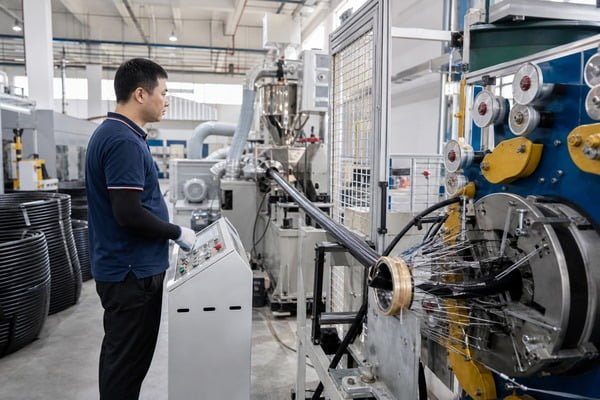
In the inquiries we handle regularly, a recurring pattern comes up. A buyer switches to a new supplier after getting a lower quote. The first one or two orders go smoothly. By the third or fourth order, dimensional variance creeps in2 — hose inner diameter slightly off, fitting crimp depth inconsistent, burst pressure at the lower end of spec. None of these issues fail a certificate audit. All of them cause problems in the field.
The Hidden Cost Buyers Consistently Underestimate
Unit price is visible. These costs are not — until they appear on your ledger:
- Return freight on non-conforming batches
- Rework labor at the workshop or distribution level
- Downstream customer complaints that damage your reputation, not just your supplier's
- Re-sourcing delays when you need to find a replacement supplier under time pressure
- Inventory write-offs on batches that cannot be sold or returned
A unit price difference of $0.50 per hose disappears quickly when a batch of 500 units needs to be returned or reworked3. Buyers who have been through this once tend to evaluate suppliers very differently on the second round.
Why Certificates Are Not Enough
ISO certification, TS documentation, and similar credentials confirm that a quality management system exists. They do not confirm that the system is applied consistently to every production run. A supplier can hold valid ISO documentation and still ship batches with measurable variance in hose wall thickness, fitting torque resistance, or pressure rating4.
The question that actually matters is: what is your batch-to-batch defect rate, and how do you track and share it? If a supplier cannot answer that concretely, the certificate on the wall is not protecting your supply chain.
What Should Buyers Check Before Cooperation?
Many buyers rely on supplier-provided documents to make their decision. That is a reasonable starting point, but it is not sufficient. Documents describe intent. Factory capability and process controls describe reality.
Before committing to an automotive AC hose supplier, buyers should verify four things directly: factory production capability, product consistency across batches, the quality control system in practice, and delivery reliability under real order volumes — not just sample conditions.
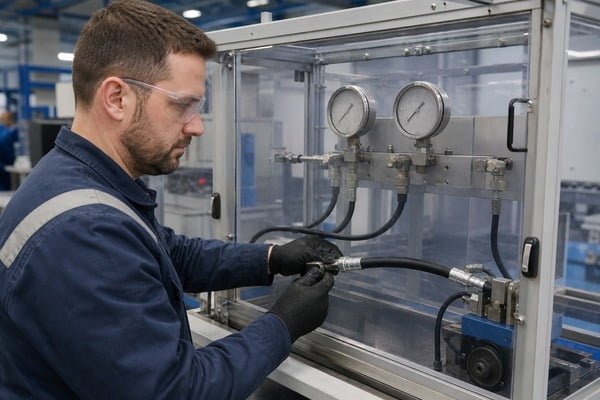
Here is how to approach each area.
Factory Capability
Start with the physical production setup. A capable AC hose manufacturer should be able to tell you — and show you — the following:
- What equipment is used for hose extrusion, braiding, and crimping
- What materials are sourced, from which suppliers, and whether incoming material inspection is standard
- What the production capacity is per month, and whether it can scale to your forecast volume without affecting quality
If a supplier is vague about equipment or hesitates to share factory photos or video, treat that as a signal. Manufacturers with real production infrastructure are not shy about it.
Product Consistency
This is the most important factor and the one most buyers undercheck. Ask the supplier directly:
- Do you maintain batch inspection records? Can I see a sample?
- What is your outgoing defect rate for this product category?
- How do you handle a batch that fails internal QC before shipment?
A supplier who maintains genuine batch records will be able to show them. A supplier who cannot — or who responds with vague reassurance — is telling you something important about how they operate5.
Quality System in Practice
Ask about the specific steps in the production quality process:
| Quality Stage | What to Ask |
|---|---|
| Incoming material | How is raw material tested before it enters production? |
| In-line sampling | How frequently are hoses sampled during a production run? |
| Outgoing QC | What tests are performed before shipment? Pressure? Dimensional? |
| Non-conformance handling | What happens when a defect is found? Is it documented? |
A supplier with a real quality system can walk you through each of these steps with specifics. If the answer at every stage is "we follow ISO procedures," push for the actual process. Procedures on paper and procedures in practice are not the same thing.
Delivery Ability
Delivery reliability is not just about lead time. It is about whether a supplier can maintain quality while meeting lead time under your volume requirements. Ask:
- What is your standard lead time for a full production order at my expected volume?
- Have you shipped on time for orders of similar size in the past year?
- What happens when raw material supply is disrupted — do you carry buffer stock?
Suppliers who consistently promise short lead times without explaining how they achieve them often compress quality steps when orders stack up.
How to Evaluate an AC Hose Manufacturer?
The most important evaluation step that buyers skip is the trading-company-vs-manufacturer check. This is not a preference issue. It is a direct factor in your ability to resolve quality problems.
When evaluating an AC hose manufacturer, buyers must first confirm they are dealing with the actual production facility — not a trading company reselling products from third-party factories. This distinction determines whether a buyer can get a direct technical response, trace a defect to its root cause, or request a process change when quality issues arise.
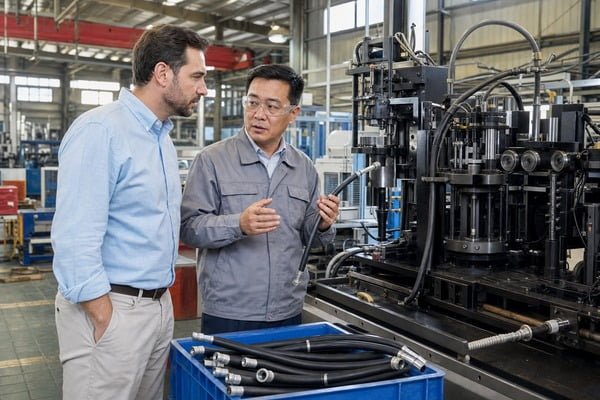
Why the Trading Company Gap Creates Real Risk
When a quality issue emerges mid-supply-chain, here is what happens with each type of supplier:
Direct manufacturer:
- Can access production records for the specific batch
- Can identify whether the issue is material, process, or equipment-related
- Can commit to a specific corrective action with a timeline
- Has technical staff who can answer questions in detail
Trading company:
- Relays your complaint to an unknown factory
- Gets a generic response that may or may not reflect the actual root cause
- Cannot commit to process changes they do not control
- May switch to a different factory without notifying you
Buyers we work with have reported cases where batch quality shifted noticeably between orders — and their trading company contact could not explain why, because they had no visibility into the production change. That is an accountability gap that costs buyers more than the price savings they captured.
How to Confirm You Are Dealing with a Real Manufacturer
- Request a factory registration document or business license that lists manufacturing scope
- Ask for a video call showing the production floor — not just a showroom
- Ask who is responsible for technical questions about hose specifications — and whether that person works at the factory
- Ask what happens to a batch that fails final inspection: is it reworked, scrapped, or shipped? A manufacturer can answer this with a specific procedure.
What Questions Should Importers Ask Suppliers?
Most buyers ask the wrong questions — or ask good questions and accept vague answers. Here is a direct set of questions that separate capable suppliers from those who rely on reassurance.
Importers should ask specific, process-level questions that require concrete answers — not yes/no confirmations. The goal is to determine whether a supplier's quality claims are backed by actual systems and data, or by the confidence that buyers rarely push back.
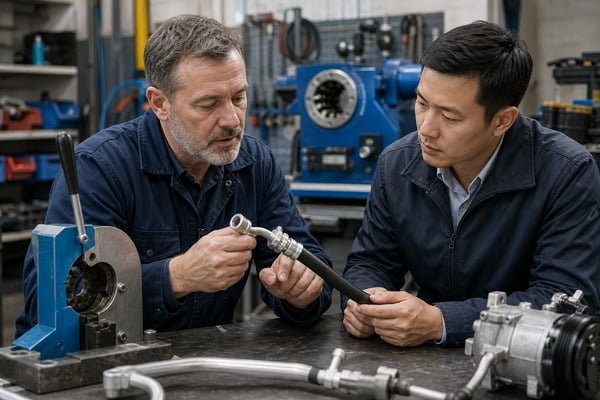
The Questions Worth Asking
On quality consistency:
- What was your batch pass rate for this product category in the last six months?
- Can you share a batch inspection report from a recent production run?
- What is the tolerance range on hose inner diameter, and how is it verified in production?
On problem resolution:
- If I receive a non-conforming batch, what is your resolution process and typical timeline?
- Can you provide a root-cause analysis when a defect is found?
- Have you had customer returns in the past year? What were the causes?
On production accountability:
- Who is my technical contact if I have a specification question during an active order?
- If I need a custom hose length or fitting configuration, what is the tooling process?
- How do you handle a situation where your raw material supplier changes a material spec?
A supplier who answers these questions with specifics — even unflattering specifics, like "our return rate was X and here's what we changed" — is demonstrating the kind of transparency that protects buyers over a long supply relationship.
Why Choose a One-Stop Solution Provider?
Once a buyer has verified quality consistency and production accountability, supply chain structure becomes the next practical consideration. Sourcing hoses from one factory and fittings from another creates coordination friction that compounds over time.
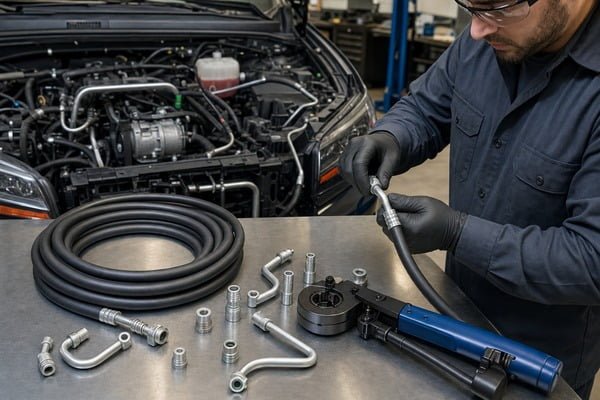
A one-stop automotive AC hose solution provider reduces procurement complexity by supplying compatible hoses, fittings, and assembly tools from a single manufacturing source. This eliminates compatibility risk between components, simplifies communication, and gives buyers a single point of accountability for the complete system.
What One-Stop Sourcing Solves in Practice
Buyers who source components from multiple suppliers report a consistent set of friction points:
- Fitment compatibility issues between hoses and fittings sourced separately
- Split accountability when a system failure cannot be traced to a single supplier
- Doubled communication overhead for specification changes, order tracking, and QC follow-up
- Inconsistent lead times when two suppliers are not synchronized on delivery
When hoses, fittings, and crimping components come from the same manufacturer, dimensional compatibility is controlled at the production level — not negotiated between suppliers after the fact6. That is a practical quality benefit, not just a procurement convenience.
What One-Stop Does Not Replace
A one-stop provider does not substitute for the verification steps described above. A supplier offering a broad product range still needs to demonstrate batch consistency, production accountability, and technical responsiveness. Product breadth is only valuable if the quality behind each product line is stable. Evaluate the manufacturer first. Evaluate the product range second.
Frequently Asked Questions
How do I know if a supplier is a real manufacturer or a trading company?
Ask for a factory registration document with manufacturing scope listed. Request a live video call of the production floor, not just a showroom. Ask who handles technical questions — and whether that person works directly in the factory. Trading companies typically cannot provide direct answers on production process or root-cause analysis7.
What certifications should an AC hose supplier hold?
ISO 9001 is the baseline for quality management. SAE J2064 is the relevant standard for automotive AC hose performance8. However, certifications confirm a system exists — they do not guarantee batch consistency. Always ask for batch inspection records alongside certification documents.
How many suppliers should I evaluate before choosing one?
Most experienced importers evaluate three to four suppliers before committing. This gives enough comparison to identify outliers on price, quality process, and responsiveness. Evaluating fewer than three makes it harder to recognize when a supplier's answers are vague or evasive by comparison.
What is a reasonable defect rate to expect from an AC hose supplier?
A well-controlled production process should have an outgoing defect rate well below 1% for standard hose configurations9. Ask the supplier for their actual figure — not a general reassurance. If they cannot provide a number, that is a red flag about how closely they track quality at the batch level.
Can I request product customization from a factory-level supplier?
Yes. A direct manufacturer with tooling capability can accommodate custom hose lengths, fitting configurations, and OEM branding. Always confirm whether the supplier has in-house tooling or outsources it — in-house tooling gives you more control over lead times and change requests.
Conclusion
Finding a reliable automotive AC hose supplier comes down to one core question: can this supplier demonstrate consistent quality at production scale — not just on samples? Certificates matter, but batch inspection records matter more. Direct factory accountability matters more than a low unit price. And verifying that you are working with a real manufacturer, not a trading company, is a procurement step that protects your entire supply chain. Use the verification questions in this article as your starting framework, and expect concrete answers. If a supplier cannot provide them, that answer is also informative.
We supply automotive AC hoses, fittings, crimping machines, and refrigerant service tools from a single manufacturing facility — with full batch inspection records available on request. If you are evaluating suppliers and want to compare notes on what consistent quality looks like in practice, reach out and let's talk through your requirements.
<!--[googlesitekit-end-of-content]-->
"Constructing a Total Cost of Ownership supplier selection ...", https://ideas.repec.org/a/taf/acctbr/v35y2005i1p3-27.html. The total cost of ownership (TCO) framework, developed in procurement literature, demonstrates that unit acquisition price represents only a fraction of total sourcing cost; quality failures, returns, and supply disruptions substantially elevate actual costs relative to initial price comparisons (Ellram, 'A Framework for Total Cost of Ownership,' International Journal of Logistics Management, 1993). Evidence role: general_support; source type: research. Supports: Procurement research consistently shows that lowest-unit-price supplier selection leads to higher total costs when quality failure costs are accounted for. Scope note: TCO literature is broad; specific cost ratio data for automotive hose sourcing scenarios is not available in open academic sources. ↩
"Challenges and opportunities for high-quality battery production at ...", https://pmc.ncbi.nlm.nih.gov/articles/PMC11725600/. Procurement and quality management research identifies a pattern of post-qualification quality drift in supplier relationships, where initial samples and early batches reflect heightened supplier attention that may not persist at scale; this phenomenon is discussed in supplier management literature under concepts including 'sample-to-production gap' and incoming inspection design (see supply chain quality management literature, e.g., Krause et al. on supplier development). Evidence role: historical_context; source type: research. Supports: Quality in later production batches from new suppliers commonly diverges from initial sample quality due to process drift, material substitution, or reduced attention after initial orders are secured. Scope note: Published research on this pattern is general to manufacturing supply chains; automotive hose-specific longitudinal defect rate data across buyer-supplier relationship stages is not available in open literature. ↩
"Analyzing Costs Using Total Cost of Ownership", https://psep.smeal.psu.edu/short-courses/supply-chain-accelerator/advanced-procurement-analyzing-costs-using-total-cost-of-ownership. Research on total cost of ownership in procurement consistently identifies quality failure costs (rework, returns, expediting, customer attrition) as substantially exceeding visible unit price differentials; see, e.g., studies on Cost of Poor Quality (COPQ) frameworks in supply chain management. Evidence role: general_support; source type: research. Supports: Quality failure costs in supply chains—including returns, rework, and reputational damage—frequently exceed initial unit price savings. Scope note: General COPQ literature covers manufacturing broadly and may not reflect automotive hose-specific cost ratios. ↩
"Strengthening Quality Through Suppliers: The ISO 9001 Perspective", https://compliantltd.com/insights/strengthening-quality-through-suppliers-the-iso-9001-perspective/. Academic and practitioner literature on quality management systems notes that certification audits assess process documentation and system compliance rather than product sampling; empirical studies have found persistent product quality failures at ISO-certified facilities, indicating a gap between system certification and actual product conformance (see, e.g., literature reviews on ISO 9001 effectiveness in manufacturing sectors). Evidence role: case_reference; source type: research. Supports: ISO certification does not prevent product non-conformance, and certified organizations have been documented shipping non-conforming product. Scope note: Published case evidence typically covers general manufacturing sectors rather than automotive hose supply specifically. ↩
"Supplier Quality Management Software for Supply Chains", https://www.compliancequest.com/supplier-quality-management-software/. IATF 16949, the international quality management standard for automotive production, requires organizations to maintain traceability records for production lots, including inspection and test results; suppliers unable to provide batch-level quality records fall below baseline automotive supply chain quality system requirements (IATF 16949:2016, clause 8.5.2). Evidence role: expert_consensus; source type: institution. Supports: Quality management standards for automotive suppliers require documented batch records and traceability; inability to produce such records indicates non-compliance with standard requirements. Scope note: IATF 16949 applies specifically to organizations supplying directly to automotive OEMs; aftermarket and replacement parts suppliers may operate under less stringent traceability requirements. ↩
"6.302-1 Only one responsible source and no other ...", https://www.acquisition.gov/far/6.302-1. Engineering literature on tolerance stack-up analysis demonstrates that dimensional variation accumulates across interfacing components; when mating parts are manufactured to independently specified tolerances rather than coordinated internal standards, assembly fit risk increases (see, e.g., Spotts et al., 'Design of Machine Elements,' or equivalent mechanical engineering design references). Evidence role: mechanism; source type: research. Supports: Sourcing interfacing components from separate suppliers introduces tolerance accumulation and interface compatibility risks that are eliminated when components are designed and manufactured to common tolerances within a single facility. Scope note: General tolerance stack-up literature is not specific to AC hose-and-fitting assemblies; the magnitude of the practical risk depends on the tightness of individual component tolerances. ↩
"Manufacturer vs Trading Company: Who Should You Trust ...", https://www.linkedin.com/pulse/manufacturer-vs-trading-company-who-should-you-trust-bulk-5zcrf. Supply chain intermediary literature notes that trading companies hold commercial relationships with manufacturers rather than operational control over production processes, limiting their ability to access batch-level records, assign process accountability, or commit to corrective actions (see supply chain management literature on intermediary roles and information asymmetry). Evidence role: mechanism; source type: research. Supports: Trading companies, as intermediaries without direct production control, lack access to factory-level data needed for root-cause analysis of quality failures. Scope note: Academic literature on this topic is general; hose-industry-specific documentation of trading company accountability gaps is not publicly available. ↩
"J2064_202104 : Coupled Automotive Refrigerant Air-Conditioning Hose ...", https://www.sae.org/standards/j2064_202104-coupled-automotive-refrigerant-air-conditioning-hose-assemblies. SAE International's standard J2064 specifies the requirements for hose assemblies used in mobile air-conditioning systems, covering dimensions, pressure ratings, permeation limits, and material compatibility (SAE International, 'SAE J2064: Refrigerant Containment of Mobile Air Conditioning Hose Assemblies'). Evidence role: definition; source type: institution. Supports: SAE J2064 defines performance and dimensional requirements for refrigerant hoses used in automotive air conditioning systems. Scope note: Access to the full standard text requires purchase; publicly available summaries may not detail all technical thresholds. ↩
"All About Six Sigma PPM (Parts per Million) for Defect Reduction", https://www.6sigma.us/process-improvement/six-sigma-ppm-defect-reduction/. Automotive quality frameworks such as IATF 16949 and Six Sigma methodologies establish defect targets at parts-per-million levels; a sub-1% outgoing defect rate is consistent with, though less stringent than, typical automotive supplier quality expectations documented in quality engineering literature. Evidence role: statistic; source type: research. Supports: Well-controlled automotive component manufacturing processes typically target defect rates measured in parts per million, well below a 1% threshold. Scope note: Published defect rate benchmarks vary by component type and tier; hose-specific defect rate data is not widely available in open literature. ↩