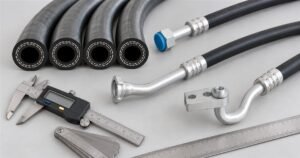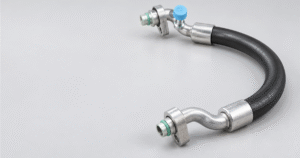
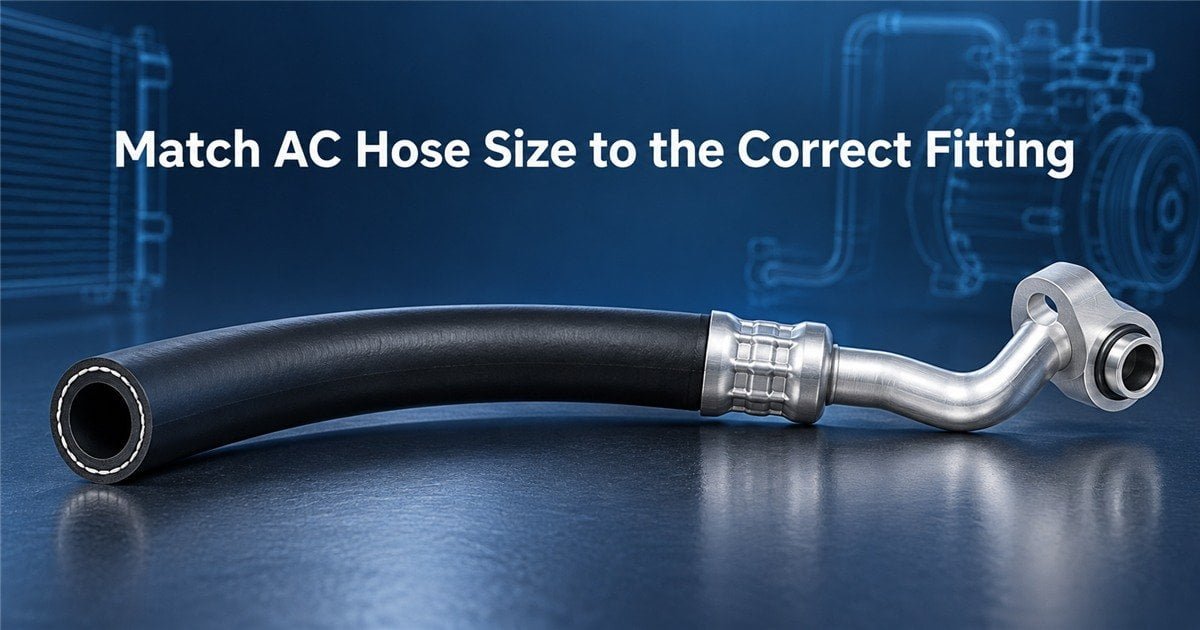
Matching AC hose size to the correct fitting size sounds straightforward — until a bulk order arrives and nothing crimps correctly. Distributors lose money on returns. Assembly shops halt production waiting for replacements. The root cause is almost always the same: buyers treated a multi-variable decision like a simple lookup.
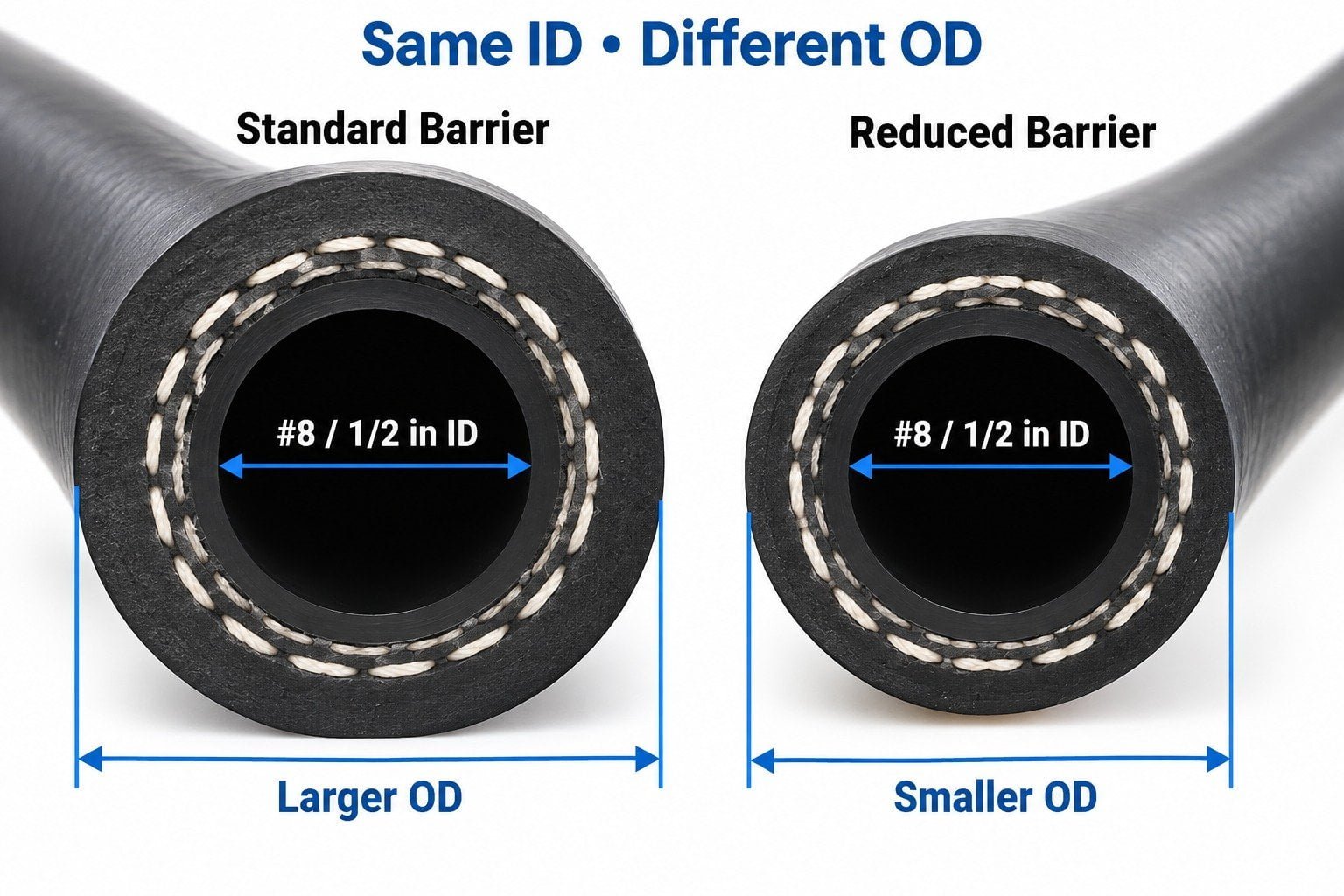
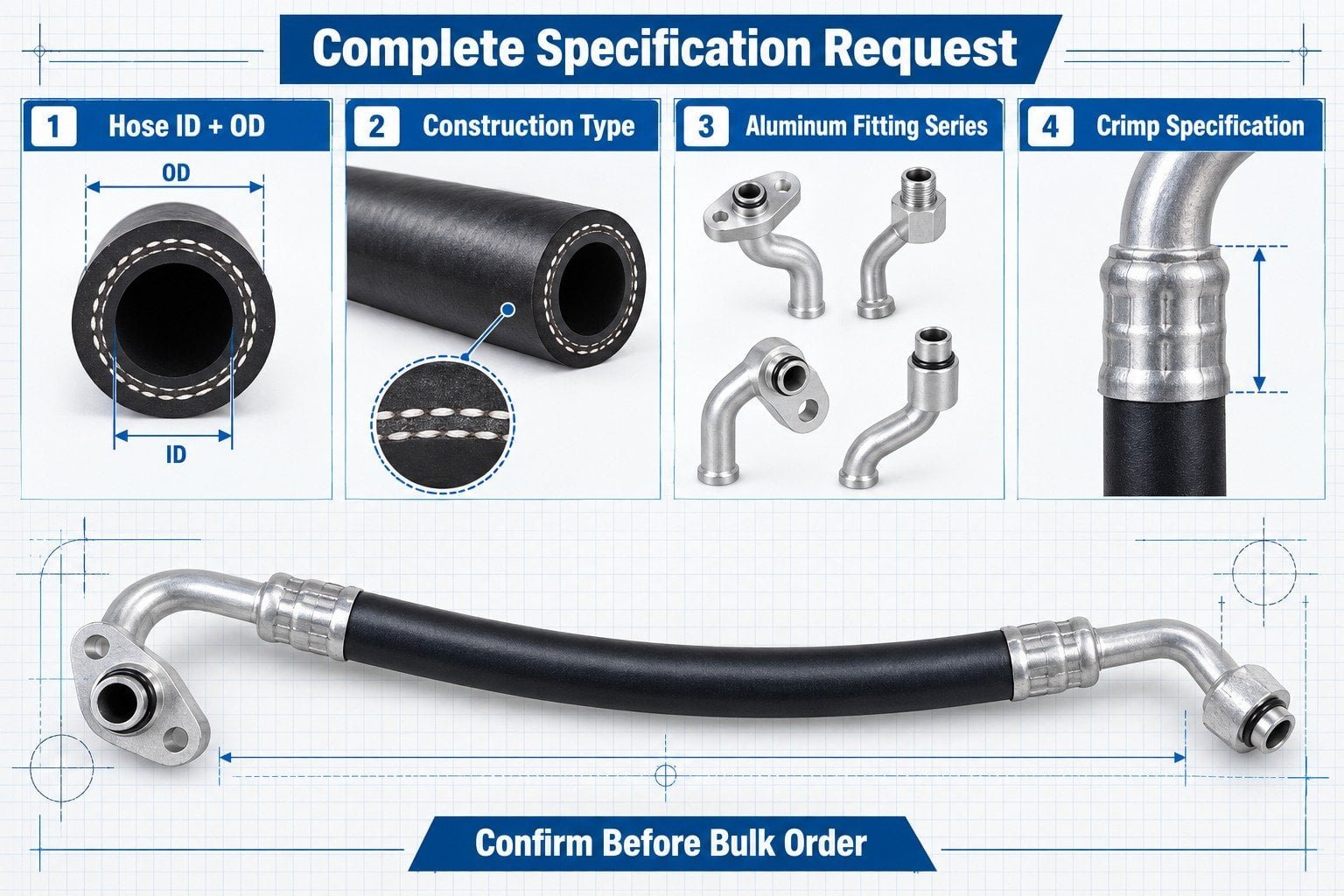
Matching AC hose size to the correct fitting size requires resolving at least four variables in sequence: hose inner diameter, hose outer diameter, hose construction type, and the target crimp ferrule specification. Nominal inch size alone is not sufficient. Two hoses labeled the same size can have different outer diameters depending on manufacturer, construction, and the standard they were built to — making fitting compatibility impossible to confirm from a single dimension.
The good news is that this decision chain is learnable. Once you understand which variables matter and in what order, you can build a reliable specification process — whether you are placing a bulk distributor order or setting up a crimping line. The sections below walk through each variable and the specific failure modes we see most often in real customer orders.
Why Doesn't Inner Diameter Alone Determine the Correct Fitting?
Buyers frequently contact us with one measurement: the hose inner diameter. It seems logical — after all, the fitting must fit inside or around the hose. But inner diameter is only the starting point.
The inner diameter tells you the flow bore and the nominal line size designation (such as #6, #8, or #10)1. It does not tell you the hose wall thickness, the outer diameter, or the construction type — all of which directly affect which fitting series will produce a correct crimp.
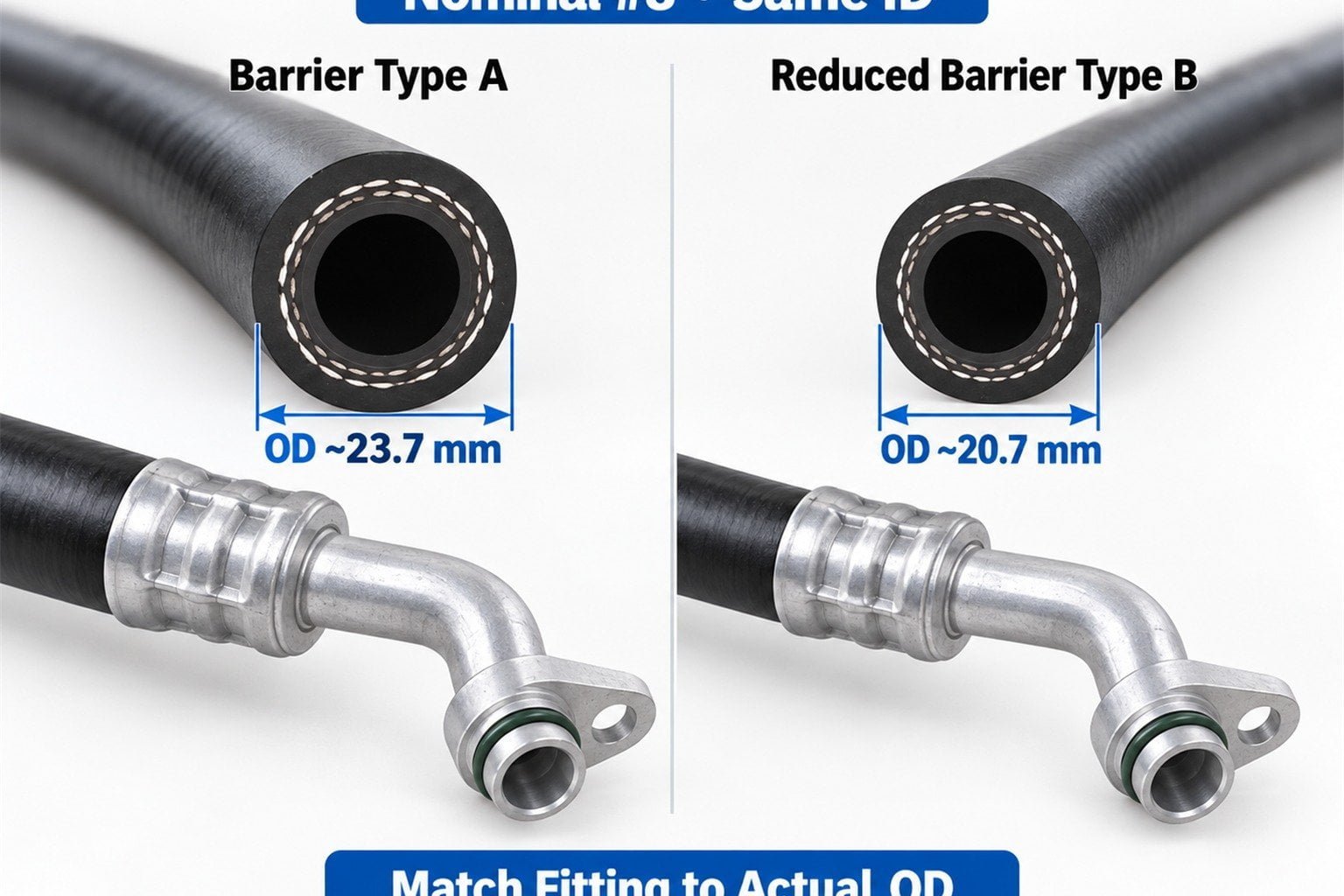
Think of it this way: the fitting must grip the outside of the hose through the ferrule2. If two hoses share the same inner diameter but differ in wall construction, their outer diameters will differ — and the crimp geometry changes with it. Using the same fitting on both without checking will produce either an under-crimp or an over-crimp.
The Two Main Hose Construction Types Buyers Encounter
In the automotive AC aftermarket, most hoses fall into two broad categories:
- Barrier hoses — feature an inner PTFE or nylon barrier layer that reduces refrigerant permeation3. Wall construction is thicker. Outer diameter tends to be larger for the same nominal size.
- Reduced barrier hoses — a lighter construction intended to reduce system weight while maintaining adequate permeation resistance. Wall is thinner than a full barrier hose. Outer diameter is smaller.
This difference in construction directly changes the OD, which changes the fitting series you need.
What the OD Difference Looks Like in Practice
The table below illustrates how the same nominal line size can produce different outer diameters depending on construction. These figures are representative examples only — always confirm exact dimensions with your hose supplier and the applicable standard before ordering fittings.
| Nominal Size | Construction Type | Approximate Hose ID | Approximate Hose OD |
|---|---|---|---|
| #6 | Barrier | ~9.5 mm | ~18–19 mm range |
| #6 | Reduced Barrier | ~9.5 mm | ~16–17 mm range |
| #8 | Barrier | ~12.7 mm | ~21–22 mm range |
| #8 | Reduced Barrier | ~12.7 mm | ~19–20 mm range |
| #10 | Barrier | ~15.9 mm | ~24–25 mm range |
| #10 | Reduced Barrier | ~15.9 mm | ~22–23 mm range |
Important: These ranges are illustrative. Actual dimensions vary by manufacturer and standard. Request the precise OD from your hose supplier before selecting fittings.
When you order fittings for a #6 hose without specifying barrier or reduced barrier, you are essentially asking a supplier to guess which OD range to design for. We see this error regularly — and it is entirely avoidable.
What Is the "Same Size, Different Standard" Problem?
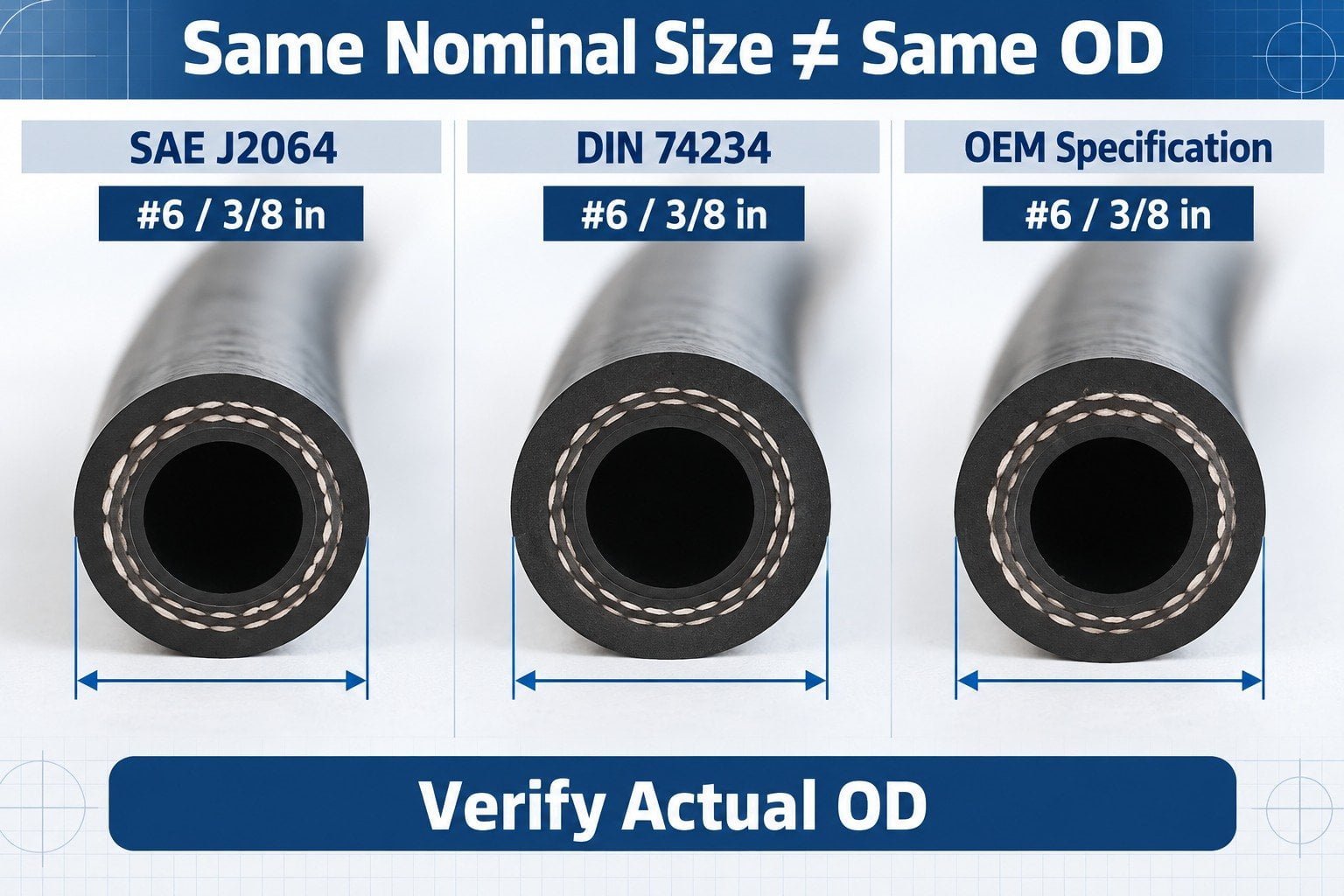
This is the hidden risk that catches even experienced buyers off guard. A #6 hose from one manufacturer is not dimensionally identical to a #6 hose from another manufacturer — especially when they were built to different standards.
The primary standards in play are SAE J2064 (common in North America), DIN 74234 (common in Europe), and various OEM-specific specifications used by vehicle manufacturers4. Each standard may define slightly different dimensional tolerances for the same nominal size.
The tolerances may look small on paper. In practice, a difference of 0.5–1.0 mm in outer diameter can mean the difference between a fitting that crimps correctly and one that does not seal under pressure5.
What to Verify with Your Supplier Before Ordering
When I work through specification consultations with new customers, I ask for the following information about their hose before we discuss fittings:
- Nominal line size (e.g., #6, #8, #10 — or metric equivalent)
- Hose construction (barrier, reduced barrier, or other)
- Hose inner diameter — confirmed measured value, not just nominal
- Hose outer diameter — confirmed measured value
- The standard the hose was built to (SAE J2064, DIN, OEM spec, or supplier's own)
- The hose manufacturer or country of origin — this helps us understand which dimensional family the hose likely belongs to
Without at least items 1 through 4, any fitting recommendation carries risk. With all six, we can cross-reference against our fitting series and confirm compatibility before a purchase order is placed.
Why Nominal Size Labels Are Not Enough
The use of fractional inch naming (1/4", 5/16", 3/8", 1/2", 5/8") alongside SAE dash designations (#6, #8, #10) adds another layer of confusion. These labels describe the flow bore, not the physical outer diameter that the fitting actually grips. Two suppliers calling their product "1/2 inch AC hose" may be referring to the same inner diameter but delivering hoses that differ by 1.5 mm in outer diameter — enough to cause a fitting mismatch.
The practical guidance here is simple: do not rely on the name, rely on the measured dimension. If you are sourcing hose from a new supplier, request a dimensional drawing or measure a physical sample before finalizing your fitting order.
What Are the Two Most Common Fitting Mismatch Failure Modes?
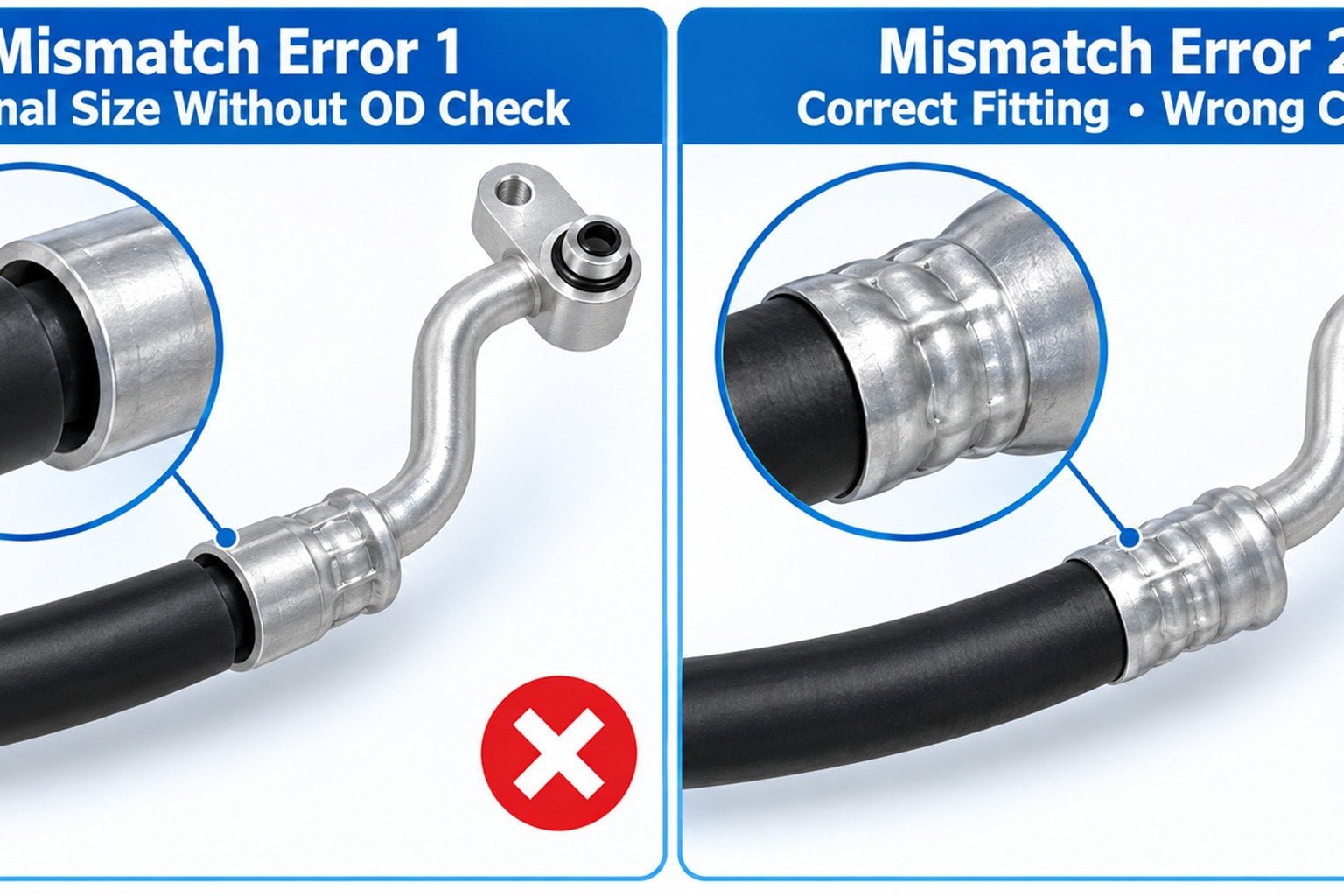
In our experience handling inquiries from both distributors and hose assembly factories, mismatches tend to cluster into two distinct failure modes. Understanding which category you fall into helps you identify where your specification process needs attention.
Knowing your failure mode also helps you ask better questions — of your supplier, your assembly team, and yourself before any order is confirmed.
Failure Mode 1: Distributors Ordering by Nominal Size Only
Distributors placing bulk orders often work from a catalog or a customer request that specifies only the nominal inch size — "we need fittings for 1/2 inch hose" or "we need #8 fittings." Without checking the hose OD or construction type of the hoses their customers are actually using, they order fittings that appear correct by name but do not match in dimension.
The result is a large inventory of fittings that cannot be used without rework — or worse, fittings that appear to assemble correctly but produce weak crimps that fail in the field.
The fix for distributors: Build a simple intake form for customer inquiries that requires hose OD and construction type alongside nominal size. This one process change eliminates the majority of bulk mis-orders we see at the order confirmation stage.
Failure Mode 2: Assembly Shops Mismatching Crimp Specification
Assembly factories tend to get the fitting right — correct series, correct nominal size — but mismatch the ferrule. A fitting designed for a barrier hose needs a ferrule with the correct inner diameter and crimp depth to match. If the shop substitutes a ferrule from a different series (perhaps because stock ran low and they used what was available), the crimp profile changes.
The outcome is not always immediately visible. The assembly may look clean. But the crimp may be under-spec, and the joint may not hold at operating pressure or temperature cycling6.
The fix for assembly shops: Treat fitting and ferrule as a matched set. Confirm crimp specifications — ferrule ID, ferrule OD, and target crimp diameter — with the fitting supplier for every hose construction type you run. Do not mix ferrule series across hose constructions without explicit confirmation from the fitting manufacturer.
What Does a Complete AC Hose Fitting Specification Request Look Like?
Customers often send us a single measurement and ask for a fitting recommendation. I understand why — it feels like enough information. But it puts the risk entirely on the supplier to guess the missing variables. A complete specification request protects the buyer.
Here is the difference between a typical incomplete request and a complete one:
Incomplete request:
"We need aluminum fittings for #8 AC hose, straight and 90-degree, male and female beadlock style."
Complete specification request:
"We need aluminum beadlock fittings for #8 barrier AC hose. Hose OD is 21.5 mm. Hose built to SAE J2064 Type C. We need straight and 90-degree configurations, male O-ring face seal and female flare. Please confirm compatible ferrule series and target crimp diameter."
Why Each Variable in the Complete Request Matters
- "#8 barrier" — eliminates the construction ambiguity immediately
- "Hose OD is 21.5 mm" — gives the fitting supplier a measured reference to cross-check against their fitting series
- "SAE J2064 Type C" — identifies the standard so the supplier can flag if their fittings are designed for a different dimensional family
- "Please confirm compatible ferrule series and target crimp diameter" — puts the crimp specification on record before the order, not after an assembly failure
This level of detail takes one additional email. It eliminates the risk of a container of wrong fittings arriving at your warehouse.
A Practical Checklist Before You Place a Fitting Order
Use this before confirming any bulk fitting purchase:
- [ ] Nominal line size confirmed (dash size or metric)
- [ ] Hose construction confirmed (barrier / reduced barrier / other)
- [ ] Hose ID confirmed (measured, not nominal)
- [ ] Hose OD confirmed (measured from actual hose sample)
- [ ] Hose standard confirmed (SAE J2064 / DIN / OEM / other)
- [ ] Fitting series confirmed against hose OD
- [ ] Ferrule series confirmed as matched set with fitting
- [ ] Target crimp diameter confirmed with fitting supplier
Frequently Asked Questions
Can I use the same fitting for both barrier and reduced barrier hose of the same nominal size?
Generally no. Barrier and reduced barrier hoses of the same nominal size typically have different outer diameters due to different wall construction. A fitting designed for one will not crimp correctly on the other. Always confirm hose OD and request the compatible fitting series for your specific hose construction from your supplier.
What does "fitting series" mean when selecting AC hose fittings?
A fitting series refers to a family of fittings designed around a specific hose outer diameter range and crimp specification. Different series exist for different hose constructions and standards. Selecting the correct series means the fitting's internal geometry and ferrule dimensions match the hose OD — producing a correct crimp profile and reliable seal.
How do I know if my hose follows SAE or DIN dimensions?
Ask your hose supplier directly and request a dimensional drawing that references the applicable standard. If you are sourcing hose without documentation, measure the actual OD with a caliper and compare it against the nominal dimensions specified in SAE J2064 or DIN 74234. When in doubt, confirm with a qualified supplier before ordering fittings in bulk.
Why does crimp diameter matter, and who should confirm it?
Crimp diameter is the target outer dimension of the ferrule after crimping. It determines whether the crimp is tight enough to seal and hold pressure without over-compressing the hose liner7. The fitting manufacturer should provide the target crimp diameter for each fitting-ferrule combination. Do not use a generic crimp spec — confirm it for your specific fitting series and hose construction.
What information should I send to a fitting supplier to get an accurate recommendation?
At minimum: nominal line size, hose construction type (barrier or reduced barrier), measured hose OD, and the standard the hose was built to. Adding the connection end type (O-ring face seal, flare, block fitting) and configuration (straight, 45°, 90°) completes the request. The more specific you are upfront, the more reliable the recommendation you receive.
Conclusion
Matching AC hose size to the correct fitting size is a sequential decision, not a lookup. The primary keyword — AC hose size — is just the entry point. What actually determines compatibility is the combination of hose inner diameter, outer diameter, construction type, applicable standard, and the crimp specification of the matched fitting-ferrule set. Skipping any one of these variables creates real risk: bulk mis-orders for distributors, assembly failures for crimping shops, and field returns for everyone downstream.
Build a complete specification process before your next order. If you are sourcing automotive AC fittings, hoses, or custom hose assemblies and want to confirm compatibility before placing a bulk purchase, we are glad to work through the specification with you. Contact the AC Parts Tech team with your hose dimensions and construction details — we will help you get the right match the first time.
<!--[googlesitekit-end-of-content]-->
"Dash Sizing for Hoses and Tubes Explained", https://www.mfcp.com/technical-info/tips/dash-size. SAE J2064 defines a dash-number sizing system for automotive air conditioning hose in which the dash number corresponds to the nominal inside diameter in sixteenths of an inch, establishing #6, #8, and #10 as standard line size designations. Evidence role: definition; source type: institution. Supports: That SAE dash size designations such as #6, #8, and #10 denote nominal inner diameter classifications for automotive refrigerant hose, as defined in SAE J2064. Scope note: Nominal designations describe the flow bore classification; actual measured inner diameters may vary within specified tolerances. ↩
"US6206048B1 - Method for repairing a bead lock hose fitting", https://patents.google.com/patent/US6206048B1/en. SAE and hydraulic hose assembly standards describe the crimp joint as a mechanical connection in which a ferrule is radially compressed onto the hose outer surface, creating retention force and sealing contact between the hose inner tube and the fitting stem. Evidence role: mechanism; source type: institution. Supports: That crimp-style hose fittings use a ferrule compressed around the hose outer diameter to mechanically retain the fitting and create a pressure seal. Scope note: Specific ferrule geometry and crimp mechanics vary by fitting design; the general principle applies broadly but details differ across product series. ↩
"Manufacturers Advisory Correspondence MAC 2022-01 Att 1", https://ww2.arb.ca.gov/sites/default/files/2022-03/attachment_1.pdf. The U.S. Environmental Protection Agency and SAE International have addressed refrigerant emissions from mobile air conditioning systems, with SAE J2064 specifying maximum permeation rates for hose assemblies as part of broader efforts to limit HFC emissions from vehicle air conditioning. Evidence role: general_support; source type: government. Supports: That refrigerant permeation through automotive AC hose is a regulated concern, with standards and regulations setting limits on acceptable permeation rates. Scope note: Regulatory frameworks and permeation limits vary by refrigerant type and jurisdiction; this source supports the general regulatory context rather than specific barrier layer performance data. ↩
"Automotive Air Conditioner Hose Type C | AC Hose for Car", https://www.sinopulse.cn/automotive-air-conditioner-hose/. Automotive industry practice, documented in supplier quality and engineering standards literature, confirms that OEMs routinely issue component-specific engineering standards that supplement or supersede published industry standards such as SAE J2064 for hose assemblies used in their vehicles. Evidence role: general_support; source type: institution. Supports: That major vehicle manufacturers maintain proprietary hose specifications that may impose dimensional or performance requirements beyond or different from SAE J2064 and DIN 74234. Scope note: OEM specifications are generally proprietary and not publicly available; the existence of such specifications is well-established, but their specific dimensional deviations from published standards cannot be generalized. ↩
"Why Sealing Fails: Hydraulic Fitting Size Tolerance Matters", https://cntopa.com/why-sealing-fails-hydraulic-fitting-size-tolerance-matters.html. Engineering literature on hydraulic and pneumatic hose assembly crimping establishes that ferrule inner diameter and hose outer diameter must fall within defined tolerances to achieve the designed crimp profile; deviations outside tolerance are associated with under-crimp or over-crimp conditions that reduce joint pressure capacity. Evidence role: mechanism; source type: research. Supports: That small deviations in hose outer diameter relative to fitting design tolerances can produce inadequate crimp geometry and compromise pressure seal integrity. Scope note: The specific 0.5–1.0 mm threshold cited in the article is illustrative; actual critical tolerances depend on fitting series, operating pressure, and refrigerant type. ↩
"Why Your Heater Hose Crimp Fitting Deserves More ...", https://hosecandy.com/blogs/updates/why-your-heater-hose-crimp-fitting-deserves-more-respect-than-youre-giving-it?srsltid=AU7gw4WdygZ8bD0knuqgm5JX3ivORTQE4Mz4T7I4cHY4ryZTkEJenNXC. Studies on hose assembly integrity and SAE qualification testing protocols document that under-crimped joints exhibit reduced pull-off force and pressure retention, with thermal cycling accelerating joint degradation by exploiting residual dimensional mismatch between the ferrule and hose. Evidence role: mechanism; source type: research. Supports: That insufficient crimp compression produces joints with reduced pressure retention capacity and susceptibility to failure under thermal cycling conditions. Scope note: Specific failure thresholds depend on operating pressure, refrigerant type, and hose construction; general literature supports the mechanism but not application-specific values. ↩
"Hydraulic Hoses, Fittings and Equipment", https://www.parker.com/content/dam/Parker-com/Literature/Polymer-Hose-Division-Europe/Sales-and-Marketing-Bulletins/4400_Rubber-Hydraulic/Technical-Handbook-UK.pdf. Hose assembly standards, including those published by SAE International, specify target crimp diameters as part of fitting qualification, with acceptable ranges defined to ensure adequate sealing force while preventing over-compression of the hose inner tube. Evidence role: mechanism; source type: institution. Supports: That target crimp diameter is a controlled parameter in hose assembly standards, governing both the minimum compression needed for sealing and the maximum compression that avoids liner damage. Scope note: Specific crimp diameter values are fitting- and hose-series-specific; a general source supports the principle but not the exact figures for any given product. ↩