Automotive AC fitting types are one of the most common sources of confusion in bulk ordering — and one of the most expensive. Choose the wrong type, size, or material, and you're looking at returned shipments, rework costs, and workshops that lose confidence in your supply. The good news is that most mistakes are avoidable with the right framework before you send an inquiry.
Automotive AC fittings are the mechanical connectors that join refrigerant hoses to compressors, condensers, evaporators, and service ports in a vehicle's air conditioning system.1 The main types are beadlock, barb, O-ring, and flare fittings. They differ in connection method, required tooling, and hose compatibility. Selecting the right type depends on your hose construction, available crimping equipment, and the refrigerant system you're servicing.
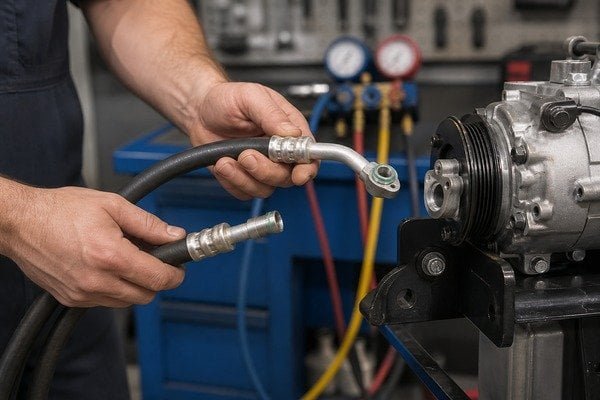
Understanding the categories is only the starting point. What matters more is how each type connects to a real purchasing decision — the tooling you have, the hose series you're sourcing, and the refrigerant system your customers are working on. Let's go through each dimension carefully.
What Are Automotive AC Fittings?
Most buyers have a general sense of what a fitting does. But when a shipment arrives and nothing installs correctly, the problem usually traces back to a definition that was never confirmed at the ordering stage.
Automotive AC fittings are the threaded or mechanically secured connectors that form leak-free joints between refrigerant hoses and system components. They must withstand refrigerant pressure, temperature cycling, and vibration — all simultaneously.2 Selecting the wrong fitting doesn't just create a leak risk. It can mean the hose physically won't attach to your crimping die, or the O-ring material degrades under the refrigerant you're using.
Why Fitting Selection Is a System Decision
We frequently hear from buyers who selected fittings based on appearance or price before confirming three variables:
- Hose construction type (beadlock-compatible vs. standard rubber)
- Available tooling (crimping machine and die set)
- Refrigerant type (R134a vs. R1234yf and the O-ring implications)
These three variables — not brand or finish — determine whether a fitting is compatible. Everything else is secondary.
What Are the Main Types of Automotive AC Fittings?
The four core types cover the vast majority of automotive AC applications. Each has a different connection mechanism, and that mechanism determines your tooling requirement before anything else.
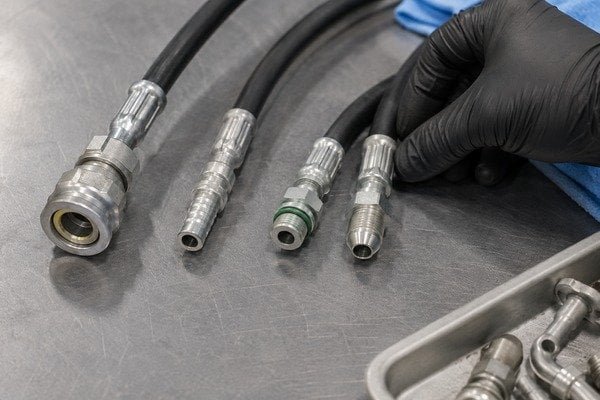
The four main automotive AC fitting types are: beadlock fittings (require crimping), barb fittings (clamp-based, no crimp machine needed), O-ring fittings (used at component connections), and flare fittings (mechanically flared metal seal). Each type suits different hose constructions and installation environments.
Beadlock Fittings
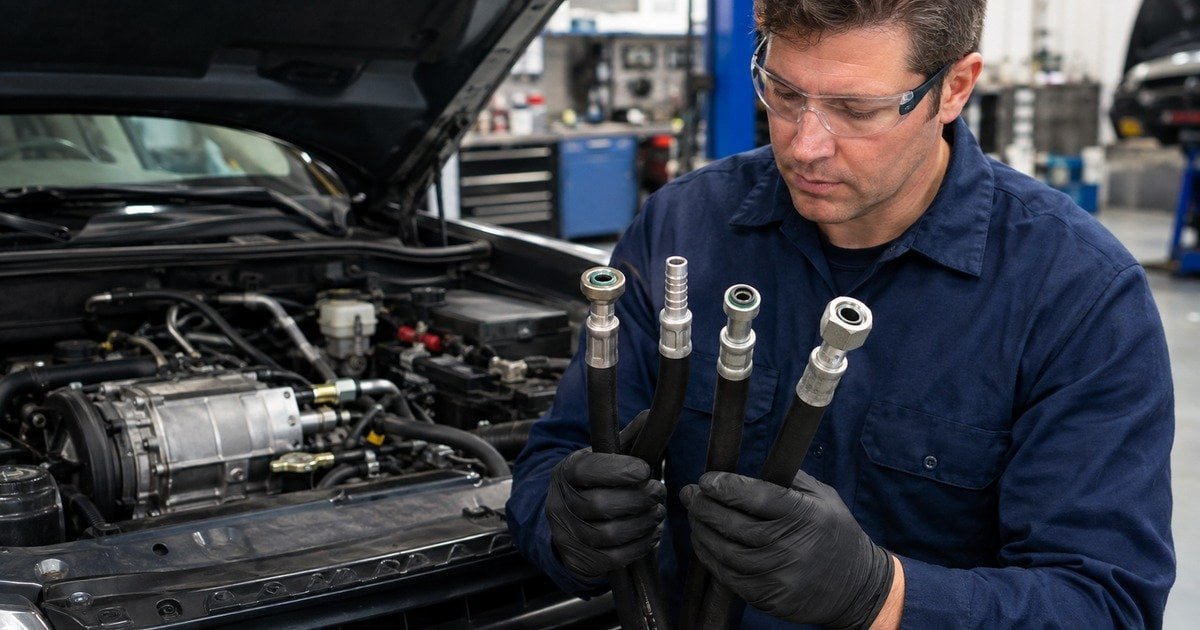
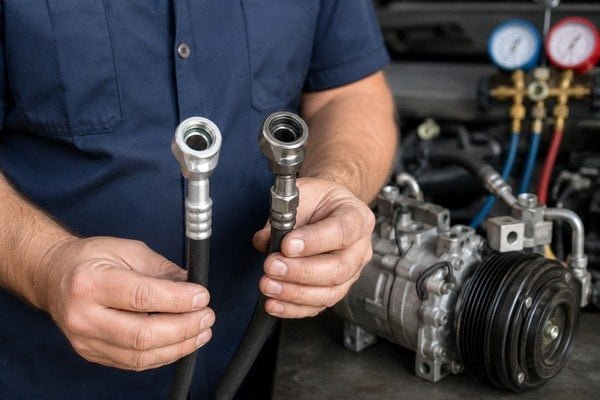
Beadlock fittings have a two-part design: a stem and a socket. The socket slides over the hose end, and crimping collapses the socket onto the hose and over the bead on the stem — creating a mechanical lock.
The key question before ordering beadlock fittings: do you or your customers have a crimping machine with the matching die set?
This is a tooling constraint, not a preference. If your workshops don't have a compatible crimper, beadlock fittings are not a viable choice regardless of their quality. We see this error repeatedly in orders from markets where tool infrastructure is still developing — buyers choose beadlock because it looks more professional, then realize at installation that the tooling isn't in place.
Beadlock fittings are the standard for high-pressure barrier hose3 and are widely used in OEM-style repair work.
Barb Fittings
Barb fittings have ridged stems that grip the inner wall of a hose. A clamp or sleeve is applied over the outer hose to hold the assembly. No crimping machine is required.
This makes barb fittings a practical choice for:
- Workshops without crimping equipment
- Lower-volume repair environments
- Markets where tool investment isn't justified by order volume
The tradeoff is that barb connections depend on clamp quality and installation technique. They're acceptable for lower-pressure lines but are generally not recommended for high-side compressor connections.
O-Ring Fittings
O-ring fittings seal through a compressed elastomer O-ring at the mating face or port. They're used primarily at the component end — where the hose assembly connects to the compressor, condenser, or service valve.
O-ring material matters. Standard HNBR O-rings perform well with R134a. For R1234yf systems, the O-ring material must be confirmed separately4 — I'll cover this in more detail in the FAQ section. Ordering fittings without confirming O-ring spec for the target refrigerant is one of the most under-discussed mistakes in this product category.
Flare Fittings
Flare fittings create a metal-to-metal seal by deforming the tube end into a cone shape that mates with a matching seat. They're more common in rigid line applications and refrigeration systems than in flexible automotive hose assemblies. In automotive AC work, you'll encounter them at certain chassis connections and older vehicle configurations.
Straight, 45°, and 90° AC Fittings: What's the Difference?
Buyers sometimes treat fitting angle as a cosmetic choice. It isn't. Routing constraints inside an engine bay determine angle selection — not aesthetics.
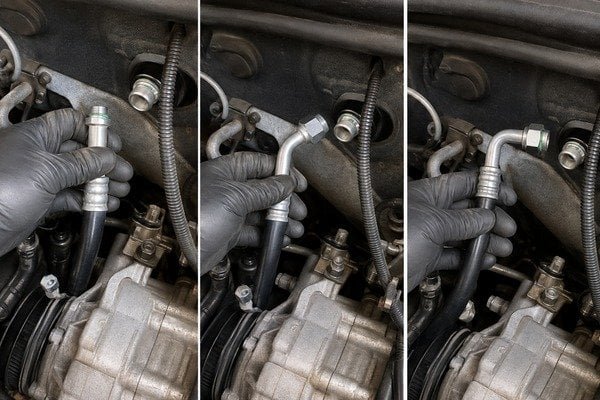
Fitting angle (straight, 45°, or 90°) controls how the hose exits the fitting relative to the port axis. The right angle is determined by the available clearance around the component, the hose routing path, and the bend radius the hose can achieve without kinking. Choosing the wrong angle creates installation problems that can't be solved without reordering.
How to Choose the Right Angle
Think of it as a routing decision, not a product upgrade:
- Straight fittings work when the hose exits in line with the port and has room to route without a tight bend nearby.
- 45° fittings are the most versatile. They reduce the routing angle at the connection point while keeping a relatively compact profile.
- 90° fittings are used when the hose must turn sharply immediately after the connection — common in tight engine bays or when the hose runs parallel to a component face.
A common order mistake we see is buyers ordering all straight fittings because they're the default option, then discovering on arrival that several connections require a 90° or 45° angle. Confirm routing requirements at the vehicle or application level before finalizing the order split.
What Are the Common Automotive AC Fitting Sizes?
Size mismatch is the highest-frequency ordering error we encounter. Buyers often estimate size visually, or they reference the hose outer diameter instead of the hose inner diameter (ID), which is what the fitting size number actually refers to.
The four standard automotive AC fitting sizes — #6, #8, #10, and #12 — refer to the hose inner diameter in sixteenths of an inch. A #6 fitting fits a hose with a 3/8" ID; a #8 fits 1/2" ID; #10 fits 5/8" ID; and #12 fits 3/4" ID. Always confirm hose ID and series before specifying fitting size.
| Fitting Size | Hose ID (inches) | Hose ID (mm approx.) | Typical Application |
|---|---|---|---|
| #6 | 3/8" | ~10 mm | Liquid line, suction (small systems) |
| #8 | 1/2" | ~13 mm | Suction line, discharge |
| #10 | 5/8" | ~16 mm | Suction line (most common) |
| #12 | 3/4" | ~19 mm | High-volume suction or discharge |
Why Visual Sizing Fails
The outer diameter of a hose varies depending on wall thickness and construction. Two hoses that look the same diameter externally may have different IDs — and will require different fittings. When a customer asks what size fitting they need, our first question back is always: what is the hose ID and hose series? Without that, size selection is guesswork.
Aluminum vs. Steel AC Fittings
Both materials are widely used. The right choice depends on application context, not blanket preference for one over the other.
Aluminum fittings are lighter and resist corrosion from refrigerant exposure. Steel fittings offer higher pressure ratings and greater mechanical durability.5 The choice between them depends on the pressure requirements of the system, the operating environment, and whether weight is a significant factor for the application.
Tradeoffs at a Glance
| Property | Aluminum | Steel |
|---|---|---|
| Weight | Lighter | Heavier |
| Corrosion resistance | Good (with anodizing) | Requires coating |
| Pressure rating range | Adequate for most A/C | Higher ceiling |
| Cost | Generally lower | Varies |
| Thread durability | More prone to cross-threading | More forgiving |
I won't claim one outperforms the other without knowing the specific application and pressure spec. What I will say is that aluminum is the dominant material in passenger car A/C fittings, while steel becomes more relevant in commercial vehicle or heavy-duty refrigeration contexts6. If you're sourcing for mixed applications, it's worth stocking both and confirming per vehicle type.
How to Match AC Fittings with Different AC Hoses
Hose construction dictates fitting type. This is non-negotiable — and it's the part of fitting selection that gets skipped most often in spec-by-price ordering.
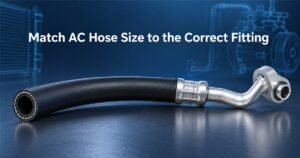
The correct fitting type is determined by the hose construction: barrier hoses require beadlock fittings; standard rubber hoses are compatible with barb fittings7. Fitting size must match hose inner diameter. O-ring spec must match the refrigerant type. These three parameters must be confirmed together — not independently.
The Three-Variable Confirmation Checklist
Before any fitting order is confirmed, verify:
- Hose type — Is it barrier hose (beadlock required) or standard rubber (barb compatible)?
- Hose ID and series — What is the exact inner diameter and manufacturer hose series?
- Refrigerant type — R134a or R1234yf? This determines O-ring material specification.
We've seen orders where the fitting type and size were both correct, but the O-ring compound was incompatible with the target refrigerant. The fittings looked fine, installed fine, and then caused slow leaks in service. Catching this at the ordering stage is far less expensive than finding it in the field.
How to Identify an Unknown Automotive AC Fitting
When a buyer sends a sample for matching, these are the measurements and checks that actually matter.
To identify an unknown automotive AC fitting, measure the hose end inner diameter, check the thread size and type at the port end, count the fitting angle, and identify the connection mechanism (beadlock socket, barbed stem, O-ring face, or flare seat). Cross-reference these against standard size charts before ordering replacements.
Step-by-Step Identification Process
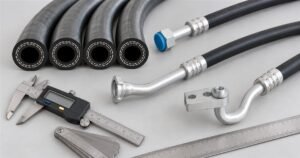
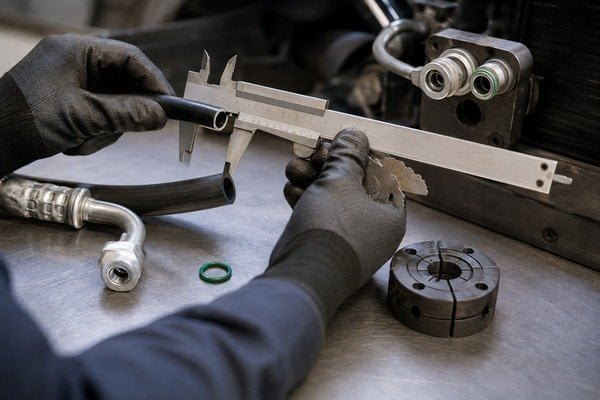
- Measure the hose bore — Use a caliper on the hose end the fitting accepts. This gives you the fitting size (#6/#8/#10/#12).
- Identify the port thread — Measure thread OD and pitch. Common threads include SAE, metric, and ACME8. Thread type affects compatibility at the component port.
- Check the connection mechanism — Is there a socket collar (beadlock), ridged stem (barb), flat face with O-ring groove, or tapered seat (flare)?
- Note the angle — Measure the offset angle from port axis to hose axis.
- Material check — Magnet test distinguishes steel from aluminum quickly.
When in doubt, send a physical sample or clear dimensional drawing. Fitting descriptions without measurements are the most common source of mismatched orders.
What Should Buyers Check Before Ordering AC Fittings in Bulk?
Bulk orders amplify every mistake. A wrong fitting type in a small trial order is a learning moment. The same error across 5,000 pieces is a significant commercial problem.
Before placing a bulk AC fitting order, confirm hose series compatibility, verify fitting size against hose ID (not OD), specify O-ring material for the target refrigerant, and confirm the angle split required for the target vehicle applications. Price should be evaluated only after all technical variables are locked.
The Two Most Common Bulk Order Errors We See
Error 1: Hose-fitting mismatch on delivery A buyer orders fittings based on a general size reference without confirming hose series. The fittings arrive at the correct nominal size but don't crimp correctly because the hose wall thickness or construction doesn't match the die spec. Result: the entire batch is unusable until the hose or fitting spec is corrected.
Error 2: Price-first ordering without refrigerant confirmation A buyer sources the lowest-price fitting with standard O-rings. The fittings go into workshops servicing R1234yf vehicles. The O-ring material isn't rated for R1234yf. Slow leaks follow. The buyer absorbs the warranty cost and the customer relationship damage.
Pre-Order Checklist for Bulk Buyers
- [ ] Hose construction type confirmed (barrier or standard rubber)
- [ ] Hose ID and series specification provided by supplier
- [ ] Fitting type selected based on available crimping tooling
- [ ] Size verified against hose ID (not visual estimate)
- [ ] Angle split confirmed per vehicle routing requirements
- [ ] O-ring material specified and matched to refrigerant type
- [ ] Sample tested before production order placed
Frequently Asked Questions
What are the most common automotive AC fitting types?
The most common types are beadlock and barb fittings for the hose end, paired with O-ring face fittings at the component connection. Beadlock fittings require a crimping machine; barb fittings use a clamp. The right choice depends on your available tooling and the hose construction you're working with.
What size AC fitting do I need?
AC fitting size (#6, #8, #10, or #12) refers to the hose inner diameter in sixteenths of an inch — not the outer diameter. Measure your hose ID accurately before specifying size. A #8 fitting fits a hose with a 1/2" ID. Visual sizing or outer diameter measurement will frequently produce the wrong result.
Are R134a and R1234yf fittings the same?
The fittings are structurally similar, but the O-ring materials are not interchangeable. Standard HNBR O-rings used in R134a systems may not be compatible with R1234yf refrigerant chemistry. Additionally, R1234yf systems carry regulatory requirements in many markets9. Verify O-ring spec and system compliance requirements before mixing components across refrigerant types.
Can automotive AC fittings be customized?
Yes. Common customization requests include thread type, port configuration, angle, material (aluminum or steel), and surface finish. OEM part number matching is also possible with confirmed dimensional drawings or physical samples10. Lead times and minimum order quantities vary depending on tooling requirements for non-standard configurations.
Are aluminum AC fittings reliable?
Aluminum fittings are the standard in most passenger vehicle AC applications and perform reliably within their rated pressure range. Key considerations are thread care during installation (aluminum is more susceptible to cross-threading than steel) and surface treatment quality if the fittings will be exposed to moisture or road chemicals. Application context determines whether aluminum or steel is the better choice.
Conclusion
Automotive AC fitting types are not a product catalog question — they're a system compatibility decision. The right fitting depends on your hose construction, your available crimping tooling, your target refrigerant, and the routing constraints of the vehicle you're servicing. Get any one of these variables wrong in a bulk order, and the cost of correction is significant.
The key takeaways: choose fitting type based on tooling first, confirm size against hose inner diameter (not visual estimate), verify O-ring material against refrigerant type, and lock all technical specifications before evaluating price. These steps eliminate the two most common bulk ordering errors before they happen.
If you're consolidating your AC fitting supply or preparing a bulk
<!--[googlesitekit-end-of-content]-->
"How Does Car AC Work?", https://www.uti.edu/blog/automotive/air-conditioning. Automotive AC systems circulate refrigerant through a closed loop connecting the compressor, condenser, evaporator, and associated service ports via pressure-rated hoses and fittings. Evidence role: general_support; source type: education. Supports: the basic components and refrigerant flow path in automotive AC systems. Scope note: Source describes the overall system architecture; fitting specifications vary by manufacturer and application. ↩
"Automotive Refrigerant Air-Conditioning Hose Requirements", https://saemobilus.sae.org/standards/j3062_202101-automotive-refrigerant-air-conditioning-hose-requirements. Industry standards for automotive AC fittings specify resistance to pressure cycling, temperature extremes, and vibration exposure typical of vehicle operating conditions. Evidence role: general_support; source type: institution. Supports: performance requirements for automotive AC fittings under operational stresses. Scope note: Standards define minimum performance thresholds; specific requirements vary by system pressure rating and vehicle application. ↩
"Hose, Fittings and Hardlines - Vintage Air", https://vintageair.com/builder-series/hose-fittings-and-hardlines/. Barrier-construction refrigerant hoses, designed to minimize refrigerant permeation, typically employ beadlock-style crimped fittings that provide mechanical retention suited to the hose construction and pressure requirements. Evidence role: general_support; source type: institution. Supports: connection methods commonly used with barrier-type refrigerant hoses. Scope note: Describes common industry practice; specific fitting requirements depend on hose manufacturer specifications and system pressure ratings. ↩
"[PDF] Compatibility of R1234yf and R134a and Lubricants used in Automotive ...", https://docs.lib.purdue.edu/cgi/viewcontent.cgi?article=3057&context=iracc. Elastomer selection for refrigerant seals depends on chemical compatibility, with R1234yf systems requiring verification of seal material resistance to the refrigerant's distinct chemical properties compared to R134a. Evidence role: mechanism; source type: research. Supports: material compatibility requirements for O-ring seals in different automotive refrigerant systems. Scope note: General compatibility principle; specific O-ring compound specifications vary by manufacturer and should be verified for each application. ↩
"Coating for Corrosion Control in the Refrigeration Industry", https://irc.wisc.edu/export.php?ID=163. Material selection for automotive fittings involves tradeoffs between aluminum's lower density and natural corrosion resistance versus steel's higher strength and pressure capacity, with choice depending on application requirements. Evidence role: general_support; source type: education. Supports: material property differences between aluminum and steel in automotive fitting applications. Scope note: General material properties; specific performance depends on alloy selection, heat treatment, surface finishing, and design geometry. ↩
"Analyzing the Automotive Air Conditioning & Refrigeration Market", https://www.linkedin.com/pulse/analyzing-automotive-air-conditioning-refrigeration-vsgse. Material selection in automotive AC components reflects application requirements, with passenger vehicles commonly using aluminum fittings for weight reduction while heavy-duty applications may prioritize steel's strength characteristics. Evidence role: general_support; source type: research. Supports: material selection patterns across different automotive segments. Scope note: Industry practice observation rather than quantified market data; actual material distribution varies by manufacturer, region, and specific vehicle platform. ↩
"Best Automotive Replacement Air Conditioning Fittings", https://us.amazon.com/Best-Sellers-Automotive-Replacement-Air-Conditioning-Fittings/zgbs/automotive/15723631. Refrigerant hose construction dictates compatible fitting types, with barrier hoses engineered for crimped beadlock connections and non-barrier constructions accommodating alternative attachment methods including barbed fittings with external clamps. Evidence role: general_support; source type: institution. Supports: fitting selection requirements based on refrigerant hose construction type. Scope note: General compatibility principle; specific fitting requirements must be verified against hose manufacturer specifications. ↩
"A/c hose thread pitch, custom hoses info needed", https://turbobricks.com/index.php?threads/a-c-hose-thread-pitch-custom-hoses-info-needed.366497/. Automotive refrigerant fittings employ various thread standards including SAE straight threads with O-ring seals, metric threads per ISO specifications, and specialized thread forms depending on regional standards and manufacturer specifications. Evidence role: general_support; source type: institution. Supports: thread standard types used in automotive refrigerant fittings. Scope note: Thread type varies significantly by vehicle manufacturer, market region, and system design; ACME threads are less common in modern automotive AC applications. ↩
"Protection of Stratospheric Ozone: Listing of HFO-1234yf Under the ...", https://www.federalregister.gov/documents/2022/05/04/2022-08923/protection-of-stratospheric-ozone-listing-of-hfo-1234yf-under-the-significant-new-alternatives. R1234yf adoption in automotive air conditioning has been driven by environmental regulations including the EU MAC Directive and similar measures in other jurisdictions aimed at reducing global warming potential of refrigerants. Evidence role: historical_context; source type: government. Supports: regulatory drivers for R1234yf adoption in automotive applications. Scope note: Regulatory landscape varies by jurisdiction and continues to evolve; specific compliance requirements depend on market and vehicle type. ↩
"Reverse Engineering & Complete Dimensional ...", https://www.gdandtinc.com/services/reverse-engineering/. Aftermarket manufacturers can produce OEM-equivalent components through dimensional analysis of original parts or engineering drawings, subject to intellectual property considerations and quality verification requirements. Evidence role: general_support; source type: other. Supports: methods used to replicate proprietary automotive components for aftermarket production. Scope note: Replication feasibility depends on dimensional complexity, material specifications, and any proprietary manufacturing processes; functional equivalence requires validation testing. ↩