If you've ever received a batch of AC hoses that passed incoming inspection but started leaking within six months of field use, you already know the real question isn't whether a factory can make AC hoses — it's how disciplined their process actually is. Most factories will show you the same product photos and spec sheets. The manufacturing process is where the real differences hide.
Automotive AC hose manufacturing involves six core steps: rubber compound preparation, extrusion, reinforcement, vulcanization, cutting, and inspection. But the quality of the finished hose depends less on which steps a factory claims to follow and more on how tightly each step is controlled — especially material selection and vulcanization, the two areas where shortcuts are least visible and most damaging.
Each step in the process is a decision point. A factory can rush vulcanization by five minutes, swap to a cheaper rubber compound, or skip temperature cycling in final testing — and the hose will still look fine in a photo. It won't fail until it's installed in a customer's vehicle, exposed to refrigerant chemistry and thermal stress, and sitting under your brand name. The sections below walk through exactly what separates a controlled process from a cost-cutting one.
What Materials Are Used for Automotive AC Hoses?
Material selection is the first place cheap factories cut corners — and the hardest place for buyers to detect without asking the right questions.
The inner tube of an AC hose must resist refrigerant permeation, withstand operating pressures typically ranging from 150 to 450 psi1, and survive temperature swings from below -30°C to above 120°C2. Not every rubber compound can do all three reliably.
The Three Main Rubber Types — and Why the Match Matters
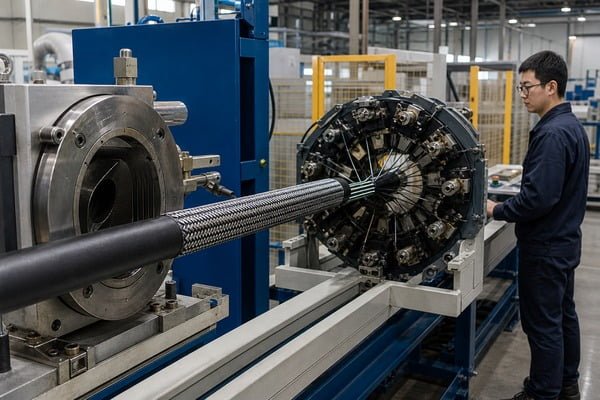
The most common rubber types used in automotive AC hose manufacturing are EPDM, CR (chloroprene rubber), and NBR (nitrile butadiene rubber). Each has a different compatibility profile:
| Rubber Type | Refrigerant Compatibility | Temperature Range | Common Use Case |
|---|---|---|---|
| EPDM | R134a, R1234yf | -40°C to +150°C | Modern passenger vehicles |
| CR (Neoprene) | R12, R134a | -35°C to +120°C | Older systems, general A/C |
| NBR | R12, mineral oil systems | -30°C to +100°C | Legacy vehicles, lower-spec applications |
Using NBR in a system running R1234yf — the refrigerant now standard in most new vehicles3 — is a known compatibility mismatch. The refrigerant chemically attacks the inner tube over time, causing swelling, delamination, and eventually micro-permeation that looks like a slow refrigerant loss rather than a sudden failure. By the time the customer traces it back to the hose, the product has been in the field for months.
I've seen this pattern in customer inquiries more than once. A workshop reports refrigerant loss on a vehicle where nothing obvious is wrong. They replace the compressor. Then the receiver-drier. Eventually someone traces it to the hose.
The right question to ask any supplier: "What rubber compound is your inner tube? Is it EPDM or CR, and what refrigerant system is it rated for?" If they can't answer without checking, that's a signal.
The outer cover layer also matters — it needs UV resistance and abrasion resistance to survive under-hood conditions. And the reinforcement layer (braided polyester or wire) affects burst pressure rating and flexibility. We'll cover that in the process steps below.
How Is AC Hose Produced Step by Step?
The production sequence looks straightforward on paper. What separates a reliable factory from a problematic one is the process control at each stage — the parameters, the equipment condition, and whether there's anyone actually checking.
Step 1: Rubber Compound Preparation
Raw rubber is mixed with additives — vulcanizing agents, accelerators, plasticizers, and antioxidants — to achieve the target compound properties. This step is done in batches using internal mixers or open mills.
Why it matters to you: Inconsistent compound mixing produces hoses with uneven wall hardness and unpredictable permeation resistance. A well-run factory tests compound consistency batch by batch, not just once per material lot.
Step 2: Extrusion
The prepared compound is fed into an extruder to form the inner tube. Wall thickness uniformity and concentricity are controlled by die design and extrusion speed.
Thin spots in the inner tube wall are invisible until a hose fails under pressure. We use continuous thickness monitoring during extrusion — not spot-checking finished hose — because catching variation at the source is the only way to prevent it from reaching assembly.
Step 3: Reinforcement
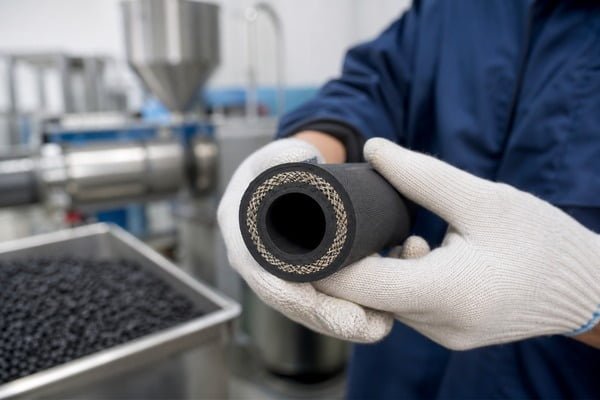
The extruded inner tube is braided or wrapped with polyester fiber or steel wire reinforcement. Braid angle and coverage percentage directly affect the pressure rating and flexibility of the finished hose4.
A tighter, more consistent braid increases burst pressure resistance. Gaps or uneven coverage create weak points5. Reinforcement is applied by machine, but the machine setup and tension settings need to be checked regularly — this is often where low-volume factories skip calibration.
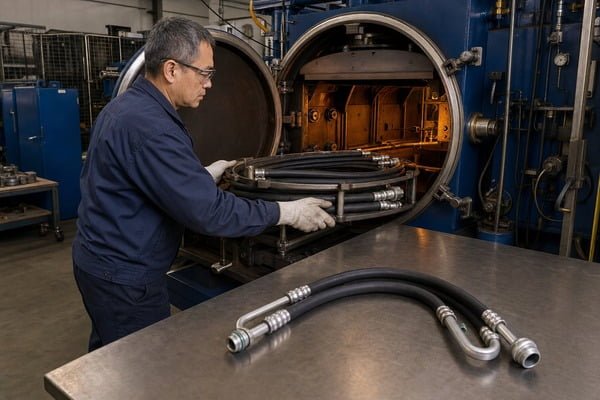
Step 4: Vulcanization
This is the most consequential and least visible step in the entire process.
Vulcanization is the heat-cure process that crosslinks the rubber polymer chains6, transforming the extruded tube from a soft, uncured compound into a finished hose with its final mechanical properties. Without complete vulcanization, rubber remains partially uncured — soft in some zones, brittle in others, and vulnerable to delamination under thermal cycling.
In our vulcanization process, hoses are cured in a temperature-controlled mold at approximately 160–170°C for a set cure time7 determined by compound thickness and formulation. Temperature uniformity across the mold is monitored because cold spots produce under-cured zones that won't show up in room-temperature burst testing.
What happens when vulcanization is rushed?
- Delamination between the inner tube and reinforcement layer under thermal cycling
- Pressure failure at lower-than-rated pressures after the hose has been through a few heat cycles
- Refrigerant permeation through under-crosslinked inner tube walls — this shows up as gradual refrigerant loss with no visible leak point
A five-minute reduction in cure time saves cost per batch. It's undetectable at inspection. But it produces a hose with a shorter functional life under real operating conditions.
Step 5: Cutting
Cured hoses are cut to specified lengths. This step is mechanically straightforward but requires calibrated tooling to maintain consistent cut length and clean end faces — particularly important for hoses that will be assembled with fittings using a crimping machine.
Step 6: Inspection
Visual inspection and dimensional checks happen at the end of the production line. This is the step most buyers think of as "quality control" — but it's only the last gate in a process that should have quality controls built in at every step before it.
How Do Manufacturers Test AC Hose Quality?
This is where I'd push back on how most factory profiles present their testing capability. Listing "pressure testing, leakage testing, temperature testing" as three bullet points tells a buyer almost nothing. What matters is what failure looks like when each test is skipped.
Pressure Testing
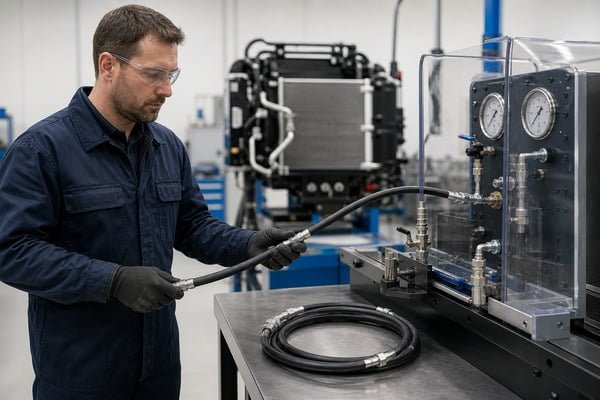
Hoses are pressurized to rated burst pressure to confirm structural integrity. A standard burst test might go to 3–4x the working pressure of the hose.
What's missed when factories only do burst testing: A hose can pass a static burst test at room temperature and still fail at working pressure after ten heat cycles. Burst testing alone doesn't validate long-term performance — it only validates the hose in a single static condition.
Leakage Testing
Leakage testing checks refrigerant permeation rate through the inner tube wall under pressure. This test is particularly important for R1234yf systems where permeation limits are tighter than older R134a applications8.
What failure looks like when this is skipped: Gradual refrigerant loss over weeks or months with no identifiable leak point. This is one of the most common complaint patterns we hear from buyers who switched to our supply after field issues with previous sourcing — the hoses held pressure in bench testing but bled refrigerant slowly in service.
Temperature Cycling Testing
Hoses are subjected to repeated hot/cold cycles — typically between -40°C and +120°C — while under pressure9. This validates that the rubber-reinforcement bond and the compound itself remain intact through the thermal stress that real under-hood operation produces.
What failure looks like when this is skipped: Delamination at the inner tube-reinforcement interface after the product has been in service through one summer season. The hose exterior looks fine. The failure mode looks like "normal wear."
A professional testing protocol combines all three — not as separate marketing claims, but as a sequence that validates the same hose sample under conditions that reflect real operating stress.
What Makes a Professional AC Hose Factory Different?
The honest answer isn't a capability list. It's the pattern of complaints that a controlled process prevents.
The most common failure we hear about from new customers who've had problems with previous suppliers breaks down into three categories:
- Gradual refrigerant loss — almost always traced to material mismatch or incomplete vulcanization
- Fitting connection failure — usually a cutting or end-face consistency issue affecting the crimp seal
- Hose hardening or cracking — typically a compound formulation issue or under-dosing of plasticizer in the mix stage
A factory that controls its vulcanization temperature curve, monitors compound mixing consistency, and runs combined pressure-leak-temperature validation produces a different failure rate than one that treats these as overhead to minimize. The difference doesn't show up in a product photo or a spec sheet. It shows up six months after your customer installs the product.
What I'd recommend asking any AC hose supplier: Can you show me your vulcanization parameters and your leakage test report for this SKU? The answer — and how quickly they can provide it — tells you more than any marketing material.
Frequently Asked Questions
What rubber is best for R1234yf automotive AC hoses?
EPDM is the most compatible rubber compound for R1234yf systems. It resists the chemical properties of the refrigerant and handles the operating temperature range of modern passenger vehicles10. Using CR or NBR with R1234yf can cause inner tube swelling and premature permeation failure.
How do I know if an AC hose failed due to manufacturing defects or installation error?
Manufacturing defects typically show as gradual refrigerant loss with no visible external damage, delamination at fittings, or hose hardening within the first year. Installation-related failures usually involve mechanical damage at the fitting crimp or visible kinking. If multiple hoses in a batch fail the same way, the cause is almost always production-related.
What is the typical burst pressure rating for automotive AC hoses?
Most automotive AC hoses are rated to working pressures of 150–450 psi depending on the application (high-side vs. low-side), with burst pressure ratings typically 3–4x the working pressure11. Working pressure rating alone is not sufficient — leakage and temperature cycling performance must also be validated.
Can AC hoses be made to custom lengths and fittings?
Yes. Most professional manufacturers offer cut-to-length and custom fitting assembly as standard OEM services. The key variable is whether the factory's cutting and crimping process is calibrated to maintain consistent end-face quality and crimp integrity across production runs.
Conclusion
AC hose manufacturing quality comes down to three things that buyers rarely see: the rubber compound chosen, the vulcanization process controlled, and the testing method used. A hose that looks correct and passes a burst test at room temperature may still fail under refrigerant chemistry and thermal cycling if any of those three areas were compromised during production.
If you're evaluating AC hose suppliers for a long-term supply relationship, ask about vulcanization parameters, request leakage test data, and confirm refrigerant compatibility for your specific application. These questions separate factories with real process discipline from those relying on spec sheets alone.
We supply AC hoses as part of a complete one-stop automotive A/C component range — including fittings, charging tools, and crimping machines. If you want to discuss your sourcing requirements or get technical clarification on material selection for your market, contact us directly and let's start a real conversation.
<!--[googlesitekit-end-of-content]-->
"Automotive Refrigerant Air-Conditioning Hose Requirements", https://saemobilus.sae.org/standards/j3062_202101-automotive-refrigerant-air-conditioning-hose-requirements. SAE International standard J51 specifies performance requirements for automotive air-conditioning hose assemblies, including pressure ratings that differentiate high-side and low-side applications; the values cited here should be verified against the current revision of that standard. Evidence role: statistic; source type: institution. Supports: The operating pressure range of 150–450 psi for automotive AC hose applications across high-side and low-side circuits. Scope note: Pressure ratings vary by refrigerant type, vehicle platform, and hose grade; a single range may not represent all configurations covered by applicable standards. ↩
"Environmental Protection Agency § 86.166–12", https://www.govinfo.gov/content/pkg/CFR-2011-title40-vol18/pdf/CFR-2011-title40-vol18-sec86-166-12.pdf. SAE J2064 covers barrier-type air conditioning hose and hose assembly requirements, including temperature exposure conditions used to validate thermal performance; the cited range should be cross-referenced against the test parameters defined therein. Evidence role: statistic; source type: institution. Supports: The service temperature range automotive AC hoses must withstand in real operating environments. Scope note: Temperature limits depend on hose position (proximity to engine heat sources), refrigerant type, and vehicle design; the range stated is broadly representative rather than universally applicable. ↩
"Commercial vehicles begin shift to R-1234yf refrigerant", https://www.sae.org/articles/commercial-vehicles-begin-shift-r-1234yf-refrigerant-sae-ma-06874. European Union Directive 2006/40/EC, as implemented and subsequently extended, required new vehicle type approvals to use refrigerants with a global warming potential below 150, effectively mandating the phase-in of R1234yf across new passenger cars sold in the EU from 2017 onward. Evidence role: historical_context; source type: government. Supports: The regulatory transition from R134a to R1234yf as the required refrigerant for new passenger vehicle air conditioning systems. Scope note: Adoption timelines and requirements differ by region; R134a remains in use in some markets and vehicle segments, so the characterization of R1234yf as universal to 'most new vehicles' globally may overstate current penetration in non-EU markets. ↩
"The Effect of Braid Angle on Hydraulic Hose Geometry", https://www.mdpi.com/2227-9717/12/1/152. Engineering analyses of textile-reinforced rubber hose have demonstrated that braid angle relative to the hose axis governs the trade-off between axial stiffness and pressure-containment capacity, with angles near 54.7° (the 'neutral angle') associated with balanced performance; coverage percentage determines the proportion of inner tube surface supported against radial expansion under pressure. Evidence role: mechanism; source type: research. Supports: That fiber reinforcement braid angle and coverage percentage are primary geometric parameters governing the pressure capacity and bending flexibility of braided rubber hoses. Scope note: The quantitative relationship between braid parameters and performance depends on fiber type, yarn count, and rubber modulus; the cited effect is directionally established but not captured by braid geometry alone. ↩
"A guide to recognizing the causes of hose failure | Power & Motion Tech", https://www.powermotiontech.com/hydraulics/hose-tubing/article/21884482/parker-hannifin-corp-hose-products-div-a-guide-to-recognizing-the-causes-of-hose-failure. Structural analyses of textile-reinforced rubber hose have shown that local reductions in fiber coverage create regions of elevated hoop stress in the underlying rubber tube under internal pressure; these stress concentrations reduce the effective burst pressure below that predicted for uniform braid coverage, consistent with observed field failures at braid discontinuities. Evidence role: mechanism; source type: research. Supports: That gaps or non-uniform coverage in fiber reinforcement braid reduce the burst pressure resistance of rubber hoses by creating stress concentration points. Scope note: The quantitative effect of coverage variation on burst pressure depends on gap size, fiber modulus, and rubber wall thickness; the general mechanism is well-established but specific failure thresholds require empirical testing for a given hose design. ↩
"Vulcanization", https://en.wikipedia.org/wiki/Vulcanization. Vulcanization is a chemical process in which rubber is hardened by forming crosslinks between polymer chains, typically using sulfur or peroxide curing agents under heat and pressure; the degree of crosslink density determines the hardness, elasticity, and chemical resistance of the finished product (see, e.g., Kirk-Othmer Encyclopedia of Chemical Technology, 'Rubber Compounding'). Evidence role: definition; source type: encyclopedia. Supports: The definition and mechanism of vulcanization as a process that forms crosslinks between rubber polymer chains to achieve final mechanical properties. ↩
"The Curing and Degradation Kinetics of Sulfur ...", https://etd.ohiolink.edu/acprod/odb_etd/ws/send_file/send?accession=wright1420455803&disposition=inline. Technical literature on rubber compounding indicates that peroxide- and sulfur-cured EPDM compounds are commonly processed at mold temperatures in the range of 160–180°C, with cure times determined by compound thickness and the rheological characteristics of the specific formulation. Evidence role: general_support; source type: research. Supports: That 160–170°C represents a typical cure temperature range for EPDM and CR rubber compounds used in hose manufacturing. Scope note: Optimal cure temperature and time are compound-specific; the range cited is indicative and should be verified against the cure curve data for the particular rubber formulation in use. ↩
"Listing of HFO-1234yf under the Significant New ...", https://www.epa.gov/system/files/documents/2021-11/pre-publication_mvac-nonroad-listing-rule_signed_11-17-21_508.pdf. SAE J2064 and associated industry documentation distinguish permeation test requirements by refrigerant type; the lower atmospheric impact threshold and regulatory context of R1234yf have driven tighter allowable permeation rates compared to earlier R134a specifications, reflecting both environmental and GWP-related compliance objectives. Evidence role: expert_consensus; source type: institution. Supports: That permeation requirements for automotive hoses used with R1234yf are more stringent than those historically applied to R134a systems. Scope note: The specific numeric permeation limits depend on hose type and test conditions defined in the current standard revision; characterizing the difference as categorically 'tighter' is broadly supported but the magnitude varies by hose class. ↩
"Service Reports", https://www.macsw.org/common/Uploaded%20files/MACS%20Service%20Reports/2021%20MSR/2021_08msr_Quiz.pdf. SAE J2064 specifies temperature exposure and cycling conditions for automotive air conditioning hose assemblies; the -40°C to +120°C range cited is consistent with the thermal conditioning parameters described in that standard, though exact limits and cycle counts vary by hose type and test sequence. Evidence role: statistic; source type: institution. Supports: The temperature range used in standardized thermal cycling tests for automotive AC hose validation. Scope note: Test conditions in published standards are subject to revision; the values cited should be confirmed against the current edition of the applicable standard for the specific hose grade under evaluation. ↩
"Compatibility of R1234yf and R134a and Lubricants used in ...", https://docs.lib.purdue.edu/cgi/viewcontent.cgi?article=3057&context=iracc. Technical evaluations of elastomer compatibility with HFO-1234yf refrigerants have identified EPDM as exhibiting lower volume swell, better retention of mechanical properties, and lower permeation rates compared to CR and NBR compounds under comparable exposure conditions, supporting its selection for barrier hose inner tube applications in R1234yf systems. Evidence role: expert_consensus; source type: research. Supports: That EPDM is the preferred inner tube material for automotive AC hoses used with R1234yf refrigerant based on chemical compatibility and temperature performance. Scope note: Comparative compatibility data is compound-specific and dependent on formulation details; broad generalizations about rubber families should be verified against test data for the specific compound grade in use. ↩
"Hydraulic Hose Working Pressure vs Burst Pressure Explained", https://hydraulichose.cn/hydraulic-working-pressure-vs-burst-pressure/. SAE J2064 specifies minimum burst pressure requirements for automotive air conditioning hose assemblies; the ratio of burst pressure to maximum working pressure defined in that standard provides the basis for evaluating whether the 3–4x factor cited here is consistent with current requirements. Evidence role: statistic; source type: institution. Supports: The minimum burst-to-working pressure ratio required for automotive AC hose assemblies by applicable standards. Scope note: The applicable safety factor may differ by hose type, pressure class, and revision of the standard; buyers should consult the current version of the relevant SAE or ISO standard for their specific application. ↩