
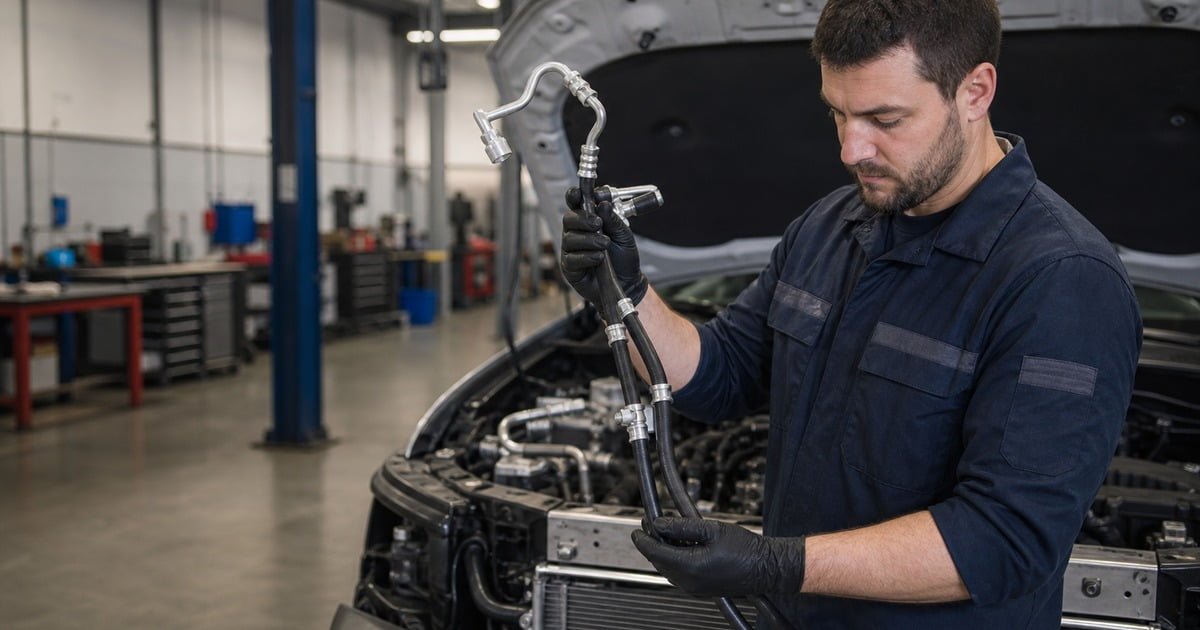
Automotive AC hose failures are one of the most common causes of refrigerant leaks in vehicle air conditioning systems1 — yet most buyers treat them as commodity tubing. If you've ever sourced hoses based on price alone and then faced early failure complaints, you already know that's an expensive assumption. The right hose structure prevents system failures. The wrong one creates them.
An automotive AC hose is a multi-layer, pressure-resistant flexible conduit that circulates refrigerant between the compressor, condenser, expansion valve, and evaporator. It is engineered to contain refrigerant under high pressure, resist permeation and temperature extremes, and absorb vibration — all simultaneously. A standard rubber tube cannot do this job reliably.
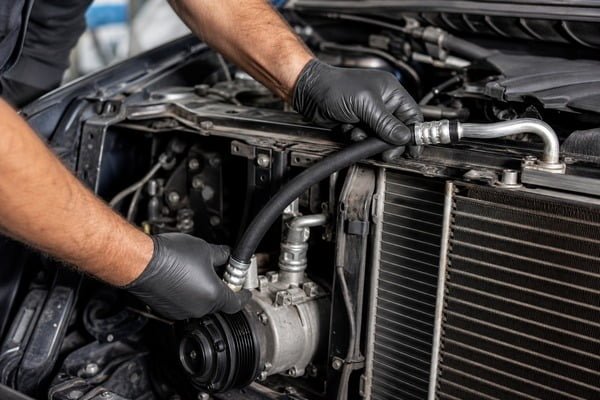
Understanding what an automotive AC hose actually is — layer by layer, side by side — changes how you evaluate suppliers, compare products, and make sourcing decisions. Let's break it down properly.
What Does an Automotive AC Hose Do?
Most buyers assume an AC hose simply "carries refrigerant from A to B." That framing misses the real engineering challenge — and it's exactly why cheap hoses cause field failures.
An automotive AC hose must simultaneously transport refrigerant under pressure, connect mechanically misaligned components, and survive continuous vibration, heat cycling, and chemical exposure for years without leaking.
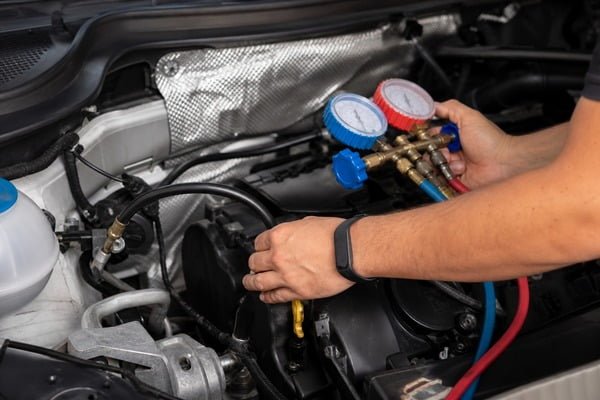
Transporting Refrigerant Safely
The primary job of an automotive AC hose is to move refrigerant — typically R-134a or R-1234yf — through a closed loop circuit2. This sounds straightforward. But refrigerant molecules are small and chemically aggressive. Under pressure, they will permeate through ordinary rubber over time3, escaping as micro-leaks the naked eye cannot detect.
By the time a customer notices that the A/C isn't cooling, the system may have already lost a significant portion of its refrigerant charge — quietly, through the hose wall.
Connecting Misaligned Components
Vehicle engines vibrate. Components shift. Manufacturing tolerances mean that no two connection points are perfectly aligned. The hose must bridge these gaps flexibly without cracking, kinking, or separating from its fittings under movement.
This is why flexibility and mechanical strength must coexist in one component. A rigid metal line cannot absorb compressor vibration. A soft rubber tube without reinforcement cannot hold system pressure.
Managing Pressure and Temperature
The AC system operates across a wide pressure range — from suction-side low pressure to discharge-side high pressure — while engine heat cycles constantly between idle and full load. In practice, this means the hose is under:
- Continuous internal pressure from refrigerant charge
- Thermal stress from proximity to the engine block
- Mechanical fatigue from compressor pulsation and road vibration
- Chemical exposure to refrigerant, compressor oil, and under-hood fluids
A hose that handles only one of these conditions reliably isn't suited for real-world use. All four stressors are present simultaneously.
How Does an Automotive AC Hose Work?
It's a common question we hear from buyers new to AC system sourcing: "Can I use the same hose on both the high side and low side?" The answer reveals a fundamental misunderstanding of how the system operates.
The automotive AC hose works differently depending on which side of the system it serves. The high-pressure discharge side and the low-pressure suction side create entirely different conditions — and using the wrong hose on either side is a structural mismatch, not just a specification oversight.
The High-Pressure Discharge Side
After the compressor compresses the refrigerant, it exits as a hot, high-pressure gas — typically between 150 and 300 psi depending on ambient conditions and system load, with temperatures that can exceed 100°C in the line itself4.
The discharge hose (from compressor outlet to condenser inlet) must withstand:
- Peak working pressure without deformation
- Elevated temperatures without softening or delamination
- Burst pressure well above normal operating range
Under-specified hoses on this side are a burst risk. This is not a gradual failure — it is sudden and potentially dangerous.
The Low-Pressure Suction Side
After the refrigerant passes through the evaporator and absorbs cabin heat, it returns to the compressor as a cool, low-pressure vapor — typically 20 to 45 psi. The temperature may drop to near or below ambient.
The suction hose (from evaporator outlet to compressor inlet) faces:
- Lower pressure, but still requires reinforcement for vacuum resistance
- Potential for condensation and moisture ingress if the outer cover degrades
- Permeation risk because refrigerant concentration is lower but continuous
Some buyers try to save cost by using lighter-spec hose on the low-pressure side. Based on what we see from customers, this creates permeation and moisture problems over time — especially in humid climates.
Refrigerant Flow and the Complete Circuit
| Circuit Position | Refrigerant State | Typical Pressure | Primary Hose Risk |
|---|---|---|---|
| Compressor → Condenser | Hot gas (high pressure) | 150–300 psi | Burst, heat deformation |
| Condenser → Expansion valve | Liquid (high pressure) | 150–300 psi | Permeation, fitting leak |
| Expansion valve → Evaporator | Mixed liquid/vapor | 20–45 psi | Kinking, moisture ingress |
| Evaporator → Compressor | Cool vapor (low pressure) | 20–45 psi | Permeation, vacuum collapse |
What Is Inside an Automotive AC Hose?
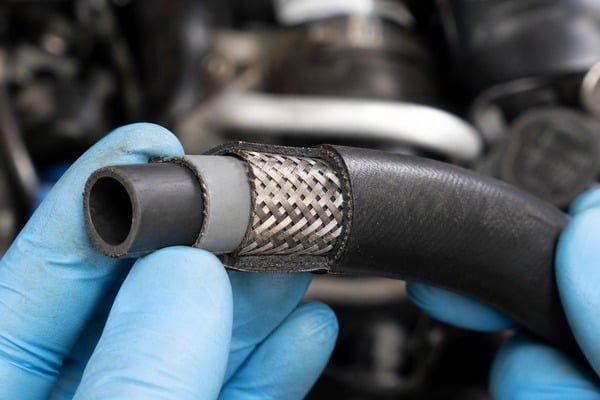
This is where most supplier comparisons fall apart. A supplier says "multi-layer construction" and a buyer assumes that means quality. But the real question is: which layers, made of what material, in what sequence? Each layer serves a distinct function — and a missing or underspecified layer doesn't just reduce performance, it changes the hose's risk profile entirely.
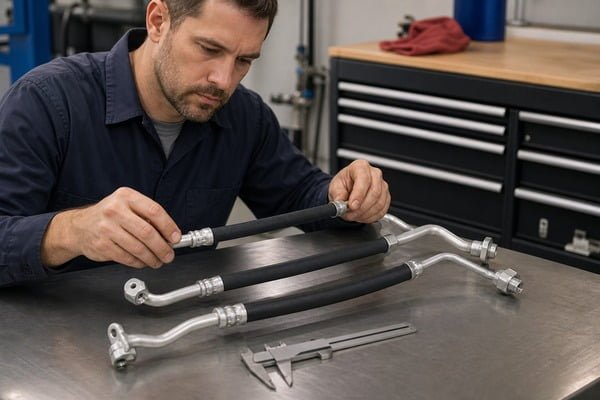
Inner Tube — The First Line of Defense
The innermost layer is in direct contact with refrigerant and compressor oil at all times. It must be chemically compatible with both, smooth enough to minimize flow resistance, and flexible enough to bend without cracking.
Common materials include EPDM rubber and NBR (nitrile butadiene rubber) for standard applications. For modern refrigerants like R-1234yf, which has different chemical characteristics, material compatibility becomes critical5. An inner tube that degrades chemically will shed particles into the system — contaminating the compressor and expansion valve.
Barrier Layer — The Permeation Wall
This is the layer that separates a basic rubber hose from a barrier hose. The barrier layer — typically a thin nylon (PA6 or PA12) film — dramatically reduces refrigerant permeation through the hose wall.
Without a barrier layer, refrigerant molecules migrate through the rubber matrix continuously. The loss may be too slow to detect short-term, but over a season of use, the system loses charge. Customers then blame the compressor or connections — not the hose.
From our production experience: When buyers ask why their systems need topping up every season despite no visible leaks, the answer is often a hose without a true barrier layer. The barrier is not optional for R-134a and R-1234yf applications.
Reinforcement Layer — Pressure Containment
Wrapped around the barrier layer (or inner tube in non-barrier designs), the reinforcement layer provides the structural strength needed to hold system pressure. It is typically constructed from:
- Braided polyester or nylon fiber (common in single-braid designs)
- Spiral-wound fiber plies (higher pressure ratings, used on discharge lines)
The number of reinforcement plies directly affects the working pressure rating. A hose with insufficient reinforcement will swell under high-side pressure — deforming at the fittings first, then leaking. When comparing suppliers, ask specifically: single braid or double braid, what fiber, and what working pressure is it rated for.
Outer Cover — Environmental Protection
The outermost layer protects everything inside from the engine bay environment: heat radiation, ozone, abrasion, oil splashes, and UV exposure. It is typically EPDM or CR (chloroprene) rubber, compounded for heat and ozone resistance.
A degraded outer cover is a warning sign that the layers beneath are at risk. We often see imported hoses with cracking outer covers within two years in hot-climate markets — usually due to under-compounded rubber used to reduce material cost. The outer cover is not structural, but its condition signals how the whole hose was built.
What Types of Automotive AC Hoses Are Available?
Not all automotive AC hoses are the same, and the type you choose is a selection decision with real consequences — not a branding preference.
The three main types differ in permeation resistance and application suitability. Choosing the wrong type for a specific refrigerant or operating environment leads to gradual system failure that is difficult to diagnose.
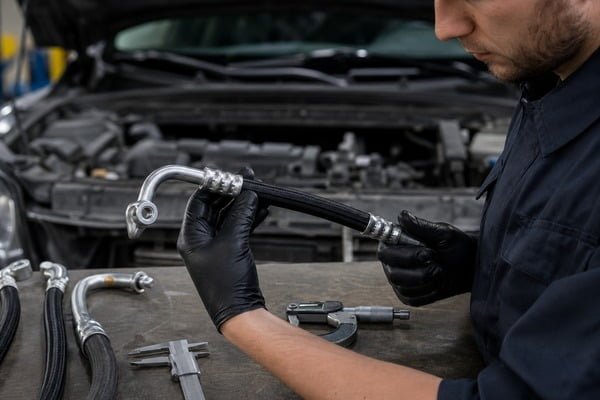
Barrier Hose
Barrier hose includes a dedicated nylon barrier layer between the inner tube and reinforcement layer. This construction dramatically reduces refrigerant permeation — making it the recommended choice for R-134a and R-1234yf systems.
Most original equipment manufacturers specify barrier hose as standard6. If you're supplying hoses for late-model vehicles or R-1234yf systems, barrier hose is not an upgrade — it's the baseline specification.
Standard Rubber Hose
Standard rubber hose (sometimes called Type A or non-barrier hose) has no dedicated permeation barrier. It relies on the rubber compound of the inner tube to resist permeation — which it does imperfectly.
Standard rubber hose is appropriate for older refrigerants like R-12 in vintage vehicle applications, or for systems where the refrigerant type and replacement interval are both managed carefully. In modern workshops servicing R-134a vehicles, it is not suitable as a direct replacement for barrier hose.
The risk of offering standard rubber hose as a "compatible" option for modern systems is that the permeation rate — invisible to the customer — will cause gradual charge loss and eventual complaints.
Reduced Permeation Hose
Reduced permeation hose sits between the two options above. It achieves lower permeation than standard rubber hose through modified inner tube compounding or a thin coating, without a full nylon barrier layer.
Some markets and applications — particularly where cost is a strong constraint and barrier hose is not locally mandated — use reduced permeation hose as a compromise. However, buyers should understand: this is a deliberate trade-off between cost and performance, not a universal solution.
| Hose Type | Barrier Layer | Permeation Level | Suitable Refrigerants | Typical Application |
|---|---|---|---|---|
| Barrier Hose | Yes (nylon film) | Very low | R-134a, R-1234yf | Modern vehicles (OEM spec) |
| Standard Rubber Hose | No | High | R-12 (legacy) | Vintage/classic vehicles |
| Reduced Permeation Hose | No (modified compound) | Medium | R-134a (cost-sensitive) | Aftermarket replacements |
Why Does AC Hose Structure Matter?
Structure matters because every procurement decision about hose type is, indirectly, a decision about failure risk in the field.
A buyer who chooses standard rubber hose for a modern R-1234yf system doesn't experience a dramatic failure — they experience gradual charge loss, repeated warranty claims, and a customer who never quite trusts the system again. The hose looked fine. The fittings were tight. But the barrier layer wasn't there.
In our experience working with importers and distributors, the most common sourcing mistake isn't choosing the cheapest supplier — it's not asking the right questions. When evaluating any automotive AC hose supplier, the questions that actually matter are:
- What is the inner tube material, and is it compatible with R-1234yf?
- Is there a true nylon barrier layer, or is this a modified rubber compound?
- How many reinforcement plies, and what fiber type?
- What is the outer cover compound, and is it rated for high-temperature under-hood environments?
A supplier who can answer all four questions precisely — with material specs, not just marketing language — is a supplier who knows what they're building. One who answers with vague phrases like "high-quality multi-layer construction" is giving you catalog copy, not product knowledge.
Structure doesn't just determine performance. It determines whether you can stand behind what you sell.
Frequently Asked Questions
Can I use one hose for both the high-pressure and low-pressure sides?
No. High-side and low-side hoses face different pressures and temperatures. High-side hoses must withstand 150–300 psi and high heat from the compressor discharge. Low-side hoses operate under lower pressure but require permeation resistance and vacuum stability. Using an underspecified hose on the high side is a burst risk.
What is the difference between barrier hose and standard rubber hose?
Barrier hose includes a nylon film layer that blocks refrigerant permeation through the hose wall. Standard rubber hose has no such layer, relying only on rubber compound resistance — which is insufficient for modern refrigerants like R-134a and R-1234yf. For most current vehicle applications, barrier hose is the correct specification.
How do I know if an AC hose is compatible with R-1234yf?
R-1234yf compatibility depends on inner tube material and barrier layer composition. Not all rubber compounds are chemically compatible with R-1234yf. Ask the supplier specifically for the inner tube material specification and whether the hose has been designed and tested for R-1234yf use — not just for "modern refrigerants" in general.
Why does my AC system lose refrigerant even when there are no visible leaks?
Refrigerant permeation through hose walls without a proper barrier layer is a common cause of gradual charge loss. The molecules are small enough to migrate through rubber slowly over time, producing no visible leak point. If a system consistently loses charge between service intervals, hose permeation is a primary suspect — especially if standard rubber hose was used.
What should I ask a supplier when sourcing automotive AC hoses?
Ask for: inner tube material name, barrier layer presence and material, reinforcement ply count and fiber type, outer cover compound and temperature rating, and working pressure specification. These four or five data points tell you far more about actual hose quality than general claims about "multi-layer" or "OEM-quality" construction.
Conclusion
An automotive AC hose is a precision component, not a generic tube. Its inner tube, barrier layer, reinforcement, and outer cover each serve a specific function — and each layer's specification determines whether the system holds pressure and refrigerant safely over years of service. Choosing the wrong hose type, or sourcing from a supplier who can't explain their own construction, is a procurement risk that shows up as field failures and warranty claims.
If you're sourcing automotive AC hoses for distribution, wholesale, or workshop supply, the place to start is not the price list — it's the layer specification. We work with importers and distributors worldwide to supply barrier hose, standard hose, and complete AC hose assemblies with full material transparency. Contact us to discuss your application requirements and get the right hose for your market.
<!--[googlesitekit-end-of-content]-->
"R-134a emissions from vehicles", https://pubmed.ncbi.nlm.nih.gov/11878368/. Research on mobile air conditioning refrigerant emissions has identified hose permeation and hose assembly failures as significant contributors to system charge loss, though the ranked prevalence among leak sources varies by vehicle age and refrigerant type. Evidence role: statistic; source type: research. Supports: The relative frequency of hose failures as a source of refrigerant leaks in vehicle AC systems. Scope note: Comparative failure-source statistics are often derived from fleet studies or emissions inventories that may not generalize across all vehicle populations or climates. ↩
"Protection of Stratospheric Ozone: Listing of HFO-1234yf ...", https://www.federalregister.gov/documents/2021/12/06/2021-25440/protection-of-stratospheric-ozone-listing-of-hfo-1234yf-under-the-significant-new-alternatives. The European Union's MAC Directive (2006/40/EC) phased out refrigerants with a global warming potential above 150 in new vehicle type approvals from 2011, accelerating industry adoption of R-1234yf as the primary replacement for R-134a in new vehicle platforms. Evidence role: historical_context; source type: government. Supports: The regulatory transition from R-134a to R-1234yf in automotive air conditioning systems and the current prevalence of both refrigerants. Scope note: Adoption timelines vary by region; R-134a remains in service in a large portion of the global vehicle fleet, making both refrigerants simultaneously relevant. ↩
"Separation and recycling of hydrofluorocarbon refrigerant ...", https://pmc.ncbi.nlm.nih.gov/articles/PMC11740966/. Gas permeation through elastomeric materials follows solution-diffusion mechanisms, where small-molecule gases dissolve into and diffuse through the polymer matrix; refrigerants such as R-134a exhibit measurable permeation rates through standard rubber compounds that accumulate to significant charge loss over operational lifetimes. Evidence role: mechanism; source type: research. Supports: The physical mechanism by which refrigerant molecules diffuse through rubber hose walls under pressure conditions typical of automotive AC systems. Scope note: Specific permeation rates depend on rubber formulation, temperature, pressure, and refrigerant type; generic characterizations may not reflect performance of specific commercial hose compounds. ↩
"What Pressure Should my Car AC Be - How To Check ...", https://www.youtube.com/watch?v=BkI9VpyOLiA. Automotive HVAC engineering references document high-side discharge pressures commonly ranging from approximately 150 to 300 psi under normal operating conditions, with discharge line temperatures varying according to ambient temperature, compressor speed, and system load. Evidence role: statistic; source type: education. Supports: Typical operating pressure and temperature ranges on the high-pressure discharge side of automotive air conditioning systems. Scope note: Exact pressure and temperature values vary significantly by vehicle make, ambient conditions, and refrigerant type; the cited range represents typical rather than universal values. ↩
"Compatibility of R1234yf and R134a and Lubricants used in Automotive ...", https://docs.lib.purdue.edu/cgi/viewcontent.cgi?article=3057&context=iracc. R-1234yf (2,3,3,3-tetrafluoropropene) differs from R-134a in molecular structure, flammability classification, and interaction with certain elastomers and lubricants; automotive industry testing has identified material compatibility as a necessary design consideration when transitioning systems to R-1234yf. Evidence role: mechanism; source type: research. Supports: The distinct chemical properties of R-1234yf relative to R-134a and their implications for hose and seal material compatibility. Scope note: Compatibility outcomes depend on specific compound formulations rather than rubber type alone; generalizations across all EPDM or NBR grades may not hold without compound-specific testing. ↩
"AC Hose by the Foot or Spool | Barrier & Reduced- ...", https://www.autocoolingsolutions.com/collections/bulk-ac-hose?srsltid=AfmBOoofjMDLtE99NlaaOYmBQL-kcylpGZsNk4C8KO64eXLSRObyXdj2. SAE J2064 and equivalent OEM material standards have progressively mandated barrier hose constructions for refrigerant-containing lines in passenger vehicles, reflecting industry consensus that permeation control is required for systems charged with R-134a and R-1234yf. Evidence role: expert_consensus; source type: institution. Supports: The industry-wide adoption of barrier hose as the OEM-specified standard for modern automotive AC systems. Scope note: OEM specifications vary by vehicle platform and manufacturer; the claim of universality across all OEMs is a generalization that may not apply to all vehicle categories or markets. ↩