

I see the same problem every week. A distributor places a bulk order for AC hoses. Two months later, they contact us again. The workshops are returning the hoses. The refrigerant leaks slowly. The system never cools properly. The distributor absorbs the cost of returns and loses trust with their customers.
Choosing the right AC hose is not about finding the cheapest option. It is about matching hose construction to refrigerant type and system pressure. If you get any of these three wrong, the hose will fail — sometimes immediately, sometimes slowly over months. This article explains how to avoid that mistake before you place your next order.
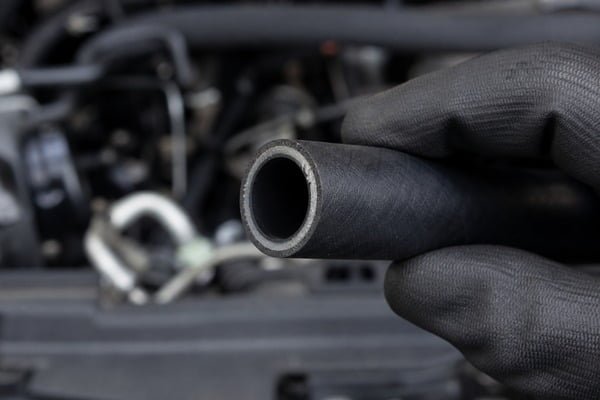
Most buyers treat AC hoses like commodity items. They order by price or by what looks similar to the old part. That approach works until the first batch of returns arrives. Then the real cost becomes clear.
What Is the Difference Between Barrier and Standard Hose?
One of the most common questions we get from new distributors is whether they really need barrier hose or if standard hose works fine. This is not a quality tier question. It is a refrigerant compatibility requirement.
Barrier hoses have an inner nylon layer that blocks refrigerant molecules from escaping through the rubber.1 Standard hoses use EPDM rubber without that barrier. R1234yf refrigerant has a higher permeation rate than R134a, so it leaks through standard EPDM rubber over time.2 If you use a standard hose with R1234yf, the system loses refrigerant slowly and cools less effectively. The workshop blames the hose. The distributor absorbs the return.
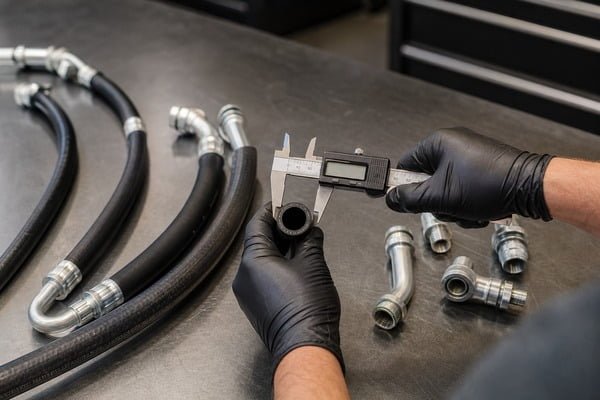
The confusion happens because standard hoses still look fine on the shelf. There is no visible damage. But refrigerant permeation is invisible. By the time the workshop notices the cooling problem, the customer has already paid for a full system recharge. That is when the complaint comes back to you.
Here is the rule I tell every distributor: match the hose construction to the refrigerant type before you check anything else. If the vehicle uses R1234yf, you need barrier hose.3 If it uses R134a, standard hose is acceptable in most cases, but barrier hose still offers better long-term performance. Some workshops prefer barrier hose for all jobs because it reduces comebacks.
| Refrigerant Type | Required Hose Construction | Why It Matters |
|---|---|---|
| R134a | Standard EPDM acceptable | Lower permeation rate allows standard rubber to hold pressure |
| R1234yf | Barrier hose required | High permeation rate causes slow refrigerant loss through standard rubber |
| R12 (legacy systems) | Standard EPDM acceptable | Similar permeation characteristics to R134a |
Do not treat this as a suggestion. It is a specification requirement. If you source barrier hose for R1234yf systems, you avoid the most common return issue we see in distributor orders.
How Do I Choose the Right Hose Size?
Distributors often ask us for hose by inner diameter alone. That question is incomplete. The correct hose size depends on three things together: inner diameter, fitting type, and system pressure rating.
AC hoses are sized by their inner diameter, but you cannot order by ID alone. The fitting on each end determines how the hose connects to the compressor, condenser, and evaporator. If the fitting type does not match the vehicle system, the hose will not seal properly even if the ID is correct. You need to know both the hose ID and the crimping end type before you select a SKU.
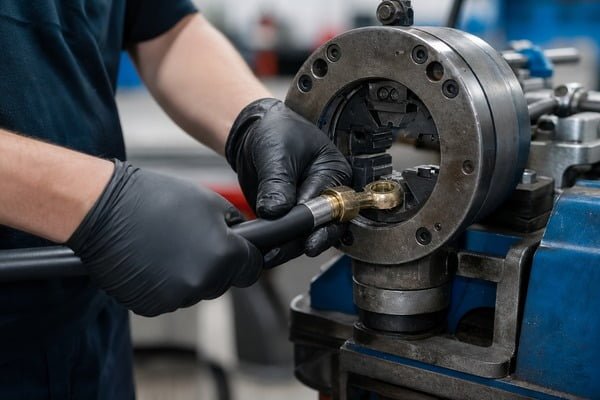
The most common sizes in automotive AC systems are #6, #8, #10, and #12.4 These numbers refer to the hose ID in sixteenths of an inch.5 A #8 hose has an inner diameter of 8/16 inch, which is 1/2 inch or about 12.7mm. A #10 hose is 10/16 inch or 5/8 inch.
But size alone does not tell you if the hose fits the system. You also need to know the fitting style on each end. The most common types are beadlock fittings, which use a barbed insert and an outer crimp ferrule to seal the hose.6 Some systems use spring lock fittings or flare fittings instead. If you order the wrong fitting type, the hose cannot connect to the vehicle system, no matter how correct the ID is.
Here is what I ask distributors when they request hose sizing: What is the vehicle make and model? What refrigerant type does it use? What is the system pressure rating? Those three answers tell me which hose ID, fitting type, and pressure class they need. Ordering by ID alone leaves two critical variables undefined.
| Hose Size | Inner Diameter (inch) | Inner Diameter (mm) | Common Application |
|---|---|---|---|
| #6 | 3/8" | 9.5mm | Low-pressure return lines |
| #8 | 1/2" | 12.7mm | Standard pressure and suction lines |
| #10 | 5/8" | 15.9mm | High-flow suction lines |
| #12 | 3/4" | 19.0mm | Large compressor discharge lines |
If you source hoses for multiple vehicle platforms, keep a reference chart that maps vehicle system to hose size and fitting type. That removes the guesswork when workshops request replacements.
What Pressure Rating Does My AC Hose Need?
In orders involving high-pressure discharge lines, we frequently see distributors assume any hose rated for refrigerant will work. That assumption causes burst failures and safety complaints.
AC hoses are rated for working pressure and burst pressure.7 Working pressure is the maximum system pressure the hose can handle continuously. Burst pressure is the point at which the hose fails catastrophically. Automotive AC systems operate at different pressures depending on the line position. The discharge line from the compressor sees the highest pressure — often 300 to 500 psi during normal operation.8 If you use a low-pressure hose on a discharge line, it will fail.
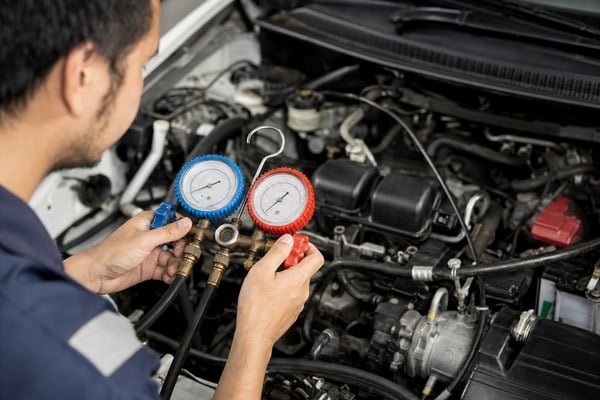
The standard pressure ratings we see in distributor orders are 350 psi working pressure for suction lines and 500 psi working pressure for discharge lines.9 Some heavy-duty systems require hoses rated to 600 psi or higher. The pressure rating is usually printed on the hose or listed in the technical spec sheet.
Distributors sometimes try to save cost by ordering lower-pressure hose for all applications. That works fine for low-pressure return lines, but it creates a safety risk on discharge lines. If the hose bursts under pressure, refrigerant sprays into the engine bay. Workshops do not order from distributors who supply hoses that fail under normal operating conditions.
Here is the matching rule I recommend: suction and return lines can use 350 psi working pressure hoses in most passenger vehicles. Discharge lines need 500 psi minimum. If the vehicle is a commercial or heavy-duty application, check the OEM spec and order the next higher pressure class.
| Line Position | Typical Pressure Range | Minimum Working Pressure Rating |
|---|---|---|
| Suction line (evaporator to compressor) | 30-80 psi | 350 psi |
| Discharge line (compressor to condenser) | 150-500 psi | 500 psi |
| Liquid line (condenser to expansion valve) | 100-300 psi | 350-500 psi |
Do not mix pressure classes randomly. Match the hose pressure rating to the line position. That prevents the most serious type of failure we see in aftermarket AC systems.
How Do I Match Hose to Refrigerant Type?
This is where most distributor mistakes happen. Refrigerant compatibility is not interchangeable. R134a and R1234yf require different hose constructions, and using the wrong one causes slow system failure.
R134a hoses use standard EPDM rubber inner liners. R1234yf hoses require a nylon barrier layer to prevent refrigerant permeation. If you install an R134a hose on an R1234yf system, the refrigerant escapes through the rubber over time. The system loses cooling capacity. The workshop recharges the system. The refrigerant escapes again. Eventually, the workshop replaces the hose and blames the distributor for supplying the wrong part.

The issue is not immediate failure. It is slow refrigerant loss that takes weeks or months to become obvious. By that time, the workshop has already installed the hose, charged the system, and returned the vehicle to the customer. When the cooling problem reappears, the workshop investigates and discovers the hose was not barrier-rated. That is when the complaint comes back to the distributor.
Some distributors assume they can use R1234yf hoses on R134a systems and avoid the compatibility problem entirely. That works technically, but it increases your cost because barrier hoses are more expensive. If you know the vehicle uses R134a, standard hose is acceptable and saves margin.
Here is the explicit compatibility table I give to every distributor who asks:
| Refrigerant Type | Required Hose Construction | Can I Use Barrier Hose? | Can I Use Standard Hose? |
|---|---|---|---|
| R134a | Standard EPDM acceptable | Yes, but higher cost | Yes |
| R1234yf | Barrier hose required | Yes, required | No — causes slow refrigerant loss |
| R12 (legacy) | Standard EPDM acceptable | Yes, but unnecessary | Yes |
Do not treat refrigerant compatibility as optional. Match the hose construction to the refrigerant type before you check size or pressure rating. That single decision prevents the majority of return issues we see in bulk orders.
What Temperature Range Does the Hose Need to Handle?
AC hoses operate in extreme temperature conditions. The discharge line near the compressor can reach 120°C (250°F) or higher during peak operation.10 The suction line can drop below -30°C (-22°F) when refrigerant evaporates. If the hose rubber cannot handle that range, it cracks or softens.
Automotive AC hoses are rated for a continuous temperature range, usually -40°C to +135°C (-40°F to +275°F).11 If the hose is installed near the engine exhaust manifold or turbocharger, the ambient temperature can exceed the hose rating and cause premature aging. Distributors need to verify that the hose temperature rating matches the installation environment.
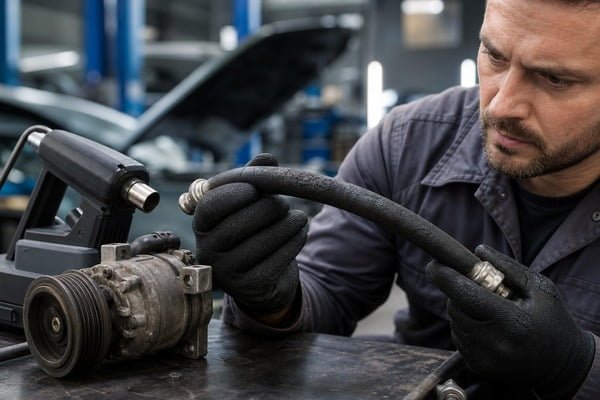
The temperature rating is especially important for discharge lines, which carry hot, high-pressure refrigerant from the compressor. If the rubber compound softens at high temperature, the hose swells under pressure and eventually leaks at the crimp connection. This is a slow failure mode that takes months to appear, but it always comes back as a warranty claim.
Some aftermarket hoses use cheaper rubber compounds that meet the temperature rating on paper but age faster under real operating conditions. I tell distributors to check whether the hose is rated for continuous operation at the high end of the temperature range, not just peak exposure. Continuous rating means the hose can handle that temperature day after day without degrading.
Should I Choose OEM or Aftermarket AC Hose?
One of the most frequent debates I hear from distributors is whether they should stock OEM hoses or aftermarket alternatives. This is not a brand loyalty question. It is a sourcing risk question.
OEM hoses are manufactured to the vehicle maker's exact specifications, including material grade, pressure rating, and fitting type. Aftermarket hoses may meet the same performance standards, or they may use cheaper materials to reduce cost. The real issue is whether you can verify that the aftermarket hose matches the OEM specification. If you cannot verify it, you are transferring risk to your customers.
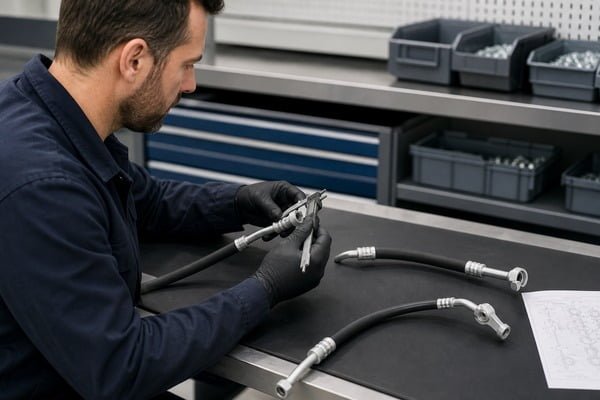
OEM hoses cost more, but they eliminate specification risk. When a workshop installs an OEM hose, they know it will fit and perform exactly like the original part. That certainty is worth the price premium in high-pressure or critical applications like discharge lines.
Aftermarket hoses offer better margin, but only if they meet the same pressure, temperature, and material standards as the OEM part. Many aftermarket manufacturers produce hoses that are functionally identical to OEM at a lower price. The question is how you verify that.
Here is the checklist I give to distributors evaluating aftermarket hoses:
| Verification Point | What to Check | Why It Matters |
|---|---|---|
| Pressure rating | Does the hose meet or exceed OEM working pressure? | Prevents burst failures on high-pressure lines |
| Temperature range | Can the hose handle -40°C to +135°C continuously? | Prevents cracking or softening under real operating conditions |
| Refrigerant compatibility | Does the hose use barrier construction for R1234yf? | Prevents slow refrigerant loss and system underperformance |
| Fitting type | Does the crimp end match the OEM fitting interface? | Ensures proper sealing and connection to vehicle system |
| Material certification | Is the inner liner SAE J2064 or ISO 1307 compliant?12 | Confirms the hose meets industry material standards |
If the aftermarket supplier can provide documentation for all five points, the hose is a safe alternative to OEM. If they cannot, you are guessing. That guess becomes your liability when the hose fails.
What Should I Check Before Placing a Bulk Order?
Most return issues I see with distributors happen because they did not verify compatibility before ordering at scale. Once you have 500 hoses in inventory that do not match your customers' systems, you cannot return them to the manufacturer. That cost stays with you.
Before you place a bulk order, verify refrigerant type, hose size with fitting type, pressure rating, and temperature range. These four parameters together define the correct SKU. If any one of them is wrong, the hose will not work in the target system. Checking all four before you order prevents costly errors after the hoses arrive.
Here is the buying checklist I recommend to every distributor:
- Refrigerant type — Does the vehicle system use R134a or R1234yf? Match the hose construction to the refrigerant type.
- Hose size and fitting type — What is the inner diameter, and what fitting style is on each end? Verify both dimensions.
- Pressure rating — Is this a suction line or a discharge line? Match the working pressure rating to the line position.
- Temperature range — Will the hose be installed near high-heat components? Verify the continuous temperature rating.
- OEM specification reference — If available, cross-reference the OEM part number to confirm all parameters match.
If you can answer all five questions, you have enough information to order the correct hose. If you cannot answer any of them, ask your customer or the vehicle manufacturer before you place the order. That five-minute verification prevents a return process that takes weeks and costs you margin.
Conclusion
Choosing the right AC hose means matching refrigerant type to hose construction, sizing the hose with the correct fitting type, and verifying pressure and temperature ratings before you order. If you get any of these wrong, the hose will fail and your customers will return the parts. Verify all four parameters before you place your next bulk order.
<!--[googlesitekit-end-of-content]-->
"Air Conditioning Hose for Car | OEM & Wholesale Supplier", https://www.strongflex.com/project/air-condition-hose/. A technical study or hose-standard reference on automotive refrigerant hose construction supports that barrier hoses use low-permeability polymer liners, including nylon-type layers, to reduce refrigerant permeation through rubber structures. Evidence role: mechanism; source type: paper. Supports: A technical source should explain that barrier-type refrigerant hoses incorporate low-permeability polymer layers, commonly nylon or similar materials, to reduce refrigerant permeation through elastomeric hose walls.. Scope note: The source may describe barrier-hose construction generally rather than confirming the construction of every hose sold as a barrier hose. ↩
"[PDF] Compatibility of R1234yf and R134a and Lubricants used in ...", https://docs.lib.purdue.edu/cgi/viewcontent.cgi?article=3057&context=iracc. Experimental refrigerant-permeation literature supports that permeation varies by refrigerant chemistry and hose material, with HFO-1234yf requiring low-permeation hose constructions in mobile air-conditioning applications. Evidence role: mechanism; source type: paper. Supports: A materials or SAE paper should compare permeation behavior of HFO-1234yf and HFC-134a through elastomeric automotive AC hose materials.. Scope note: The source may establish relative permeation behavior under test conditions, not the exact leak rate in every vehicle installation. ↩
"Listing of HFO-1234yf under the Significant New Alternatives Policy ...", https://www.regulations.gov/document/EPA-HQ-OAR-2021-0347-0025. Industry standards for mobile air-conditioning refrigerant hoses support the use of low-permeation, refrigerant-compatible hose constructions for R1234yf systems. Evidence role: expert_consensus; source type: institution. Supports: An SAE or other standards-based source should support that mobile AC hose assemblies for modern refrigerants are specified for low permeation and compatibility, which commonly requires barrier construction for R1234yf service.. Scope note: The standard may specify performance requirements rather than using the article's simplified phrase that all R1234yf vehicles 'need barrier hose.' ↩
"Wisepick 25PCS Air Conditioning Hose and Fitting Kit Includes 6.5ft ...", https://www.amazon.com/Wisepick-25PCS-Conditioning-Fitting-Fittings/dp/B0CQC49BJQ. Automotive service and hose-specification references identify refrigerant hoses by dash-number sizes, commonly including #6, #8, #10, and #12 in mobile air-conditioning applications. Evidence role: general_support; source type: institution. Supports: A hose standard or automotive service-training reference should show that refrigerant hoses are commonly specified using dash-number sizes such as #6, #8, #10, and #12.. Scope note: The source may document standard size designations without proving these are the most common sizes in every market. ↩
"Understanding Dash Sizing - Force America", https://forceamerica.com/understanding-dash-sizing?srsltid=AfmBOooxItrGV6wFW3IRnFy-taLSd4Stu5NySx3N2Zx6cxmbD0QH_Bmg. Technical hose-sizing references define dash numbers as nominal size designations based on sixteenths of an inch, supporting the conversion from #8 to approximately 1/2 inch inner diameter. Evidence role: definition; source type: education. Supports: A technical education or standards source should define dash-size numbering as a nominal hose size convention based on sixteenths of an inch.. Scope note: Some hose types use nominal rather than exact inner diameters, so the conversion is a sizing convention rather than a guaranteed measured value. ↩
"Fittings - Cold Hose", https://coldhose.com/collections/fittings?srsltid=AfmBOoqXSjLKckz1jaZf6yjQmqnUbmoxi8LRr31fj6j-zFVP0F29wBII. Automotive air-conditioning service references describe beadlock fittings as crimped hose-end assemblies in which an insert and ferrule mechanically compress the hose to form the seal. Evidence role: mechanism; source type: education. Supports: A service-training or technical reference should describe beadlock AC fittings as hose-end fittings sealed by inserting a nipple or barb and crimping a ferrule or sleeve around the hose.. Scope note: Terminology and exact fitting geometry vary by manufacturer, so the source supports the general beadlock mechanism rather than every fitting design. ↩
"Refrigerant hose meets SAE J 2064 standards | Parker NA - Products", https://ph.parker.com/us/en/product-list/517pm-refrigerant-hose-with-abrasion-ozone-resistant-cover. Refrigerant-hose standards specify pressure-performance criteria, including maximum working pressure and burst-pressure testing, supporting the distinction between continuous service pressure and catastrophic failure pressure. Evidence role: definition; source type: institution. Supports: A hose standard should define working pressure and burst pressure as performance ratings used for refrigerant hose assemblies.. Scope note: The standard defines test requirements under controlled conditions and does not by itself predict the service life of a particular installed hose. ↩
"Servicing Motor Vehicle Air Conditioners | US EPA", https://www.epa.gov/mvac/servicing-motor-vehicle-air-conditioners. Automotive HVAC training references identify the compressor discharge line as part of the high-pressure side of the system and report high-side pressures that can reach several hundred psi depending on ambient temperature and operating conditions. Evidence role: statistic; source type: education. Supports: An automotive HVAC training source should document typical high-side or compressor-discharge pressures and identify the discharge line as the highest-pressure line.. Scope note: Exact pressures vary by refrigerant, ambient temperature, airflow, charge level, and vehicle design, so the cited range should be treated as contextual rather than universal. ↩
"Refrigerant hose meets SAE J 2064 standards | Parker NA - Products", https://ph.parker.com/us/en/product-list/517pm-refrigerant-hose-with-abrasion-ozone-resistant-cover. Mobile refrigerant-hose standards and technical specifications support the use of distinct working-pressure ratings for AC hose assemblies, with ratings in the several-hundred-psi range appropriate to different line positions. Evidence role: general_support; source type: institution. Supports: A standards or technical-specification source should show working-pressure classes for mobile AC refrigerant hoses, including ratings in the 350–500 psi range.. Scope note: A neutral source may confirm the existence of these pressure classes without proving that they are the most common ratings in the author's distributor orders. ↩
"Let's experiment and test compressor. Discharge temperature ...", https://www.youtube.com/watch?v=wFRB7DIKHQs. Automotive HVAC references report that compressor discharge gas is the hottest portion of the refrigeration circuit and can reach temperatures near or above 120°C under high-load conditions. Evidence role: statistic; source type: education. Supports: An automotive HVAC engineering or training reference should document that compressor discharge gas and nearby discharge-line temperatures can reach high values, including around 120°C under demanding operating conditions.. Scope note: Measured hose-surface temperature may be lower or higher depending on ambient heat, airflow, refrigerant charge, compressor load, and routing. ↩
"Portable AC Hose 2026: We Tested 3 Types, One Saved 15 ...", https://ccmp.usc.edu/video/p-portable-ac-hose-2026-we-tested-3-types-one-saved-15-energy-with-data-6a3c02b6691a6.html. Refrigerant-hose specifications for mobile air-conditioning applications commonly state service-temperature ranges extending from approximately -40°C to above 120°C, supporting the need to verify hose temperature ratings. Evidence role: statistic; source type: institution. Supports: A refrigerant-hose standard or technical specification should list operating temperature requirements for automotive AC hoses near -40°C to +135°C.. Scope note: The exact upper temperature rating depends on the hose construction and applicable standard, so +135°C should be verified for the specific product. ↩
"J3062_202101 : Automotive Refrigerant Air-Conditioning Hose ...", https://www.sae.org/standards/j3062_202101-automotive-refrigerant-air-conditioning-hose-requirements. Standards documentation identifies SAE J2064 as applicable to automotive refrigerant hose assemblies and ISO 1307 as specifying hose dimensions and tolerances, supporting their use as compliance checks in hose procurement. Evidence role: definition; source type: institution. Supports: A standards-body or standards-summary source should identify SAE J2064 as a refrigerant hose standard for mobile AC systems and ISO 1307 as a hose standard addressing dimensions, tolerances, and related measurements.. Scope note: ISO 1307 is a general hose dimensional standard and does not by itself certify refrigerant compatibility or full AC-system performance. ↩