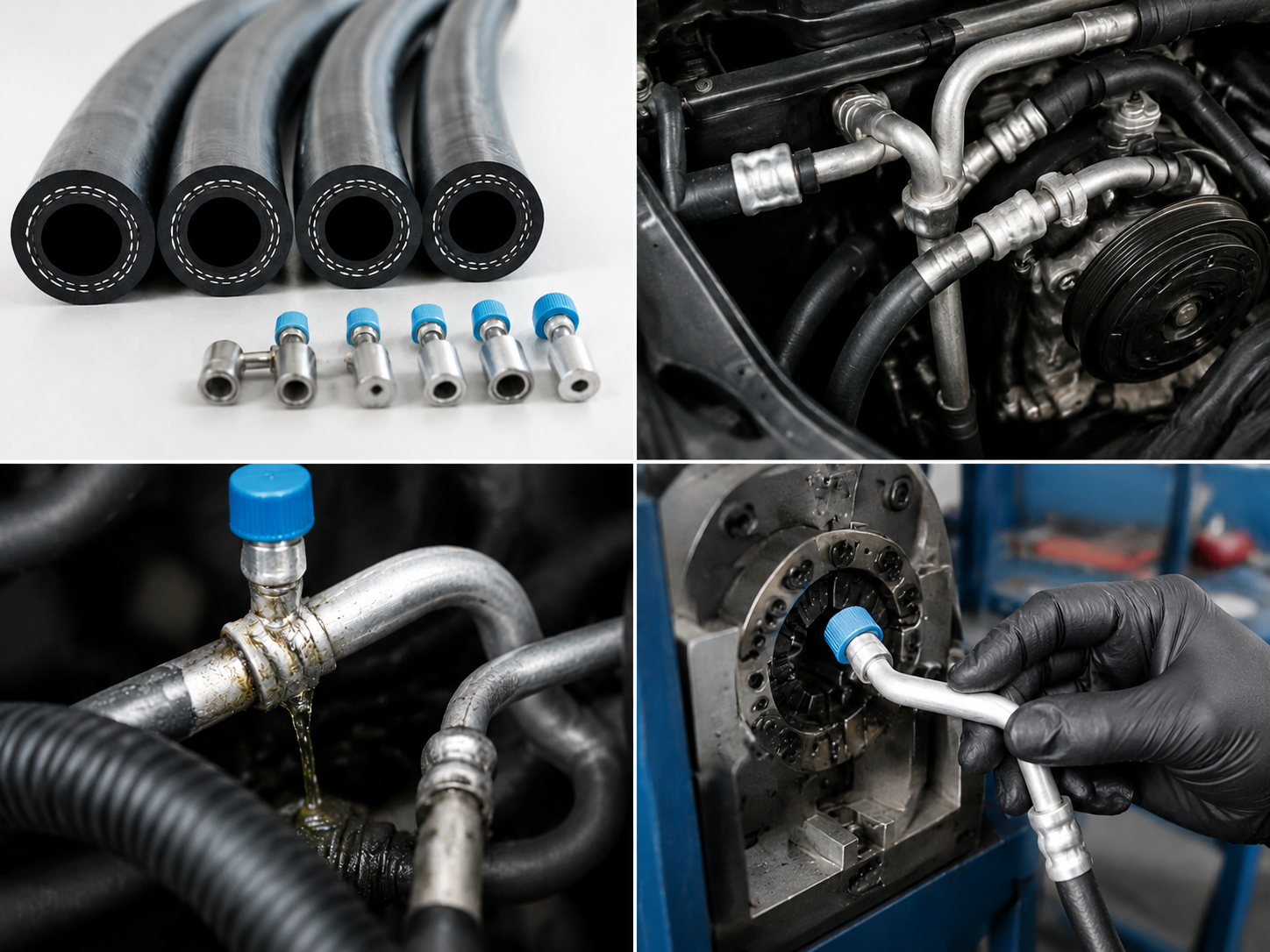
A small AC hose leak can turn a perfectly working air conditioning system into an expensive repair. Many vehicle owners do not notice the problem until the cabin stops getting cold.
An automotive AC hose can leak because of aging rubber, vibration, poor crimping, damaged fittings, corrosion, excessive pressure, or improper installation. Finding the real cause early can prevent bigger repairs and help maintain cooling performance.
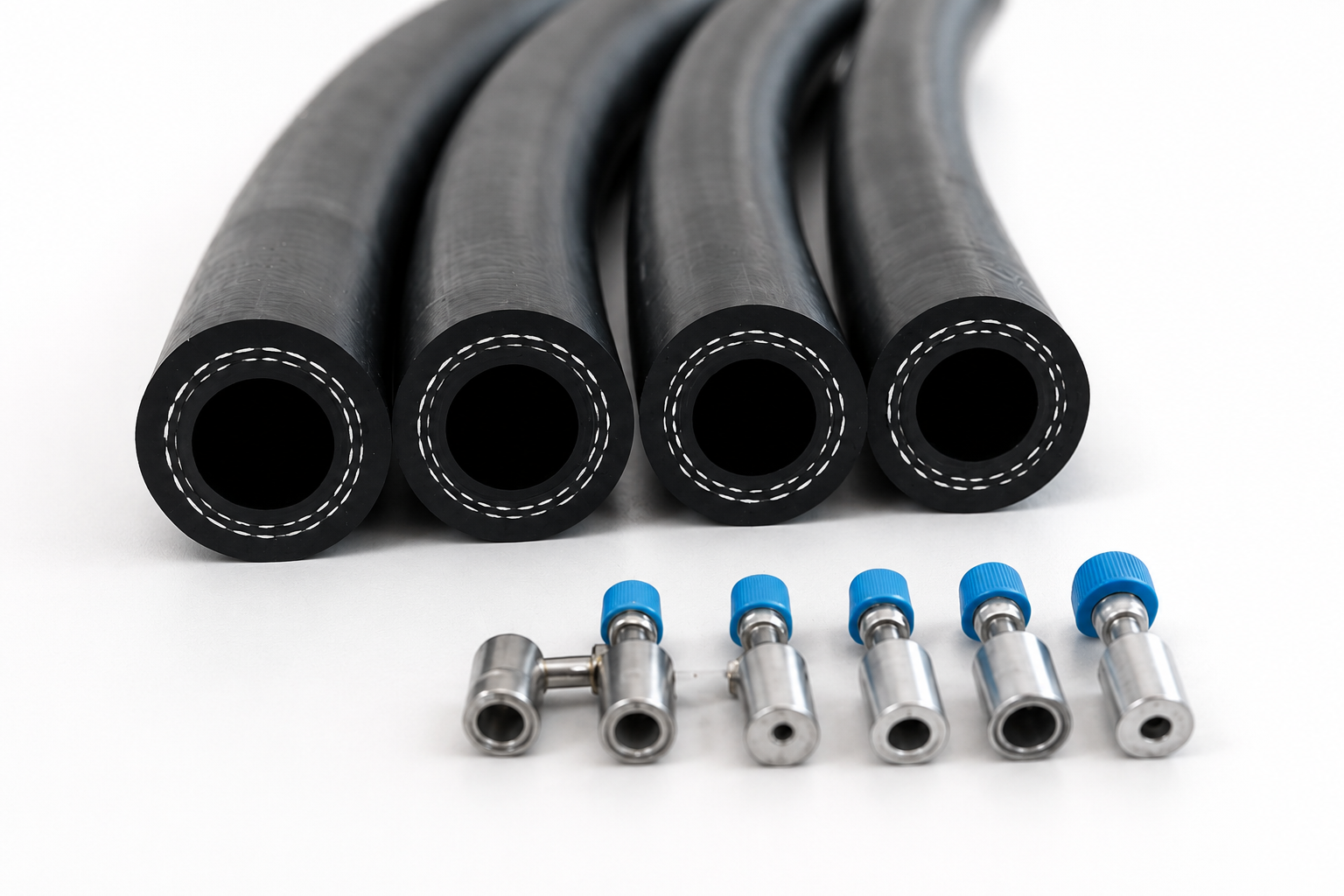
I have spent many years working with automotive AC hoses, fittings, and hose crimping equipment. During that time, I noticed that many people focus on adding refrigerant when the system stops cooling. The real problem is often a leaking hose. Understanding why a hose leaks is the first step toward solving the issue correctly.
What Causes an AC Hose Leak?
Many AC hose leaks do not happen suddenly. Most leaks develop over time due to wear, pressure, and environmental conditions.
An automotive AC hose usually leaks because the hose material degrades, the fitting connection becomes loose, or the crimping process was not performed correctly.
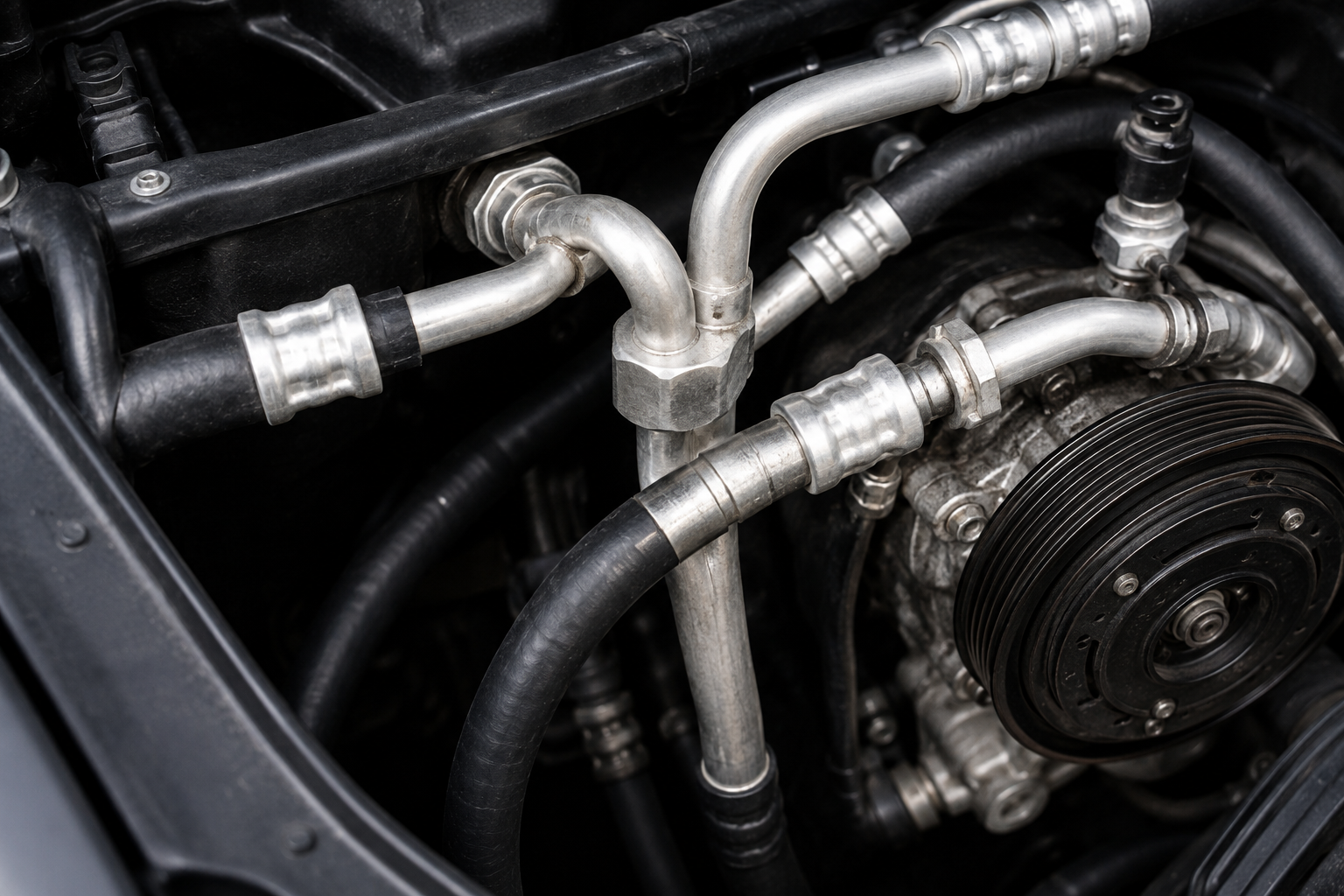
When I inspect failed hoses, I often find several common causes.
Common Causes of AC Hose Leaks
| Cause | Description |
|---|---|
| Aging Rubber | Rubber becomes hard and brittle over time1 |
| Vibration | Engine vibration stresses hose connections2 |
| Poor Crimping | Incorrect crimp diameter creates leaks3 |
| Damaged Ferrule | Deformed ferrules cannot seal properly |
| Corrosion | Moisture damages metal fittings4 |
| High Pressure | Excessive system pressure weakens hoses5 |
| Poor Installation | Twisted hoses experience abnormal stress |
Many people assume the hose itself failed. In reality, the leak often occurs at the fitting connection. I have seen cases where replacing the entire hose was unnecessary because only the fitting connection required repair.
The operating environment also matters. Vehicles working in mining areas, construction sites, and high-temperature regions often experience faster hose deterioration6. Dust, vibration, and heat continuously stress the AC system.
Understanding the actual cause helps avoid replacing good parts and reduces repair costs.
AC Hose Leak Symptoms?
A small leak can exist for weeks or even months before the driver notices a problem. Early detection helps prevent complete refrigerant loss.
Common AC hose leak symptoms include reduced cooling performance, oily residue around fittings, low refrigerant levels, longer compressor cycles, and unusual system pressures.
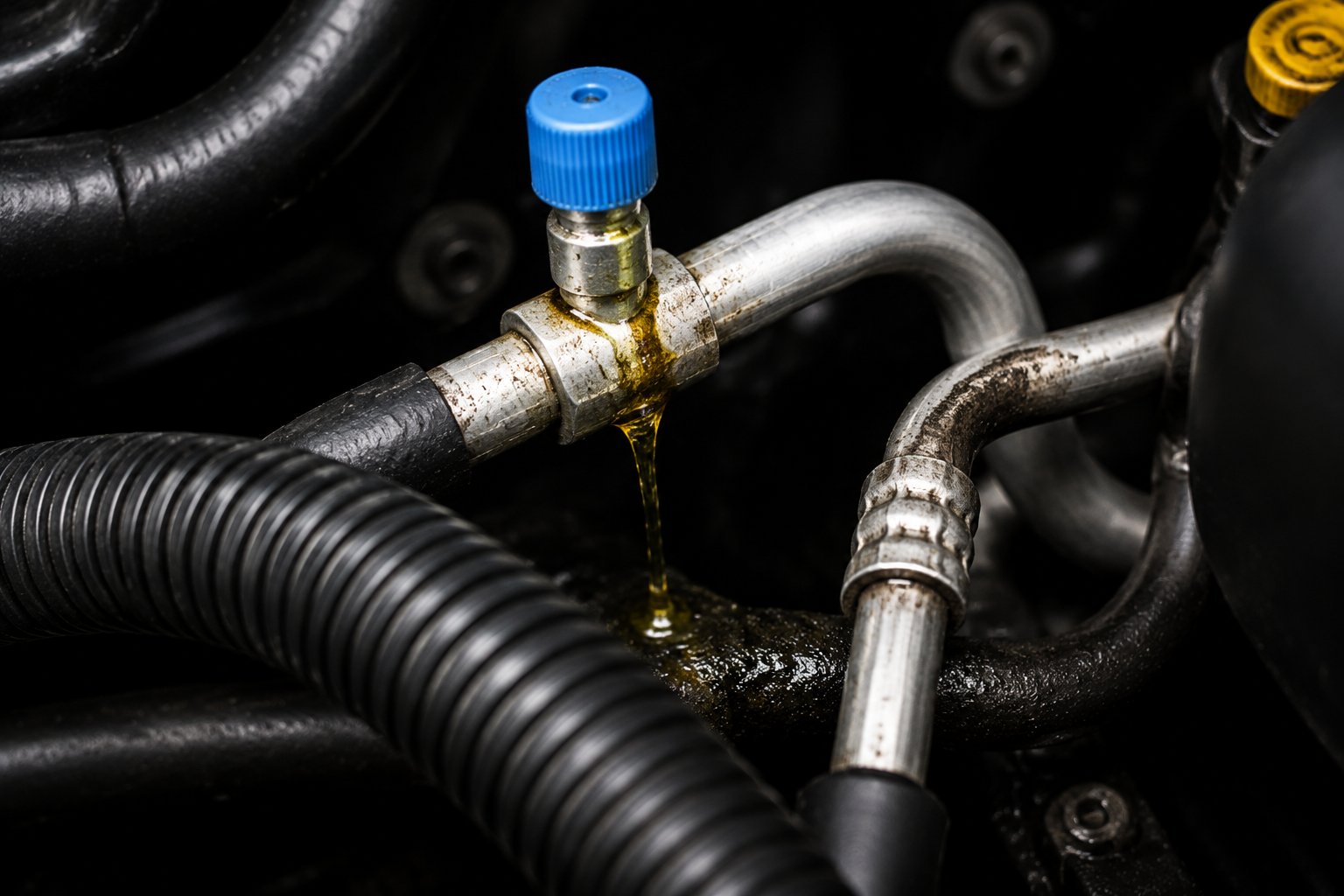
The first sign is usually weaker cooling.
Typical Warning Signs
| Symptom | Possible Cause |
|---|---|
| Warm Air | Refrigerant loss |
| Weak Cooling | Reduced system pressure |
| Oily Residue | Refrigerant oil escaping |
| Frequent Recharging | Undetected leak |
| Compressor Cycling | Low refrigerant level |
| Pressure Imbalance | System leakage |
Many refrigerants carry compressor oil through the system7. When a leak develops, oil often escapes together with the refrigerant. This leaves a greasy residue around fittings and hose connections.
I often advise technicians to inspect fittings carefully before replacing expensive components. A simple visual inspection can sometimes reveal the leak immediately.
Early diagnosis saves time and prevents unnecessary replacement of compressors, condensers, and expansion valves.
Does a Leaking AC Hose Affect Cooling?
Many drivers continue using their AC system even after noticing reduced cooling. This can lead to additional damage.
Yes, a leaking AC hose directly affects cooling performance because refrigerant escapes from the system. Lower refrigerant levels reduce heat transfer efficiency8 and increase compressor workload.
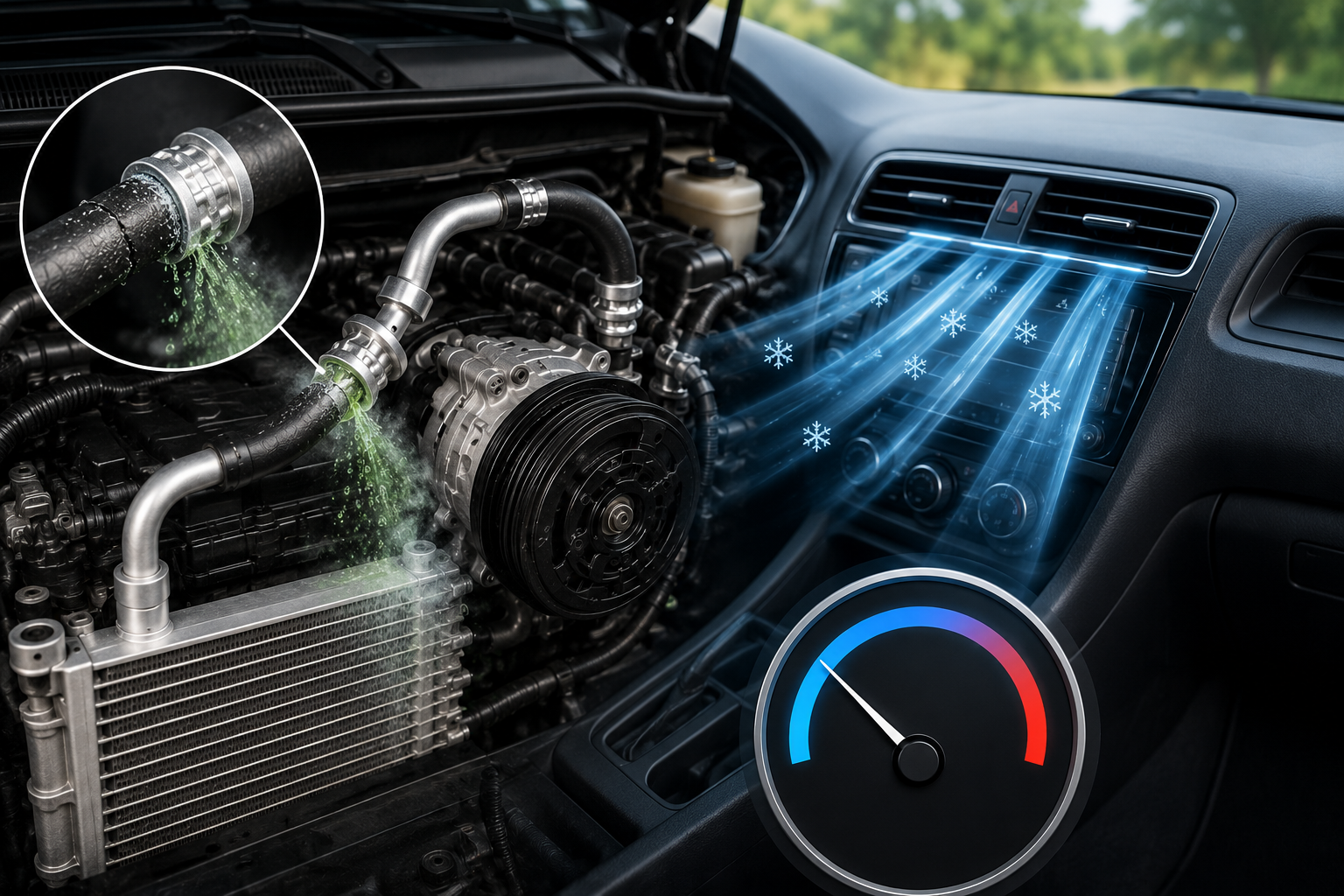
The cooling process depends on maintaining proper refrigerant pressure.
How Leaks Affect Performance
| Refrigerant Level | Cooling Performance |
|---|---|
| Full Charge | Excellent |
| Slightly Low | Reduced |
| Moderately Low | Poor |
| Severely Low | Very Weak |
| Empty System | No Cooling |
As refrigerant decreases, the evaporator cannot absorb enough heat from the cabin9. The result is warmer air from the vents.
Many modern vehicles have pressure protection systems10. If refrigerant pressure drops too low, the compressor may stop operating completely. This protects the compressor but leaves the vehicle without cooling.
I have seen customers repeatedly add refrigerant every few weeks. This temporarily restores cooling but never solves the actual leak. Eventually the repair cost becomes much higher than fixing the hose in the beginning.
Why Is My Car AC Losing Refrigerant?
Many vehicle owners ask why refrigerant keeps disappearing even after a recent recharge.
A properly functioning AC system should not consume refrigerant11. If refrigerant levels continue to drop, a leak is almost always present somewhere in the system.
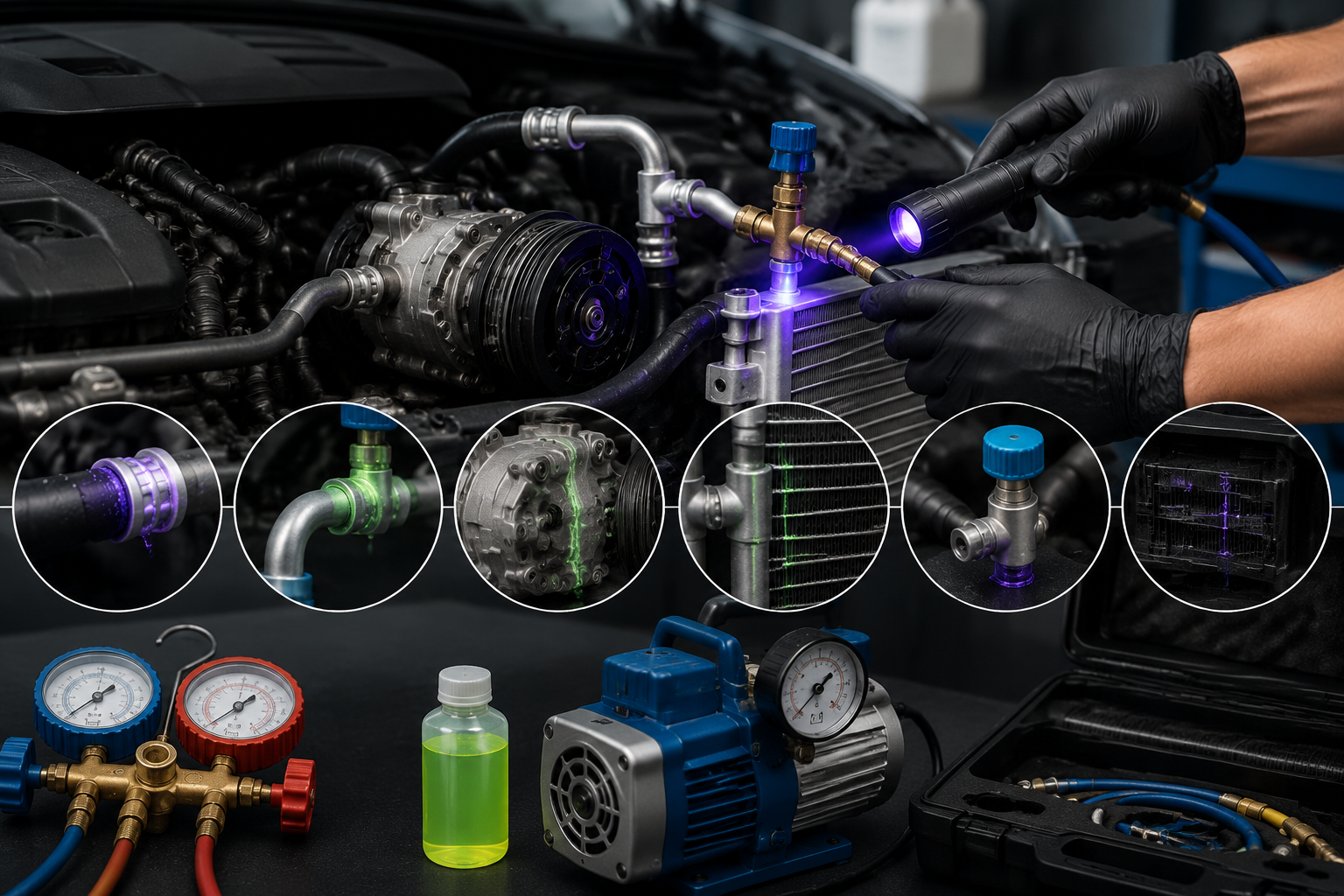
The leak may not always be visible.
Common Refrigerant Leak Locations
| Component | Leak Probability |
|---|---|
| AC Hose | High |
| Hose Fittings | High |
| Compressor Seals | Medium |
| Condenser | Medium |
| Service Ports | Medium |
| Evaporator | Low to Medium |
In my experience, hoses and fittings are among the most common leak points. They experience constant vibration and pressure fluctuations.
Some leaks are extremely small. The system may lose refrigerant slowly over several months. In these situations, technicians often use UV dye or nitrogen testing to locate the leak12 accurately.
Replacing refrigerant without identifying the leak is rarely a long-term solution. Proper diagnosis is always the better investment.
Conclusion
Most automotive AC hose leaks result from aging, vibration, poor crimping, damaged fittings, or excessive pressure. Finding the real cause early helps restore cooling performance and prevents more expensive repairs later.
<!--[googlesitekit-end-of-content]-->
"Analysis of Mechanical Properties and Mechanism of Natural ... - PMC", https://pmc.ncbi.nlm.nih.gov/articles/PMC8271995/. Rubber elastomers undergo oxidative degradation and cross-linking reactions when exposed to heat, oxygen, and ozone, leading to hardening and loss of flexibility over time. Evidence role: mechanism; source type: research. Supports: the chemical and physical processes by which rubber materials degrade over time. Scope note: This describes general rubber degradation mechanisms rather than AC hose-specific failure rates ↩
"Automotive Hose Testing - Smithers", https://www.smithers.com/industries/transportation/automotive/automotive-hose-testing. Cyclic vibration in automotive applications generates alternating stress concentrations at connection points, which can lead to fatigue failure in both elastomeric and metal components. Evidence role: mechanism; source type: research. Supports: how cyclic mechanical vibration induces fatigue stress in hose-to-fitting connections. ↩
"[PDF] Introduction to Hydraulic Hose and Fittings", https://dlnr.hawaii.gov/mk/files/2017/01/Freitas-S-18-a.pdf. Industry standards specify crimp diameter tolerances within hundredths of an inch, as deviations can compromise the seal integrity between hose and fitting. Evidence role: general_support; source type: institution. Supports: the importance of precise crimping dimensions in preventing hose assembly leaks. Scope note: Standards exist but specific tolerance values vary by hose type and manufacturer ↩
"Research reveals how humidity affects atmospheric corrosion of ...", https://www.llnl.gov/article/49876/research-reveals-how-humidity-affects-atmospheric-corrosion-aluminum-metal. Galvanic corrosion occurs when dissimilar metals are in electrical contact in the presence of an electrolyte, with moisture facilitating the electrochemical reaction that degrades metal surfaces. Evidence role: mechanism; source type: encyclopedia. Supports: the electrochemical process by which moisture causes corrosion in metal fittings. ↩
"How to Choose Custom AC Hoses: Size, Fittings & Pressure", https://morelandhose.com/choosing-the-right-custom-ac-hoses-a-comprehensive-guide/. When internal pressure exceeds the rated capacity, hose walls experience tensile stress that can cause delamination of reinforcement layers and eventual rupture. Evidence role: mechanism; source type: education. Supports: how pressure exceeding design specifications stresses hose materials. Scope note: This describes general pressure failure mechanisms rather than specific AC system pressure thresholds ↩
"[PDF] Failure Rate Estimates for Passive Mechanical Components", https://inldigitallibrary.inl.gov/sites/sti/sti/Sort_7467.pdf. Elevated temperatures, UV exposure, and particulate contamination accelerate oxidative degradation and mechanical wear in elastomeric materials, reducing service life in harsh operating environments. Evidence role: general_support; source type: research. Supports: how environmental stressors accelerate elastomer degradation. Scope note: This describes general environmental effects rather than specific data on AC hose failure rates in different industries ↩
"Oil Circulation Rate Measurements with Flow-through and ...", https://docs.lib.purdue.edu/cgi/viewcontent.cgi?article=3330&context=iracc. Refrigerant and compressor oil form a miscible mixture that circulates throughout the system, with the refrigerant flow carrying oil to lubricate moving components. Evidence role: mechanism; source type: education. Supports: how refrigerant acts as a carrier medium for lubricating oil in AC systems. ↩
"[PDF] Effect Of The Refrigerant Charge On The System Performance And ...", https://docs.lib.purdue.edu/cgi/viewcontent.cgi?article=3251&context=iracc. Heat transfer capacity in vapor-compression systems depends on adequate refrigerant mass flow rate; insufficient charge reduces the amount of heat absorbed during evaporation and rejected during condensation. Evidence role: mechanism; source type: education. Supports: the thermodynamic principle linking refrigerant quantity to heat transfer performance. ↩
"[PDF] A Study of Evaporation Heat Transfer Coefficient Correlations at Low ...", https://www.ideals.illinois.edu/items/9780/bitstreams/36163/data.pdf. The evaporator's cooling capacity depends on sufficient liquid refrigerant entering the coil to undergo phase change; inadequate charge results in incomplete coil utilization and reduced heat absorption from the air stream. Evidence role: mechanism; source type: education. Supports: how refrigerant quantity affects evaporator heat absorption. ↩
"Automotive AC Low-Pressure Switch: Function, Common Failures ...", https://www.youtube.com/watch?v=pByYRUKOGDo&vl=en-US. Automotive AC systems commonly incorporate low-pressure cutoff switches that disengage the compressor clutch when refrigerant pressure falls below a threshold, preventing compressor damage from inadequate lubrication. Evidence role: general_support; source type: education. Supports: the use of pressure switches to protect AC compressors in modern vehicles. ↩
"Vapor-compression refrigeration - Wikipedia", https://en.wikipedia.org/wiki/Vapor-compression_refrigeration. Vapor-compression refrigeration systems operate as sealed circuits where refrigerant continuously cycles between liquid and vapor phases; refrigerant loss indicates a breach in system integrity. Evidence role: general_support; source type: education. Supports: the closed-loop nature of refrigeration systems. ↩
"How to Find AC Leaks in Your Car (UV Dye) - YouTube", https://www.youtube.com/watch?v=pCv7rCdcXsc. Fluorescent UV dye added to refrigerant and nitrogen pressure testing are standard diagnostic procedures for locating leaks in automotive AC systems, as recommended by industry service guidelines. Evidence role: general_support; source type: institution. Supports: established diagnostic methods for identifying refrigerant leaks. ↩